
DiskPart is a command-line utility built into Windows that allows you to manage your computer’s disks and partitions. It has some common DiskPart commands, such as:
- DiskPart create partition
- DiskPart delete partition
- DiskPart format partition
- DiskPart convert gpt/mbr disk
- DiskPart extend partition/volume
This guide will delve into the DiskPart extend volume command, outline the step-by-step process, and introduce its alternative: MiniTool Partition Wizard.
What Is DiskPart Extend Volume/Partition?
The DiskPart extend volume command is used to increase the size of an existing partition or volume by incorporating unallocated (free) space while preserving all existing data.
For the extend command to work, your disk must meet these specific criteria:
- Same disk: There is free space available on the same physical disk, unless you are using dynamic disks or RAID configurations.
- Contiguous unallocated space: For basic disks, the unallocated space must be immediately to the right of the volume you want to extend. There should be no other partitions (like a recovery or EFI partition) in between.
- File system: The volume must be formatted with NTFS or ReFS. DiskPart cannot extend FAT32 or exFAT partitions.
Well, how do you check these requirements? Simply right-click Start and choose Disk Management to open it. Then check if the volume you want to extend is NTFS and if there is contiguous unallocated space to its right.
Additionally, before starting the extension process, you need to confirm the following necessary information in Disk Management:
- Disk number
- Partition number
- Current size of the target partition
- Amount of available unallocated space
How to Extend Partition Using DiskPart?
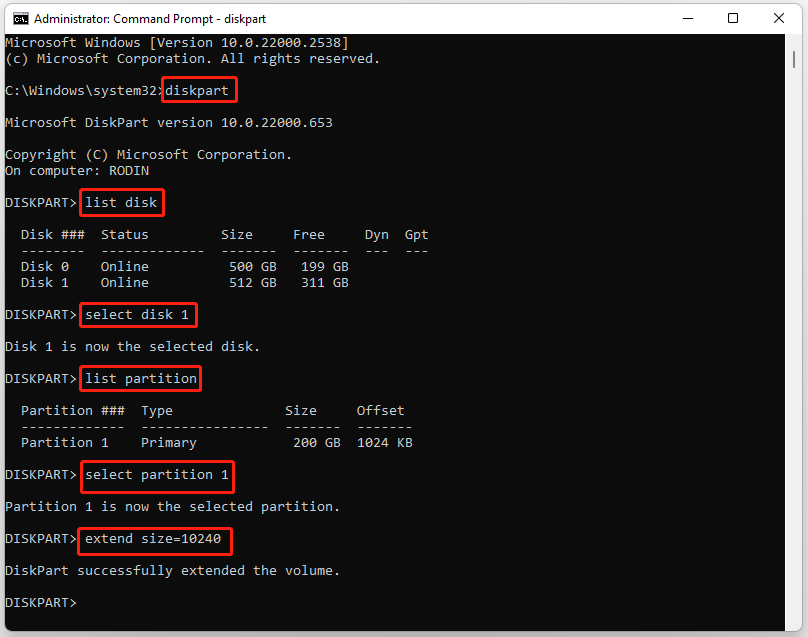
To use DiskPart to extend volume, here are the detailed steps:
- Type cmd in the Search bar, right-click Command Prompt, and select Run as administrator.
- Type diskpart and press Enter to launch the DiskPart utility.
- Type list disk and press Enter. This command will show all disks.
- Type select disk * (replace * with your target disk number) and press Enter.
- Type list partition and press Enter. This will display all partitions on the target disk.
- Type select partition * (replace * with your target partition number) and press Enter.
- Type extend size=n (replace n with the size in MB you want to extend) and press Enter.
- Wait until you receive the information saying “Disk Part successfully extended the volume”.
Common Error Messages When Using DiskPart to Extend Volume
When using the DiskPart extend partition command, common error messages and their solutions are provided in the following section.
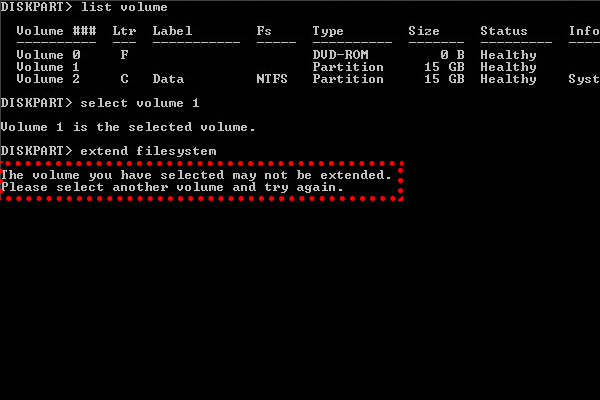
Error 1. You may not extend OEM, ESP, or recovery partitions, or, offline volumes. The volume you have selected may not be extended. Please select another volume and try again.
As the error message said, this error occurs when you extend an OEM, ESP, or recovery partition, or offline volumes. You can not directly extend these partitions.
Error 2. There is not enough usable free space on specified disk(s) to extend the volume.
Causes:
- No adjacent unallocated space.
- A hidden partition, like an MBR reserved partition, blocks the partition extension. When you use the list partition command, all partitions in the disk will be displayed, including the Reserved partition. Then check if its number # is after the partition you want to extend.
If the blocking partition (including the hidden and protected partition) is not necessary and has no important data, you can use the delete partition command in DiskPart to delete it. Then, perform partition expansion again.
If the blocking partition includes important data, you can use a third-party tool like MiniTool Partition Wizard to move partitions safely without losing data.
Error 3. Virtual Disk Service error: There is not enough usable space for this operation.
When you perform a partial extension, the size of the extended space you entered is larger than the size of the unallocated space. You should check the total size of the unallocated space.
Error 4. Virtual Disk Service error: The volume cannot be extended because the file system does not support it.
This error message appears when you extend a non-NTFS/ReFS file system partition. If the partition to be extended is an FAT32 file system, you can use the convert <driveletter>: /fs:ntfs command in Command Prompt to convert the partition from FAT32 to NTFS.
If the partition is another file system like ext4 or exFAT, you need to format it to NTFS to perform the extension. But this will delete data.
Error 5. Diskpart failed to extend the volume. Please make sure the volume is valid for extending.
This error message often happens in Windows Server, where only the extension of data volumes is supported. If you attempt to extend a system or boot volume, you will receive this error.
Simultaneously, you can’t extend the partition if the system page file is located on the partition. You can temporarily move the page file to a different drive.
If Windows DiskPart limitations are a persistent issue, consider using a free third-party partition manager like MiniTool Partition Wizard, which often offers more flexibility, such as moving non-contiguous unallocated space without data loss.
DiskPart Extend Volume Alternative – MiniTool Partition Wizard
Compared to DiskPart, MiniTool Partition Wizard is a more powerful partition manager. It bypasses many of DiskPart’s restrictions, allowing you to resize and move partitions more flexibly. It offers several critical advantages over DiskPart:
- Extend with non-adjacent space: You can extend a partition by directly taking free space from any other existing partition or unallocated block on the same disk, even if it isn’t next to the target partition.
- Move partitions: Unlike DiskPart, this tool allows you to “move” a blocking partition (like a Recovery Partition) to shift unallocated space next to your C: drive.
- FAT32 support: It can extend and resize FAT32 partitions, whereas DiskPart is limited to NTFS and ReFS.
- Safe preview: It uses a “Pending Operations” queue. You can see a preview of your changes and click “Apply” only when you are certain, reducing the risk of accidental data loss.
In addition to its advantages in partition expansion, MiniTool Partition Wizard can format/delete/clone a partition, recover data from hard drives, and wipe disks. It also performs excellently in conversion between MBR and GPT without data loss, and in converting NTFS to FAT32 or vice versa without data loss.
Therefore, for easy partition management and expansion, MiniTool Partition Wizard may be a better choice. Its Extend Partition and Move/Resize Partition features can help you do a partition expansion.
MiniTool Partition Wizard FreeClick to Download100%Clean & Safe
Now, download and install this free partition manager to try the following features.
Extend Partition
To use the Extend Partition feature to enlarge a partition, here are the steps:
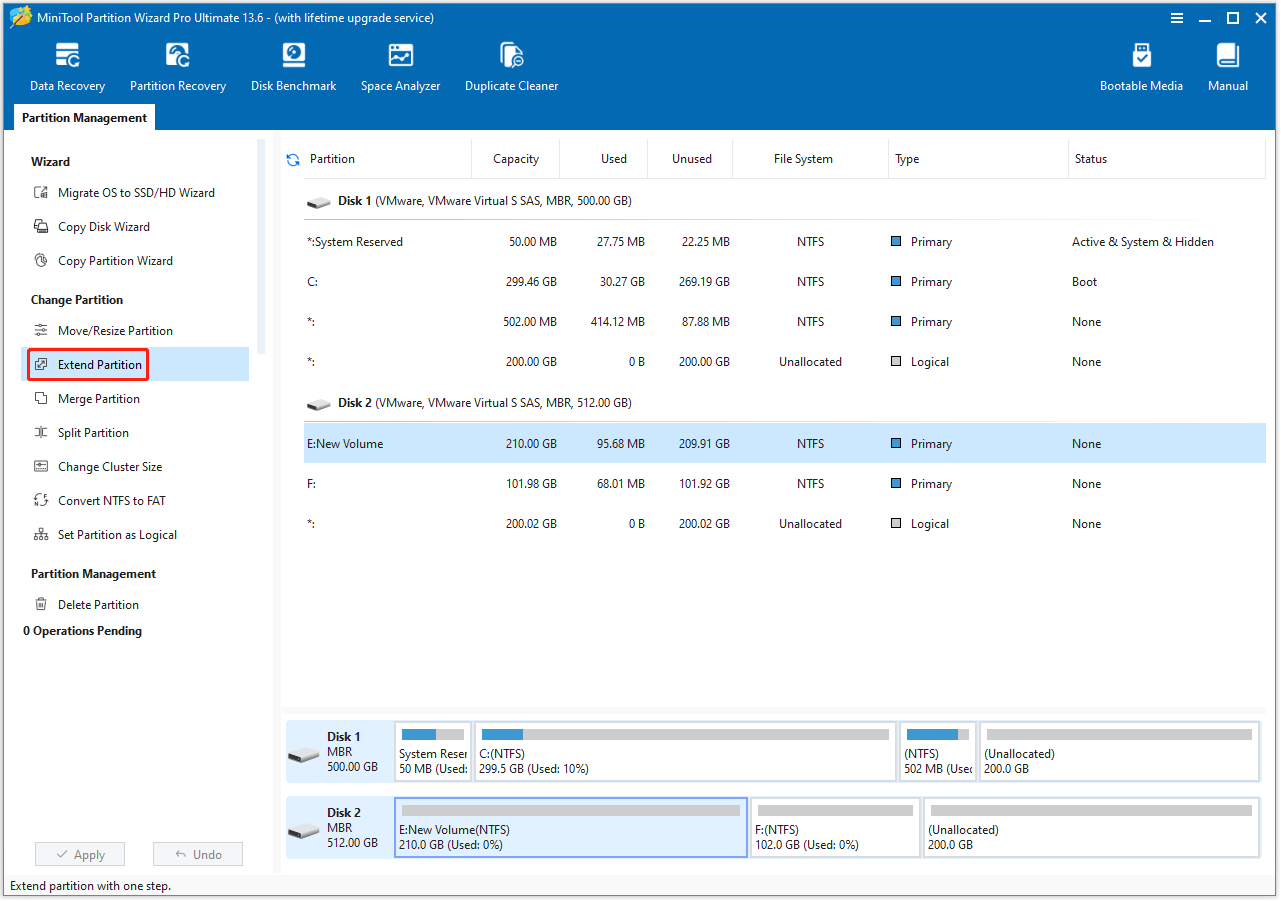
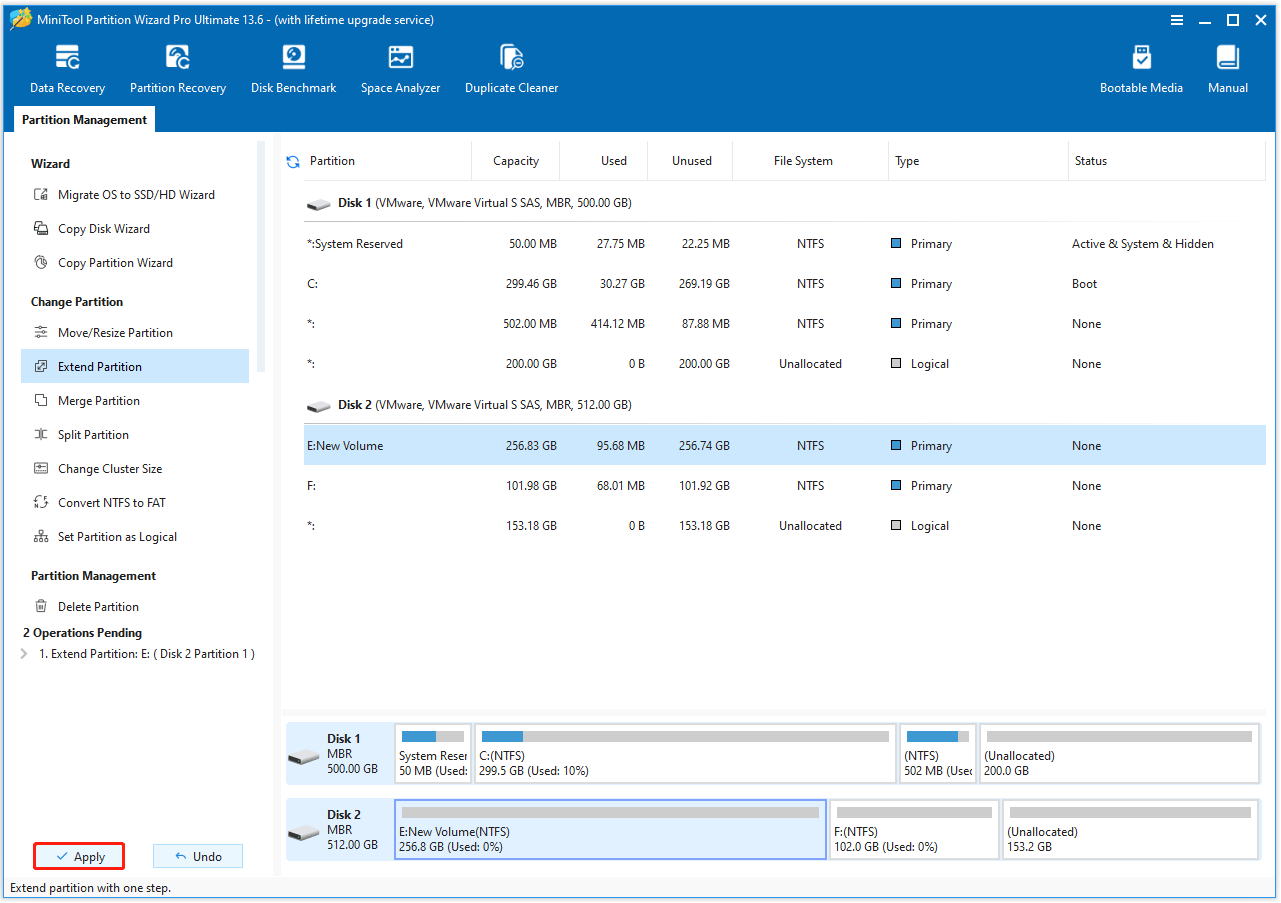
Step 1. Launch MiniTool Partition Wizard to enter its main interface. Then highlight the partition you want to extend and choose the Extend Partition feature from the left action panel.
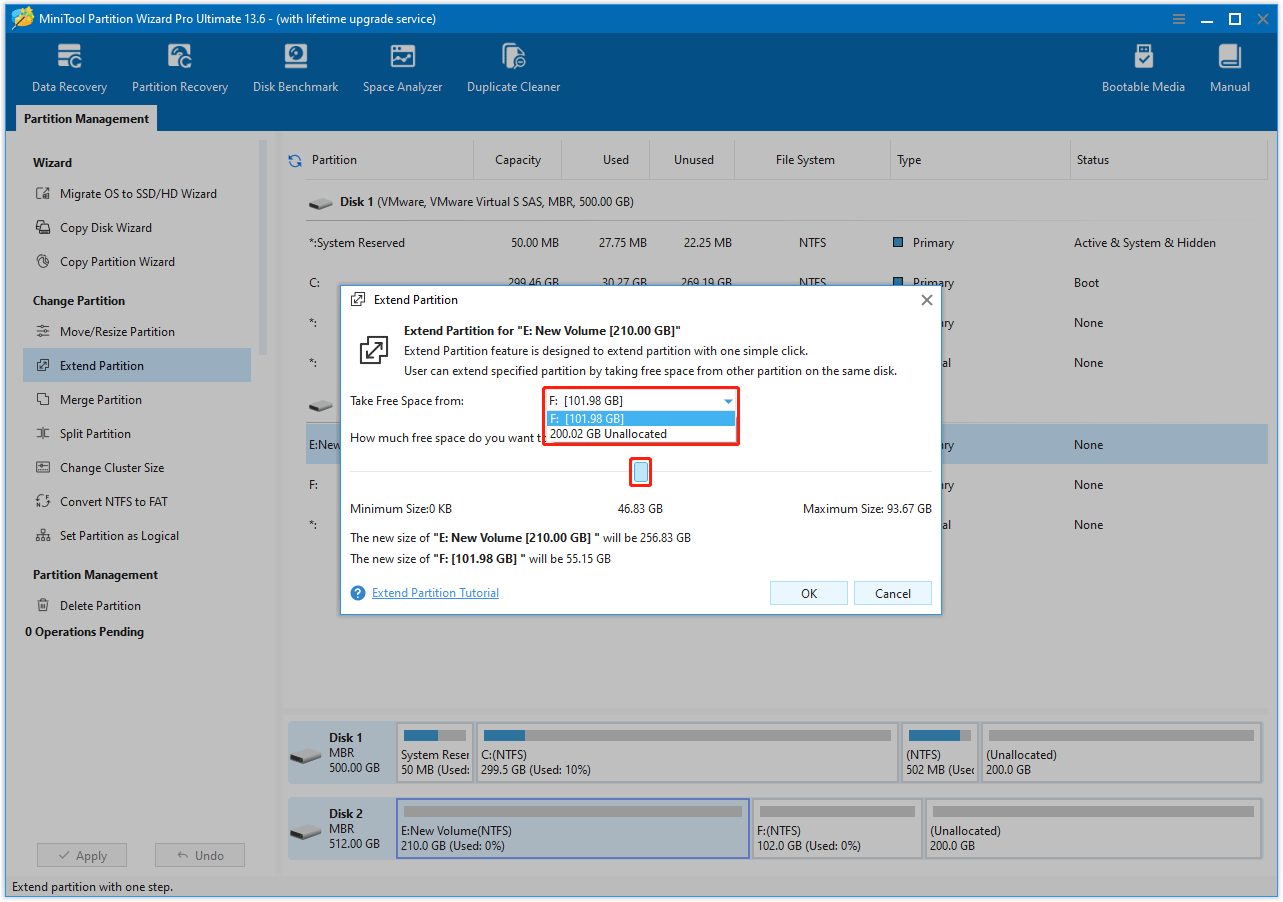
Step 2. Open the drop-down list of Take Free Space from and choose a partition or unallocated space to take free space. Drag the sliding handle leftwards or rightwards to decide how much space to take, with the partition size changing intuitively. Then click OK to continue.
Step 3. Preview this change and then click Apply.
Move/Resize Partition
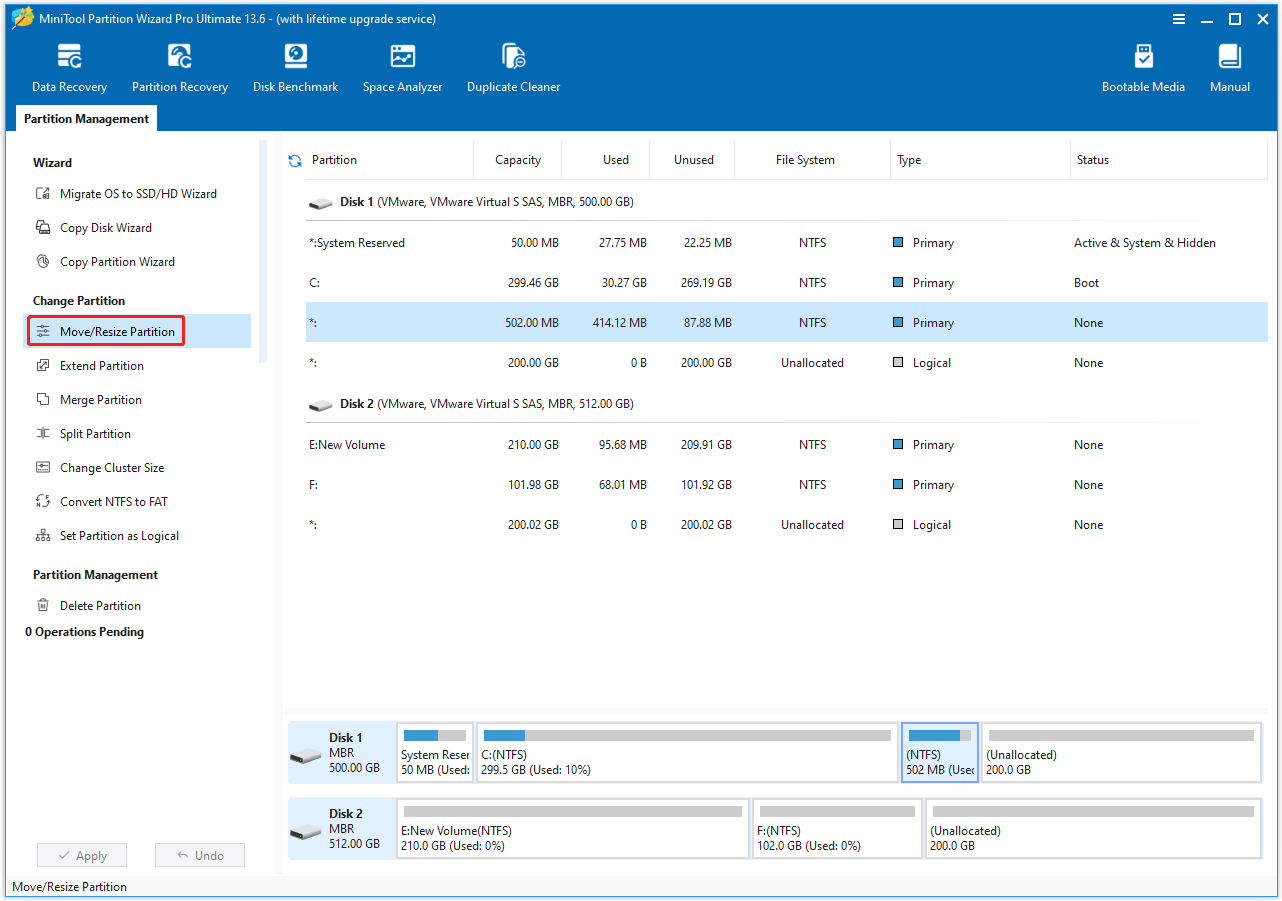
To use the Move/Resize Partition feature to extend, shrink, and move a partition, the steps are as follows:
Step 1. On its main interface, select the partition (for example, the recovery partition) to operate and click the Move/Resize Partition feature from the left action panel.
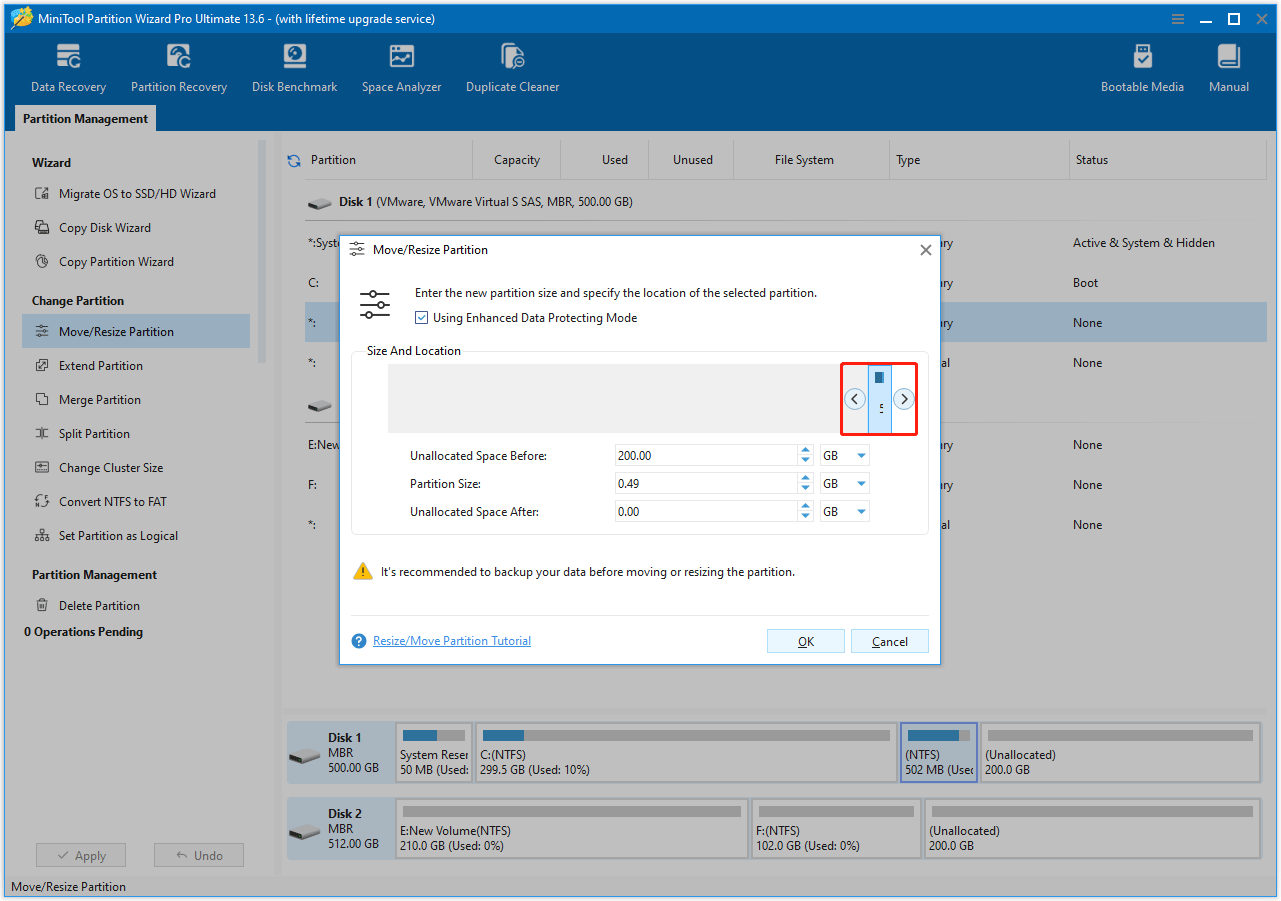
Step 2. In the pop-up window, the blue handle represents the partition, while the blank area means unallocated space. Do the following and click OK to go back to the main interface.
- To shrink a partition, shorten the handle by dragging the triangles.
- To extend a partition, there should be unallocated space next to (on the left or right side) the partition you want to expand. Then, lengthen the handle to occupy more unallocated space. Alternatively, you can manually type the specified partition size in MB, GB, or TB.
- To move a partition, drag the whole partition handle towards unallocated space or manually define unallocated space before or after the partition.
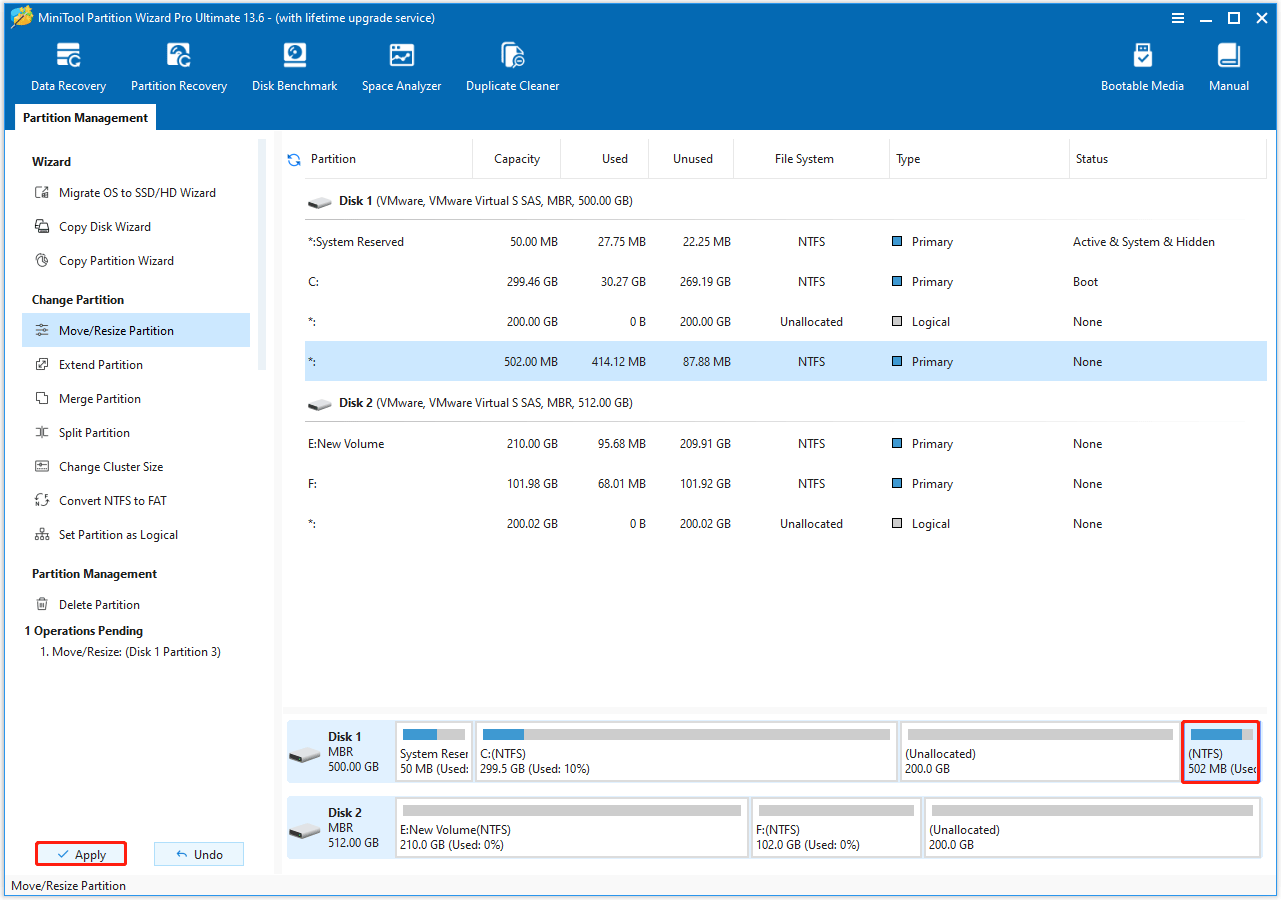
Step 3. From the main interface, you can preview that the selected partition has changed its position. Then click Apply.
DiskPart Extend Volume FAQ
Even if you see no partition blocking the way in Disk Management, if the extension still fails, a hidden MBR reserved partition is likely blocking it. You can delete it in DiskPart to resolve the issue.
It cannot extend partitions if other data volumes or recovery partitions are in the way, requiring them to be deleted first.
If a partition blocks this, delete it or clean the disk using DiskPart. Or, you can use third-party tools like MiniTool Partition Wizard to move it.
Using delete partition override forces DiskPart to delete these protected partitions.
Bottom Line
Expanding volumes on basic disks is an essential skill for Windows users, and both DiskPart and MiniTool Partition Wizard offer effective solutions.
If you want a user-friendly graphical interface, more flexible partitioning options, and additional features such as disk cloning and recovery, choose MiniTool Partition Wizard.
If you have any problems or suggestions when using MiniTool Partition Wizard, you can contact us by sending an email via [email protected]. We’ll get back to you as soon as possible.
User Comments :