
Upgrading from a traditional hard drive to a solid-state drive (SSD) is one of the best ways to improve your computer’s performance. This post shows you how to move Windows to SSD without reinstalling Windows and all your applications. Then, you can continue using your computer without losing your files or settings.
Can You Move Windows to SSD Without Reinstalling
You can move Windows to an SSD without reinstalling it by using disk-cloning or OS-migration software. The process transfers the existing Windows installation, system files, applications, and settings to the SSD, allowing you to boot from the new drive without performing a clean installation.
Compared to Windows clean installation, Windows migration allows you to enjoy the performance boost provided by an SSD while avoiding the need to reinstall the operating system and various applications—especially large games and professional software.
To clone Windows to SSD, you just need to connect the original hard drive and the new SSD to the computer. Then, the migration can be completed by system migration or disk cloning software—MiniTool Partition Wizard.
MiniTool Partition Wizard DemoClick to Download100%Clean & Safe
Here is a quick video guide:
How to Move Windows to SSD
How to move OS to SSD using MiniTool Partition Wizard? The Migrate OS to SSD/HD feature is recommended. It can either migrate Windows only or clone the entire system disk to the SSD. In addition, it allows you to resize partitions and convert MBR to GPT during the OS migration.
Here is the guide on how to migrate Windows to SSD.
Step 1: Prepare an SSD whose space is larger than the used space in the HDD. Then, connect the SSD to your PC. For desktops, you can install the SSD directly into an empty slot on your motherboard. For laptops, you can connect the SSD externally via a USB-to-SATA or USB-to-NVMe enclosure/adapter.
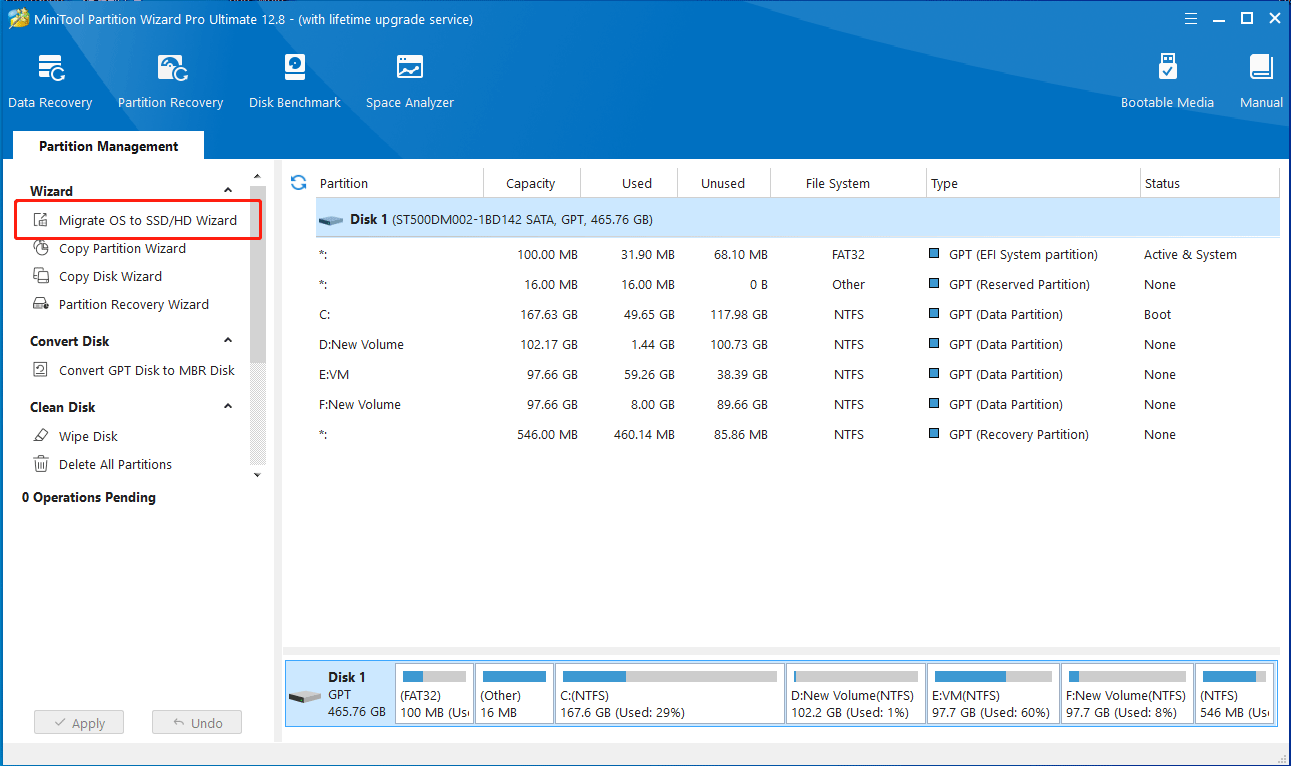
Step 2: Download, install, and launch MiniTool Partition Wizard. Click on Migrate OS to SSD/HD Wizard from left action panel.
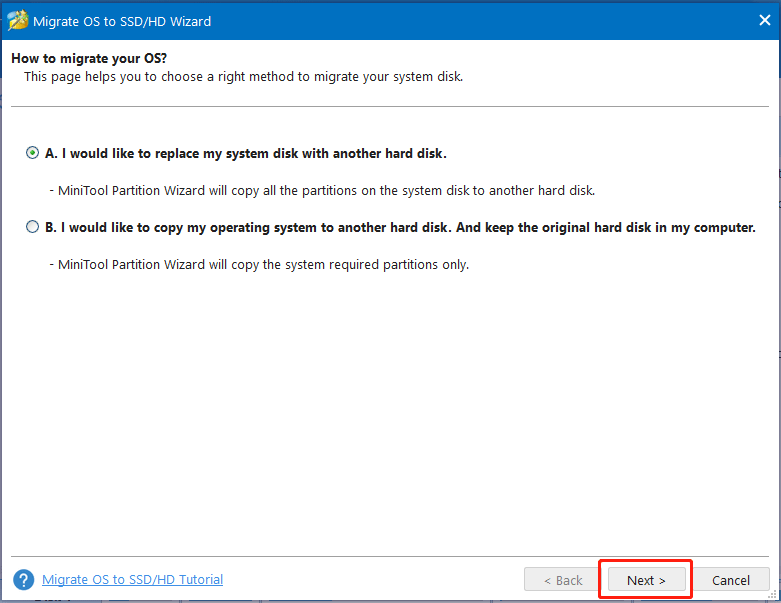
Step 3: Choose the method you want to migrate the OS and click Next. Option A will clone the entire disk while Option B just migrates the OS only. No matter which method you choose, the data on the original disk won’t be deleted.
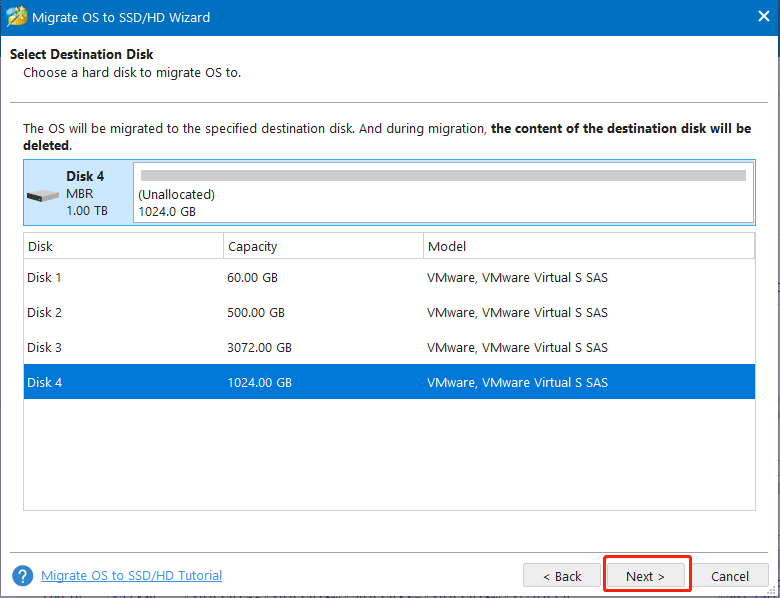
Step 4: Select the SSD as the target disk to migrate system disk to and then click Next.
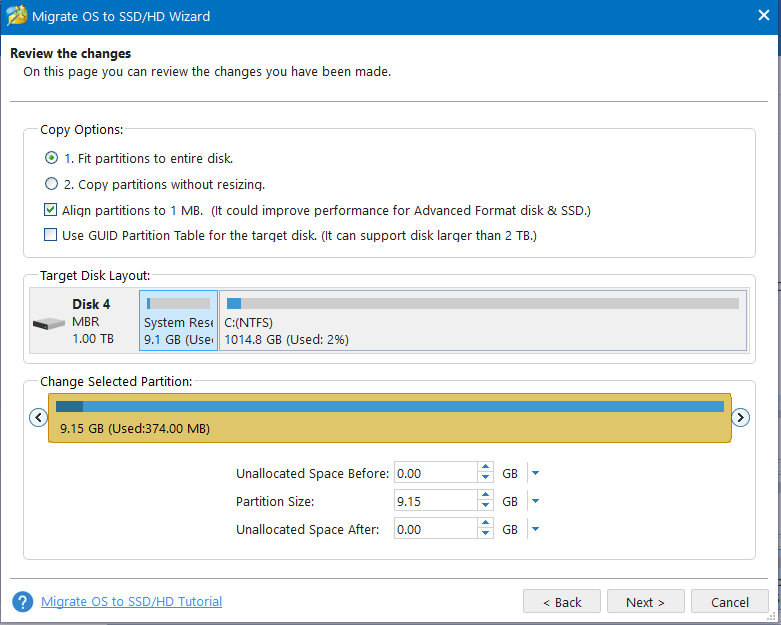
Step 5: Choose copy options. In addition, users can edit partition size or location by dragging the handle bar. Then, click Next.
- Fit partitions to entire disk: All the partitions will be cloned to the target disk and occupy their entire capacity in proportion to the partition size.
- Copy partitions without resizing: All partitions will be cloned to the destination disk at the original partition size. This option is available when the destination disk is large enough to hold all partitions on the source disk.
- Align partitions to 1 MB: SSDs require partition alignment to 4KB boundaries for optimum performance and life.
- Use GUID Partition Table for the target disk: This option only appears when the original disk is an MBR disk. If this option is selected, the destination disk will be converted to a GPT disk after the OS migration.
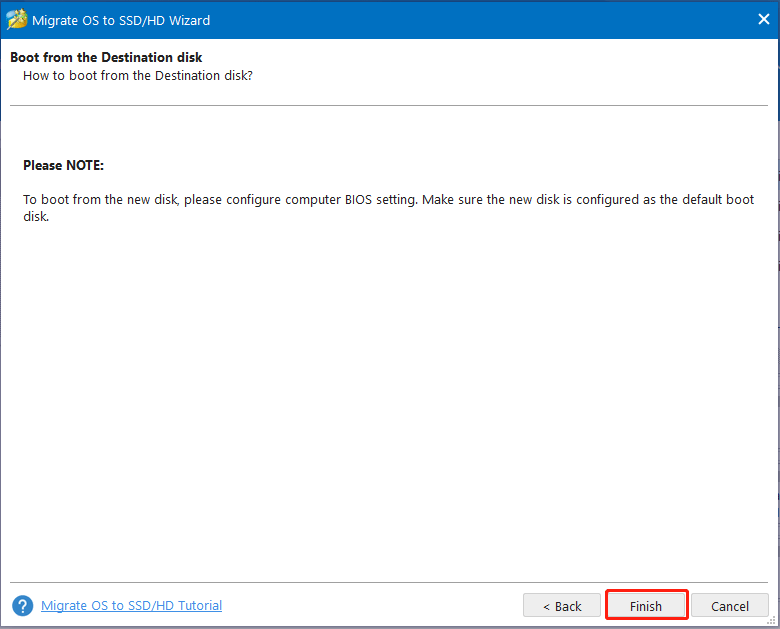
Step 6: After the migration is complete, a note will appear showing how to boot from the target disk and you need to follow the instructions. Read these instructions and click Finish to return to the main window.
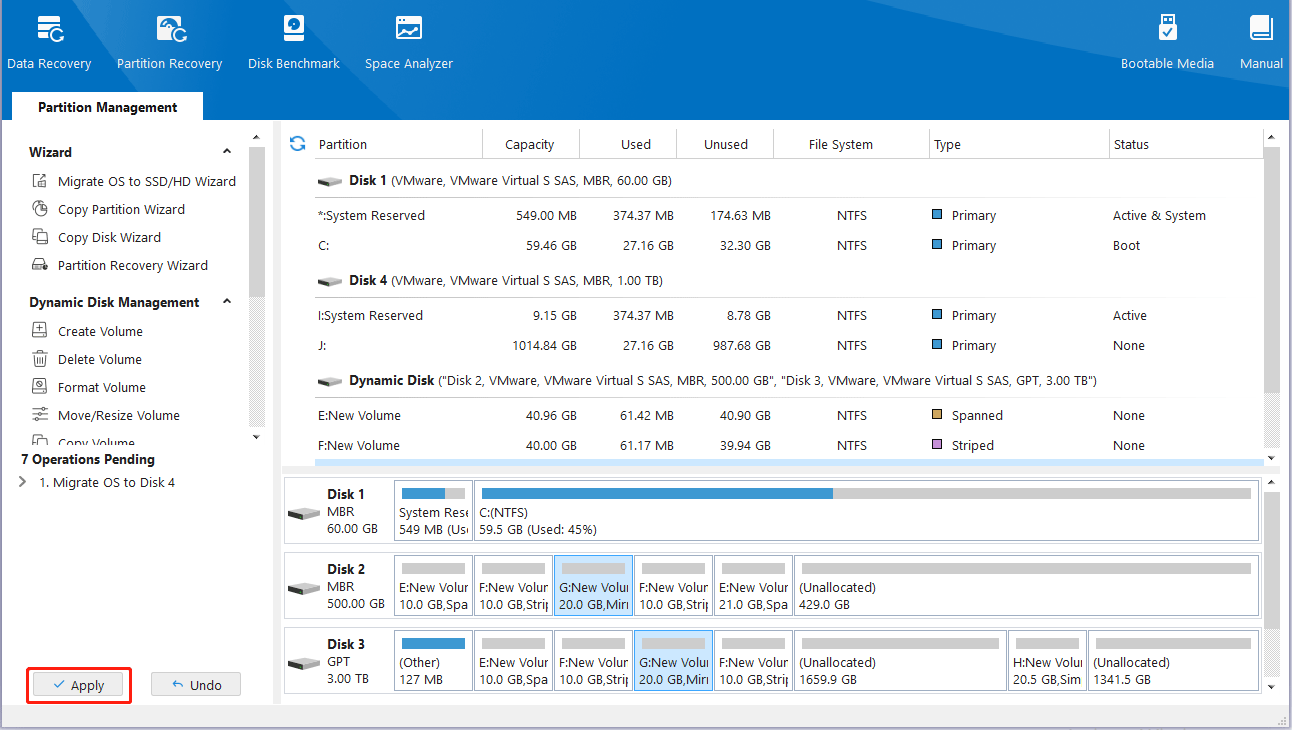
Step 7: Click Apply button to apply all these pending changes. After the operation is completed, you can see that Windows has been migrated to the SSD.
After migration:
- Restart the computer.
- Enter BIOS or UEFI firmware.
- Set the SSD as the first boot device.
- Save the changes and restart.
Windows should now boot from the SSD.
Common Problems After Migrating Windows to SSD
If you encounter some common problems after migration OS, refer to the following tips:
#1. Windows Won’t Boot
Possible causes include:
- Incorrect boot order
- Missing EFI or System Reserved partition
- Incomplete migration
Verify that all required boot partitions were copied and that the SSD is selected as the primary boot device.
#2. SSD Is Too Small
The destination SSD must have enough available capacity for the data being migrated.
If necessary:
- Delete unnecessary files.
- Uninstall unused applications.
- Shrink the system partition before migration.
#3. BIOS Doesn’t Detect the SSD
Check:
- SATA or M.2 connection
- BIOS storage settings
- SSD compatibility
How to Migrate Windows to SSD FAQ
Bottom Line
In short, cloning Windows 10/11 to SSD is a very useful way to significantly improve your computer’s performance and general user experience. You can enjoy accelerated boot time, faster program launches, and greater system responsiveness by switching your operating system, applications, and data from an HDD to an SSD!
If you have any advice or problems regarding using MiniTool Partition Wizard, please don’t hesitate to contact us via [email protected]. Thanks in advance.
About The Author

Position: Columnist
Linda has been an editor at MiniTool for seven years. She continuously learns about computers and puts her knowledge into practice. Moreover, she is particularly knowledgeable in disk management, data recovery, system installation, and PDF editing. Her articles typically reference multiple examples or are based on her own experience, providing users with the most suitable solutions.
User Comments :