
If you are seeking a free USB formatter to format a USB drive to FAT32, exFAT, or NTFS, you have come to the right place. Here, 6 free USB format tools are introduced, including 3 Windows built-in format tools and third-party software like MiniTool Partition Wizard, Rufus, and SD Card Formatter.
What Is USB Formatting?
USB formatting prepares a USB drive or its partition for storing data by creating a new file system. It usually removes existing data, and you can choose a file system such as FAT32, exFAT, or NTFS depending on your needs.
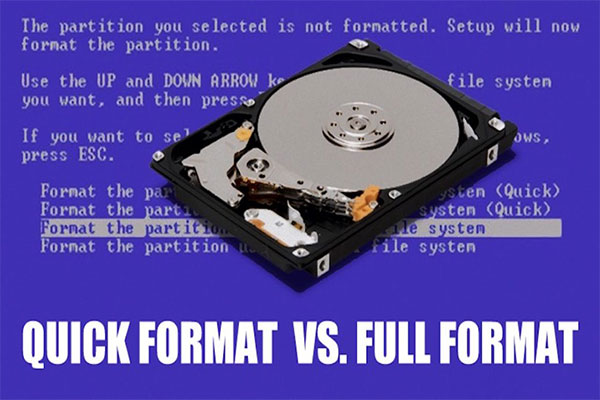
Windows generally offers two formatting options: Quick Format and Full Format. Quick Format removes the file system information and marks the space as available for reuse, while Full Format takes longer and checks the drive for bad sectors.
For most healthy USB drives, Quick Format is sufficient. If you suspect the drive has errors or bad sectors, a Full Format may be more appropriate.
Why/When Do You Need to Format USB Drives?
In general, you may format USB drives for the following reasons.
- Clear Data: Formatting a USB drive can quickly delete all data. Compared to deleting files one by one, formatting is more efficient.
- Protect Privacy: Full format can erase data, making data unrecoverable. If you need to use a USB flash drive on a public computer or lend a USB flash drive to someone else, you can perform a full format on the USB to prevent a potential data breach risk.
- Improve Compatibility: Different devices and operating systems support different file system formats. If the file system of the USB drive is not compatible with the target device, formatting is necessary.
- Restore USB to Normal: During the use of a USB drive, some errors may occur. For example, the USB drive becomes RAW, unrecognized, and inaccessible, or shows the wrong size. Then, you can format the USB drive to restore it to its normal state.
What’s the Best Format for USB Drives?
The best format for USB drives depends on your purpose for using this USB drive. For example:
- APFS and HFS+, if you use the USB drive on a Mac PC frequently.
- NTFS, if you use the USB drive on a Windows PC frequently.
- FAT32 and exFAT, if you need to use the USB drive on various operating systems and devices.
- FAT32, if you use the USB drive to flash BIOS or make a Windows installation USB drive.
In short: choose exFAT for everyday cross-platform use, FAT32 for maximum compatibility (e.g., BIOS flashing or bootable drives), and NTFS if the USB drive will mainly store large files on Windows.
6 Free USB Formatters
To format USB drive Windows 11, you can use the following 6 free USB format tools. 3 of them are Windows built-in tools, and the rest are third-party free tools.
- Windows File Explorer: Best for its simple formatting process.
- Windows Disk Management: Gives a view of the USB drive partition layout.
- Windows DiskPart: Can be used to create a script.
- MiniTool Partition Wizard: Multilingual support and can format large USB to FAT32 as well as format USB drives to EXT2/3/4 on Windows PCs.
- Rufus: No installation and can format large USB to FAT32.
- SD Card Formatter: Released by the SD Association.
Here is a video guide:
Windows File Explorer
Best for: quick, everyday formatting without installing any extra software.
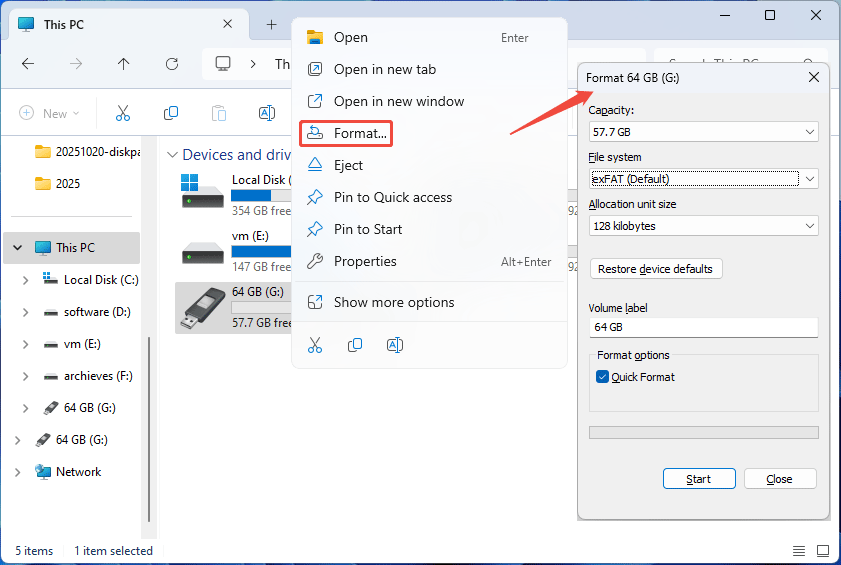
Windows File Explorer is the simplest built-in USB formatter for basic formatting tasks. If your USB drive is recognized normally by Windows, you can format it directly from File Explorer. The steps are as follows:
- Plug the USB drive into your computer.
- Open Windows File Explorer by pressing the Windows logo key + E.
- Click This PC on the navigation sidebar.
- You will then see the USB device displayed on the right panel.
- Right-click this USB drive and select Format.
- On the pop-up window, select a proper File system (FAT32, exFAT, or NTFS) and Allocation unit size (cluster size). The allocation unit size is kept to the default in most cases.
- Change the Volume label if necessary.
- Click Start to format the USB drive.
Windows Disk Management
Best for: users who want a visual overview of partitions before formatting.
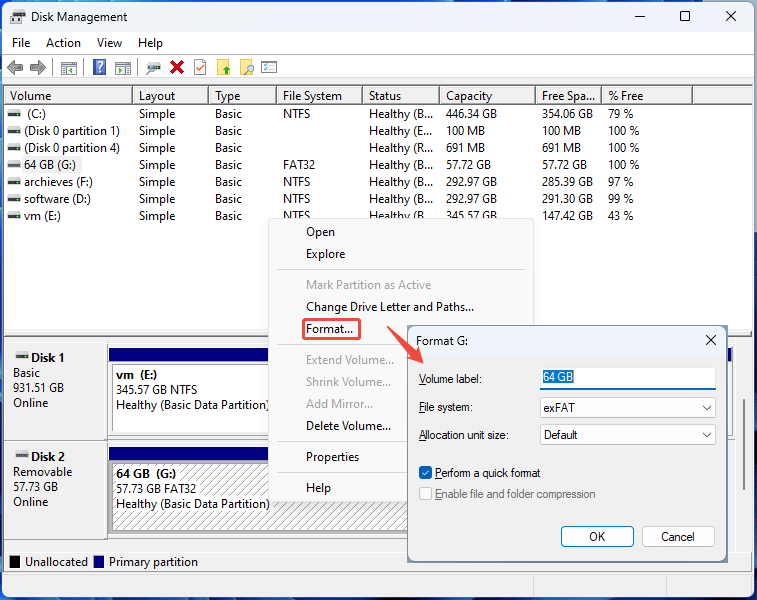
Windows Disk Management is a GUI tool dedicated to managing disks and partitions. It is able to display information about each drive on your computer and all partitions in each drive, initialize disks for use, create/format/delete partitions, extend/shrink partitions, etc.
To format a USB drive using Disk Management, the steps are as follows:
- Plug the USB drive into your computer.
- Press the Windows logo key + X and then select Disk Management from the menu.
- Once the tool opens, find the Removable disk, which is the USB drive. You can also identify it by its size.
- Right-click the partition on the USB flash drive and select Format from the menu.
- In the pop-up window, set Volume label, File system, and Allocation unit size.
- Determine whether to perform a quick format and then click OK.
- Read the warning pop-up and click OK to start formatting the USB drive.
Windows DiskPart
Best for: advanced users who want to format a USB drive via command line or scripts.
Windows DiskPart is a command-line tool for managing disks and partitions. Its features are almost the same as those of Windows Disk Management, but it is suitable for scripting.
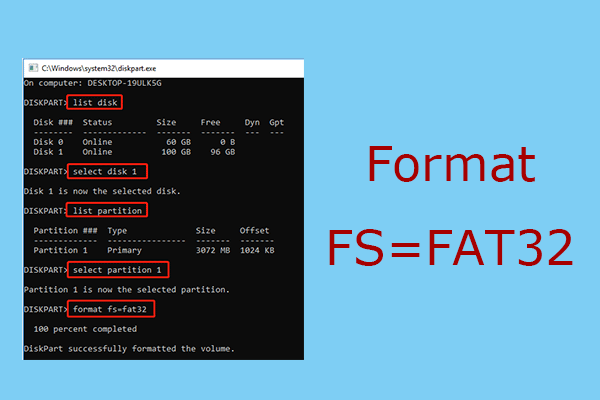
Here is the guide to DiskPart format USB:
- Insert the USB drive into your computer.
- Press the Windows logo key + R to open Run. Type “diskpart” in the text bar and press Enter. Then, click Yes on the User Account Control window. The DiskPart tool will open.
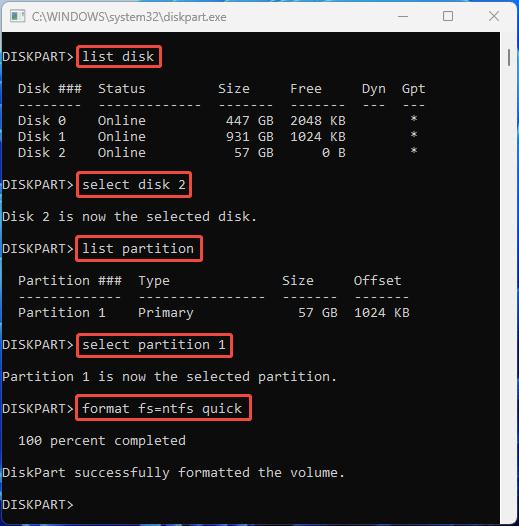
- In the DiskPart window, type “list disk” and press Enter to list all disks on the computer, including the USB drive.
- Identify the USB drive by its size. Then, type “select disk *” and press Enter to give focus to it. * is the disk number of the USB drive.
- Type “list partition” and press Enter to list partitions on the USB drive.
- Type “select partition *” and press Enter to select it. There is usually only one partition on the USB drive, and * is its partition number.
- Type “format fs=* quick” and press Enter to format the USB drive. Replace * with the desired file system (fat32, exfat, or ntfs). Omit ‘quick’ for a full format.
Important: Check the disk number and capacity carefully before using select disk. Selecting the wrong disk can result in data loss.
MiniTool Partition Wizard
Best for: formatting large USB drives to FAT32, plus support for EXT2/3/4 and a multilingual interface.
MiniTool Partition Wizard is a professional disk and partition management tool. It can create/format/delete a partition, move/resize or extend a partition, change drive letter, change cluster size without formatting, etc.
Here is how to format a USB drive with this software.
MiniTool Partition Wizard FreeClick to Download100%Clean & Safe
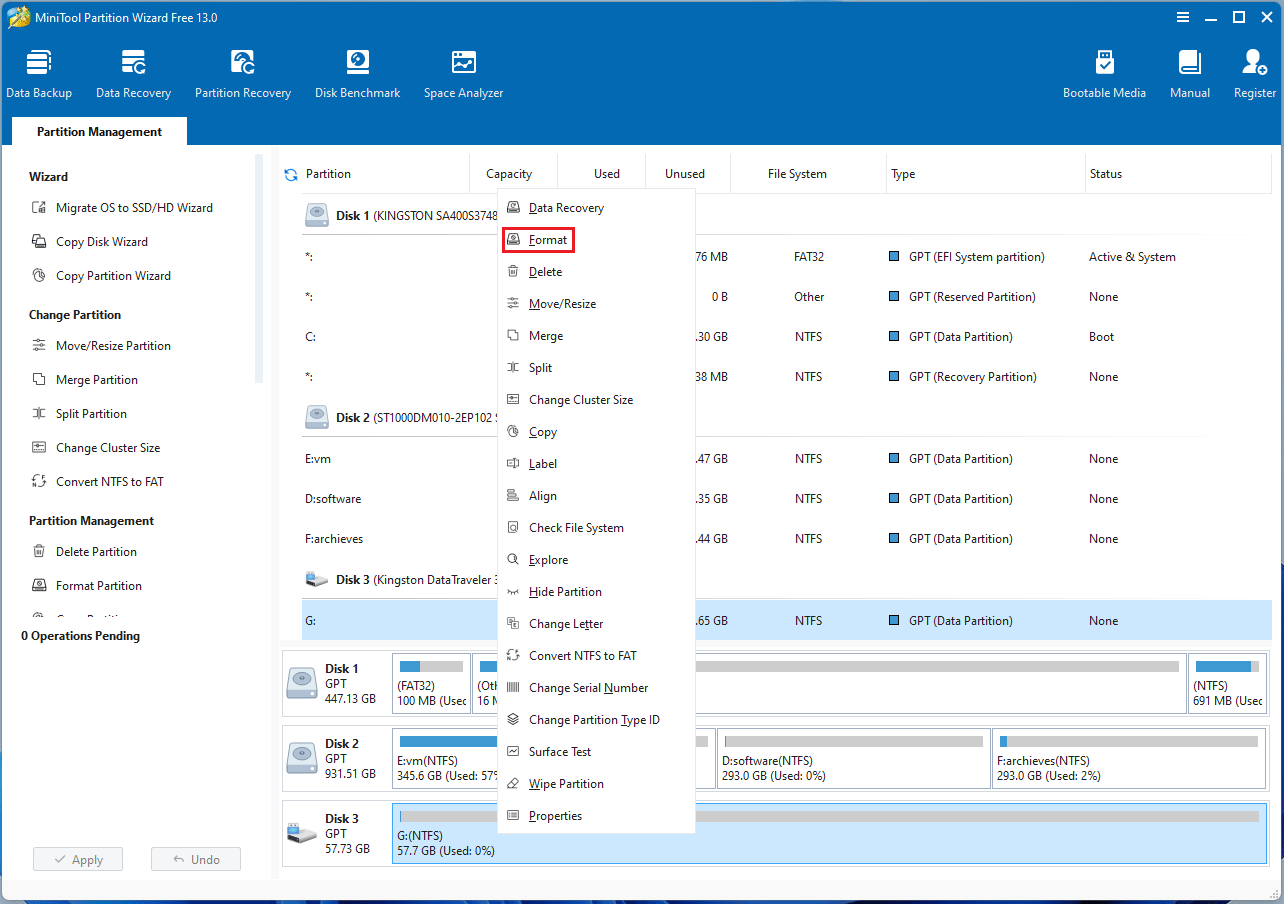
Step 1: Plug the USB drive into your computer. Click the above button to download MiniTool Partition Wizard and then install it. Launch this software, find the USB drive, right-click the partition on it, and choose Format.
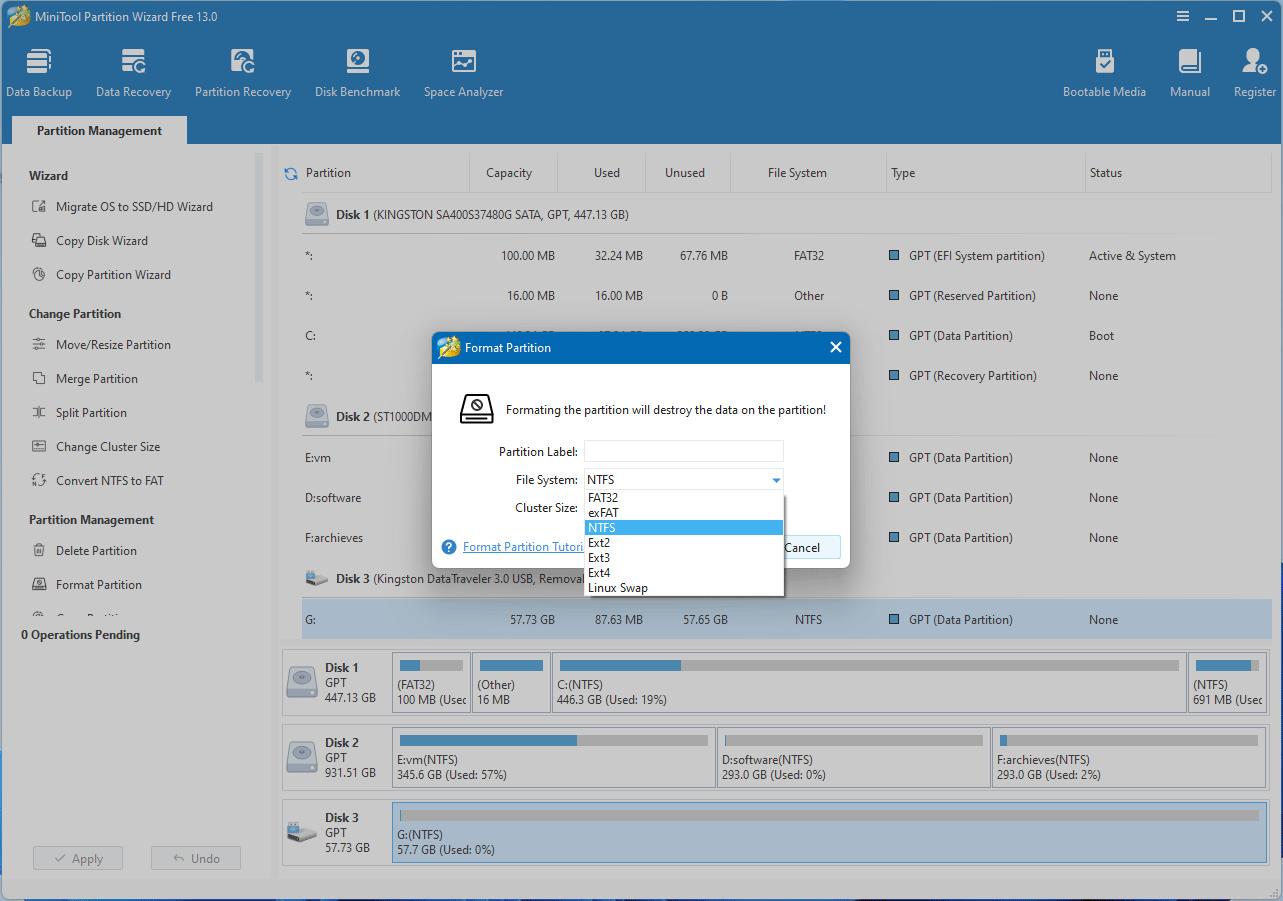
Step 2: On the pop-up window, set Partition Label, File System, and Cluster Size. Then, click OK. Note that the supported file systems include FAT32, exFAT, NTFS, EXT2/3/4, and Linux Swap.
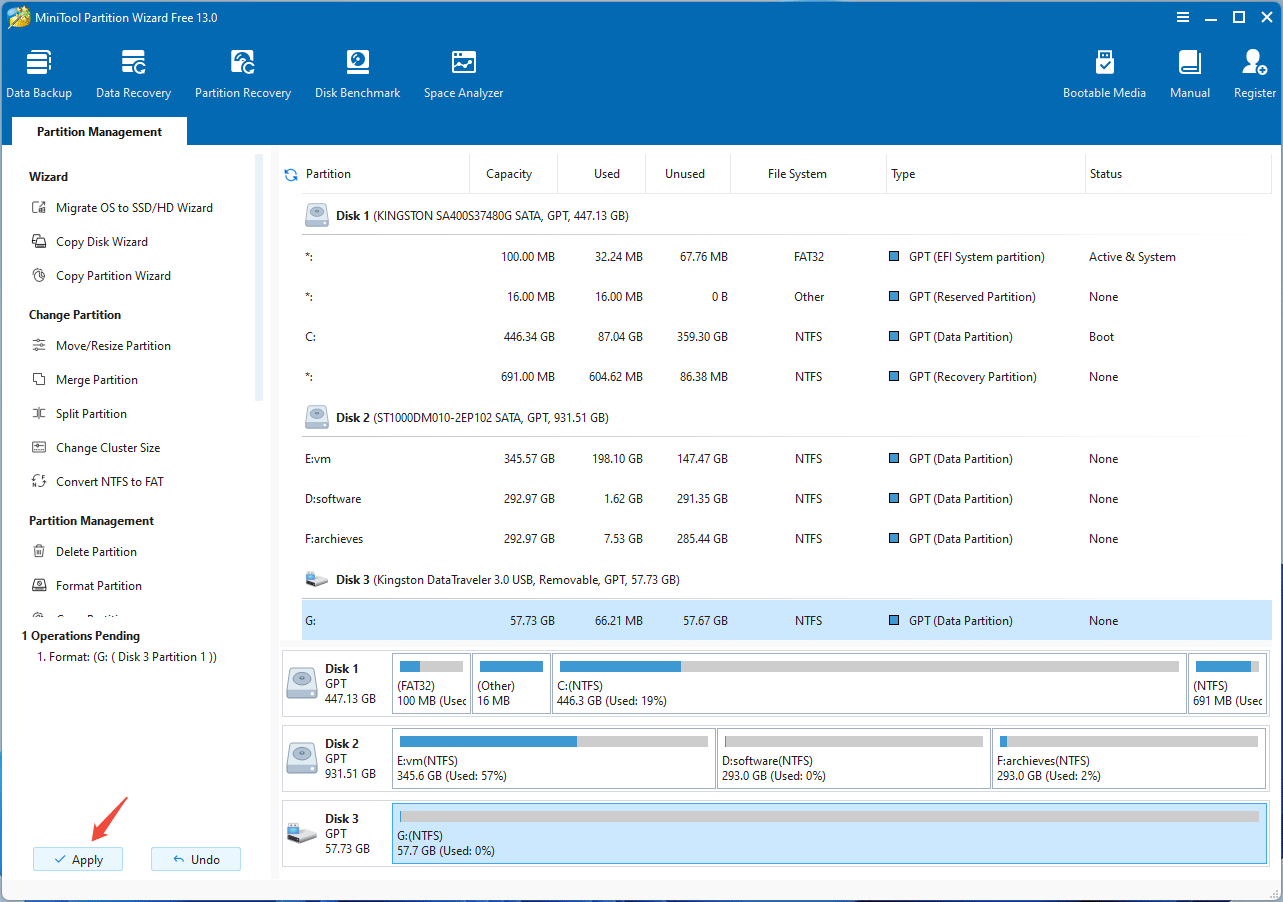
Step 3: Click Apply to carry out the operation.
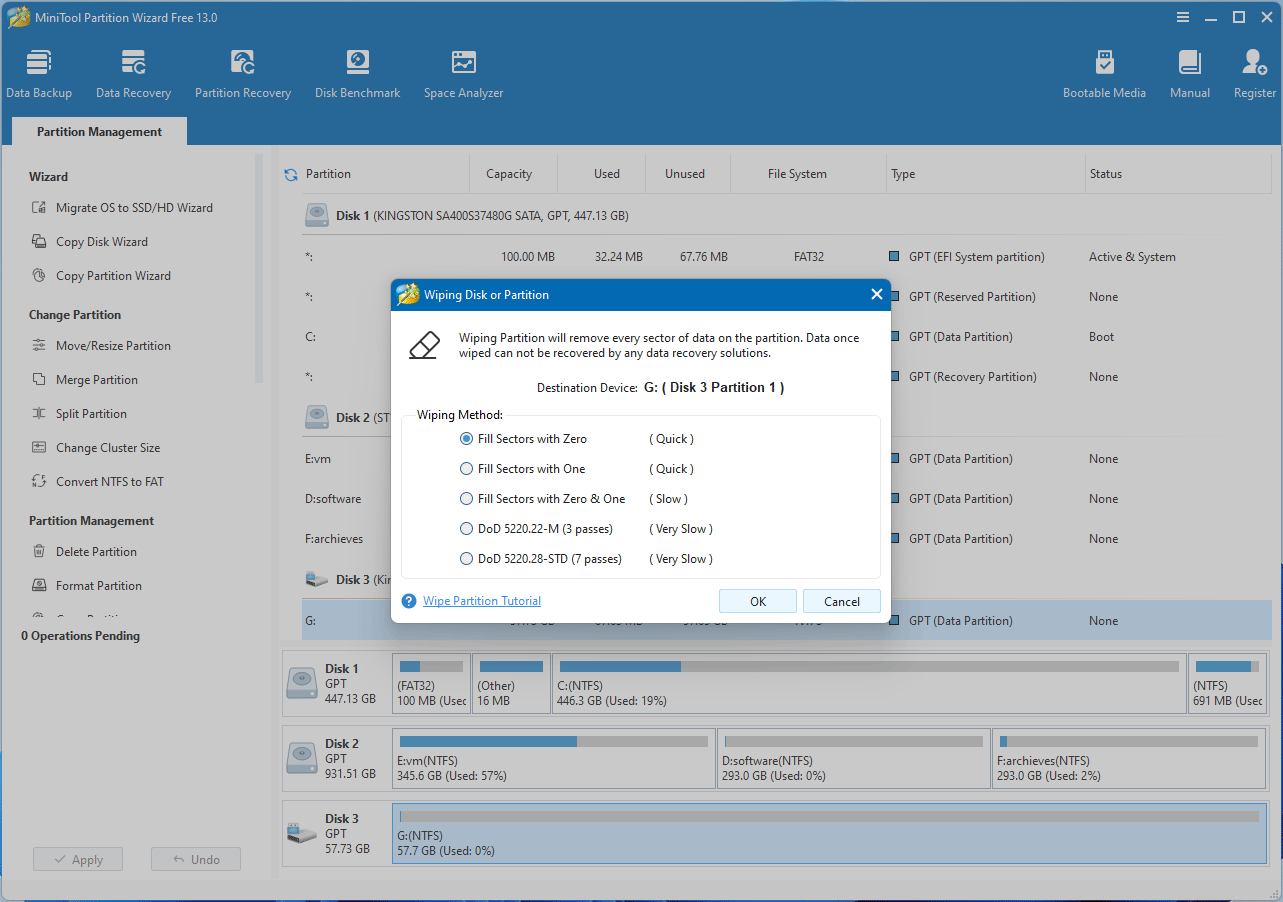
Note that MiniTool Partition Wizard doesn’t offer the full format option. If you want to erase data thoroughly, you can use its Wipe Partition or Wipe Disk feature. They offer various wiping methods. For speed, select the Quick options.
- Wipe Partition: Turn the USB drive to unformatted. You need to perform a quick format later for use.
- Wipe Disk: Turn the USB drive to uninitialized. You need to initialize the USB drive and create partitions later for use.
Rufus
Best for: users who need a portable, install-free tool to format large (32GB+) USB drives to FAT32.
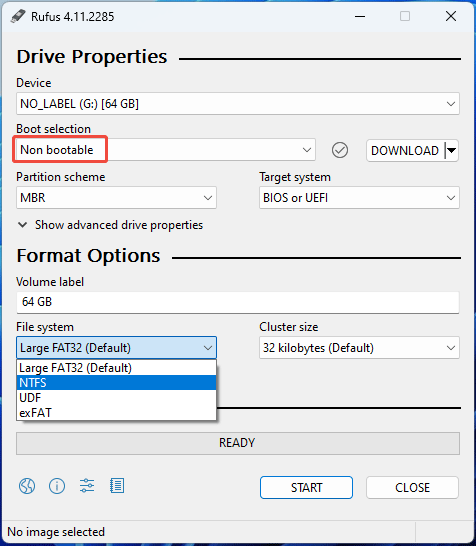
Rufus is a free tool that creates a bootable USB drive by burning ISO images to USB. It is also capable of simply formatting a USB drive. The supported file systems include FAT32, exFAT, NTFS, and UDF. It can also format USB drives larger than 32GB to FAT32.
Follow the steps below to format a USB drive via Rufus:
- Plug the USB drive into your computer.
- Download Rufus from its official website. Choose the Windows X64 Standard version.
- Double-click the downloaded file to run Rufus. Rufus will detect the USB drive and select it automatically.
- Change the Boot selection option to Non bootable.
- Select a File system and then click START.
SD Card Formatter
Best for: formatting SD cards (and USB drives) using the official SD Association tool.
SD Card Formatter is a tool released by the SD Association to format SD cards on PCs, but many people would also use this tool to format a USB drive. Here is the guide:
- Download SD Card Formatter from the SD Association. Choose the Windows version.
- You will get a ZIP file, and you need to unzip it.
- In the extracted folder, you will see a folder named SDCardFormatterv5_WinEN.
- Open this folder and you will find a setup file.
- Run this file to install SD Card Formatter.
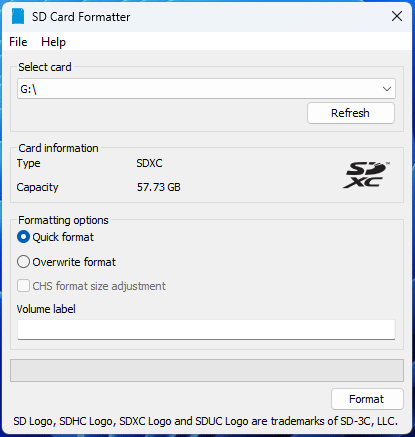
- Plug the USB drive into your computer and then launch the SD Card Formatter tool.
- The USB drive will be selected by default. You need to choose the formatting option: quick format or overwrite format.
- Click Format.
USB Format FAQ
However, if the USB drive is larger than 32GB, you need to use third-party software like MiniTool Partition Wizard or Rufus to format the USB drive to FAT32.
Then, use the DiskPart Attributes command to remove the read-only status. The commands are as follows:
1. List disk
2. Select disk * (* is the disk number of the USB drive)
3. Attributes disk clear readonly
Then, try formatting the USB drive using Windows built-in tools or third-party softwa
Bottom Line
A USB formatter can format a USB drive to FAT32, exFAT, NTFS, or other file systems for various devices. Windows includes built-in formatting tools, while third-party options like MiniTool Partition Wizard and Rufus offer more features. Choose a formatter that meets your needs, especially for larger drives or when Windows can’t format normally.
Always back up important files before formatting a USB drive. For issues related to MiniTool software, contact [email protected].
About The Author

Position: Columnist
Charlotte is a technology columnist with a strong focus on the Windows operating system, specializing in disk management, backup, and data recovery. She is passionate about analyzing computer errors, identifying root causes, and delivering practical solutions. In her free time, she stays updated on the latest developments in computer systems and hardware while continuously learning new technologies to broaden her expertise. Her writing style is clear and easy to understand, making complex technical topics accessible even to users with limited computer knowledge.
User Comments :