
Want to increase Recovery Partition size in Windows 10/11? A small or full Recovery Partition can prevent WinRE updates from installing successfully. This post from Partition Magic explains the Recovery Partition and provides two safe methods to increase its size.
About Recovery Partition
The Recovery Partition is a special partition in your disk without a drive letter. It contains the files of system backup images and files that guide system restoration. So, you can use it to restore the system to its original factory settings.
To know more about Recovery Partition, you can refer to this post: Get Comprehensive Understanding of Windows 10 Recovery Partition.
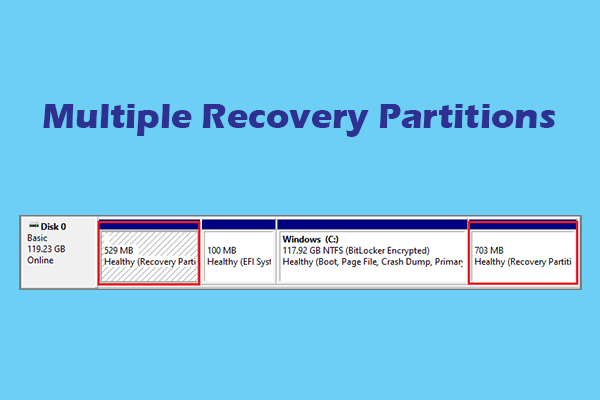
Why Do You Need to Increase Recovery Partition Size?
You may need to increase the Recovery Partition size when it is too small or nearly full to provide enough free space for the Windows Recovery Environment (WinRE). Insufficient space can prevent WinRE updates or servicing operations from completing successfully.
For example, insufficient space in the Recovery Partition was associated with the Windows 10 KB5034441 update failure, which could display error 0x80070643. You can refer to this MiniTool article about the KB5034441 update failure for more details.
How Much Space Does a Recovery Partition Actually Need?
There’s no single fixed number, and the required size varies by device and Windows configuration. As a general reference:
- Windows 10 Recovery Partitions are commonly reported to be around 450MB by default. However, this is based on commonly reported configurations rather than an official Microsoft requirement.
- According to Microsoft’s official UEFI/GPT partition guidance, the Recovery Partition should have enough space for the winre.wim image and any customizations, plus 250MB of free space for WinRE servicing. For custom DISKPART layouts, Microsoft recommends a 990MB Recovery Partition with at least 250MB of free space. The BIOS/MBR partition guidance provides similar guidance and recommends 250MB of free space for future WinRE updates.
- For the WinRE cumulative-update issue specifically, Microsoft’s KB5028997 support page instructs affected users to free up 250MB of space when manually resizing the Recovery Partition.
If your Recovery Partition is nearly full or does not have enough free space for WinRE servicing, consider increasing its size before a Windows update fails.
How to Increase Recovery Partition Size?
How to increase Recovery Partition size? In this section, we summarize two effective methods to help you increase WinRE partition size.
| Method | Difficulty | Data-Loss Risk | Best For |
| MiniTool Partition Wizard | Beginner-friendly — GUI | Low | Most users, especially when the unallocated space isn’t directly adjacent to the Recovery Partition |
| Command Prompt (diskpart) | Advanced — command-line only | Higher if a step is skipped or mistyped | Users comfortable with CMD who don’t want extra software |
Method 1. Increase Recovery Partition Size with MiniTool Partition Wizard
MiniTool Partition Wizard is a reliable disk partition manager that allows you to easily increase your Recovery Partition size. This is especially useful if you prefer not to use command-line tools or if unallocated space isn’t adjacent to the Recovery Partition.
In addition, this feature-rich tool can also help you partition hard drives, change cluster size, rebuild MBR, format USB to FAT32, check disk errors, align partitions, convert MBR to GPT, do disk benchmarks, create/delete partitions, recover data from hard drive, and more.
Here’s the guide on how to increase the Recovery Partition size:
# 1. Use the Move/Resize Partition Feature
If there is no other unallocated space on the disk of your OS drive and recovery drive, you can shrink your OS drive and then use the newly unallocated space to increase the Recovery Partition size. Here’s the guide:
Step 1. Click the Download button to get the MiniTool Partition Wizard installation package. Then, follow the on-screen instructions to install the app on your computer.
MiniTool Partition Wizard FreeClick to Download100%Clean & Safe
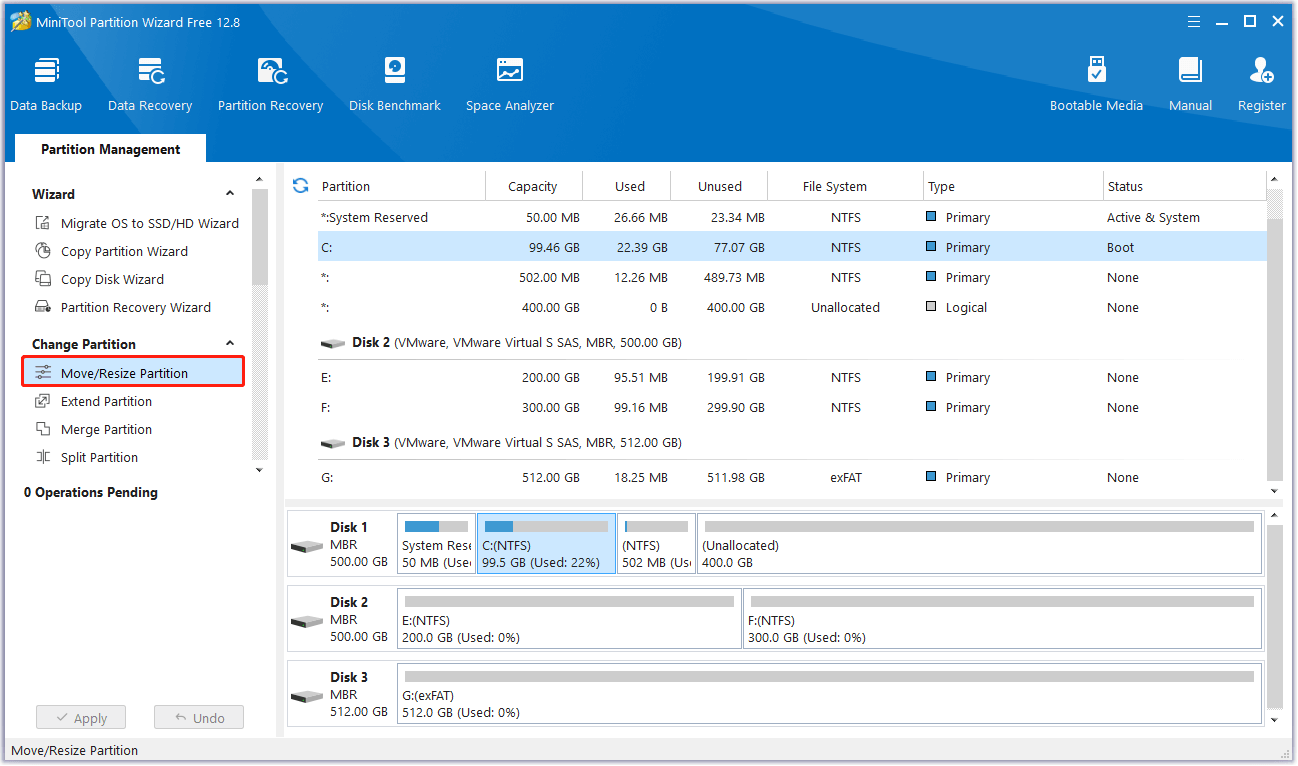
Step 2. Launch it into its main interface. Choose the C drive from the disk map, and select the Move/Resize Partition feature from the left pane.
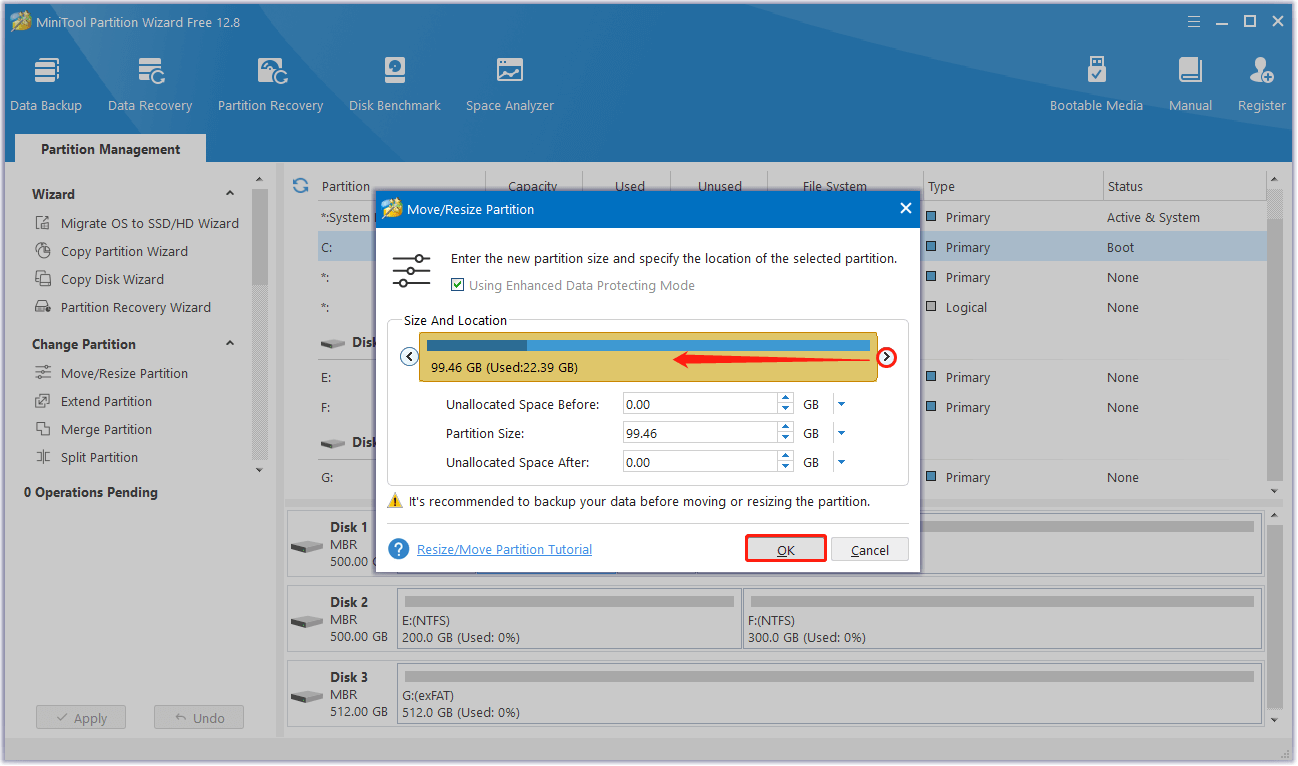
Step 3. Drag the small arrow to the left to shrink the size of C drive, and then click OK to save the changes.
Step 4. Click the Apply and Yes keys sequentially to execute the pending operations.
# 2. Use the Extend Partition Feature
The Extend Partition feature can also help you increase WinRE partition size. It can not only use the unallocated space to increase the size of Recovery Partition but also use the space on other partitions. Here’s how to use the Extend Partition feature to increase the Recovery Partition:
Step 1. Launch MiniTool Partition Wizard into its main interface.
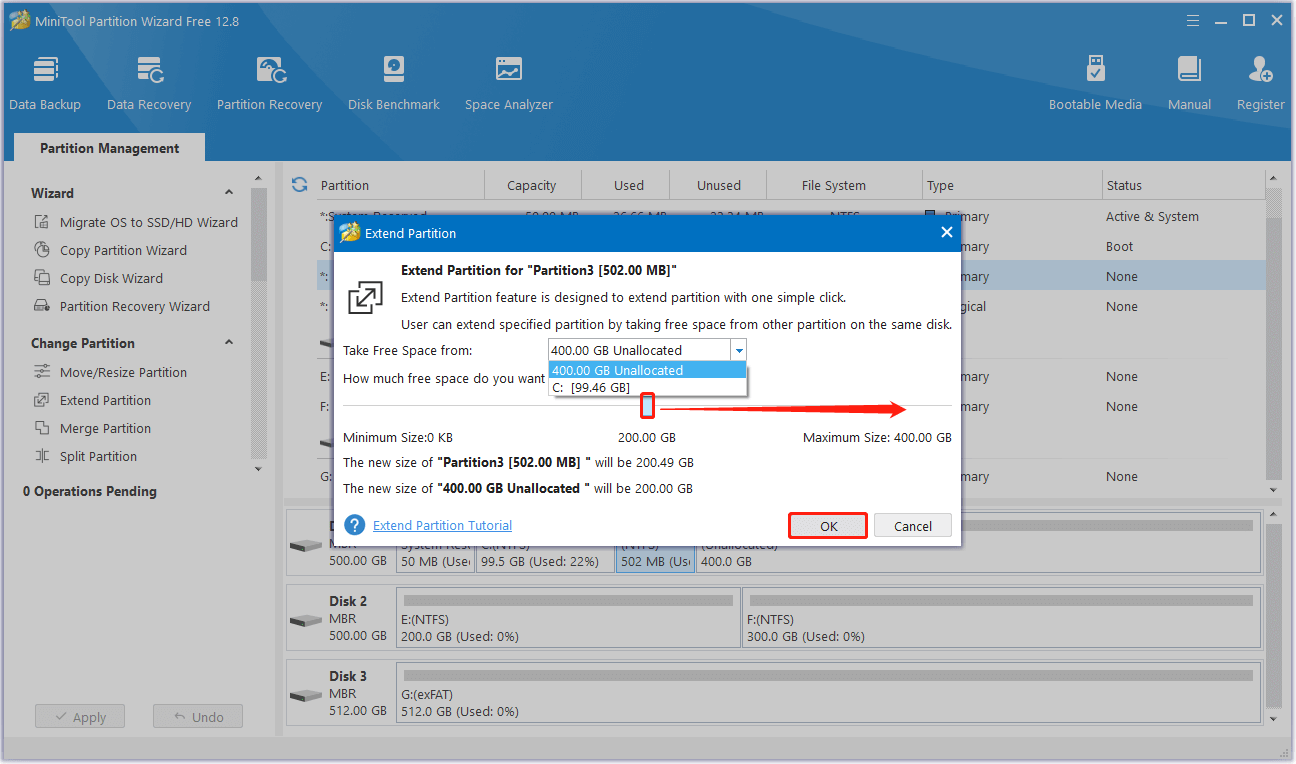
Step 2. Choose the Recovery Partition from the disk map on the right panel, and then select the Extend Partition feature from the left pane.
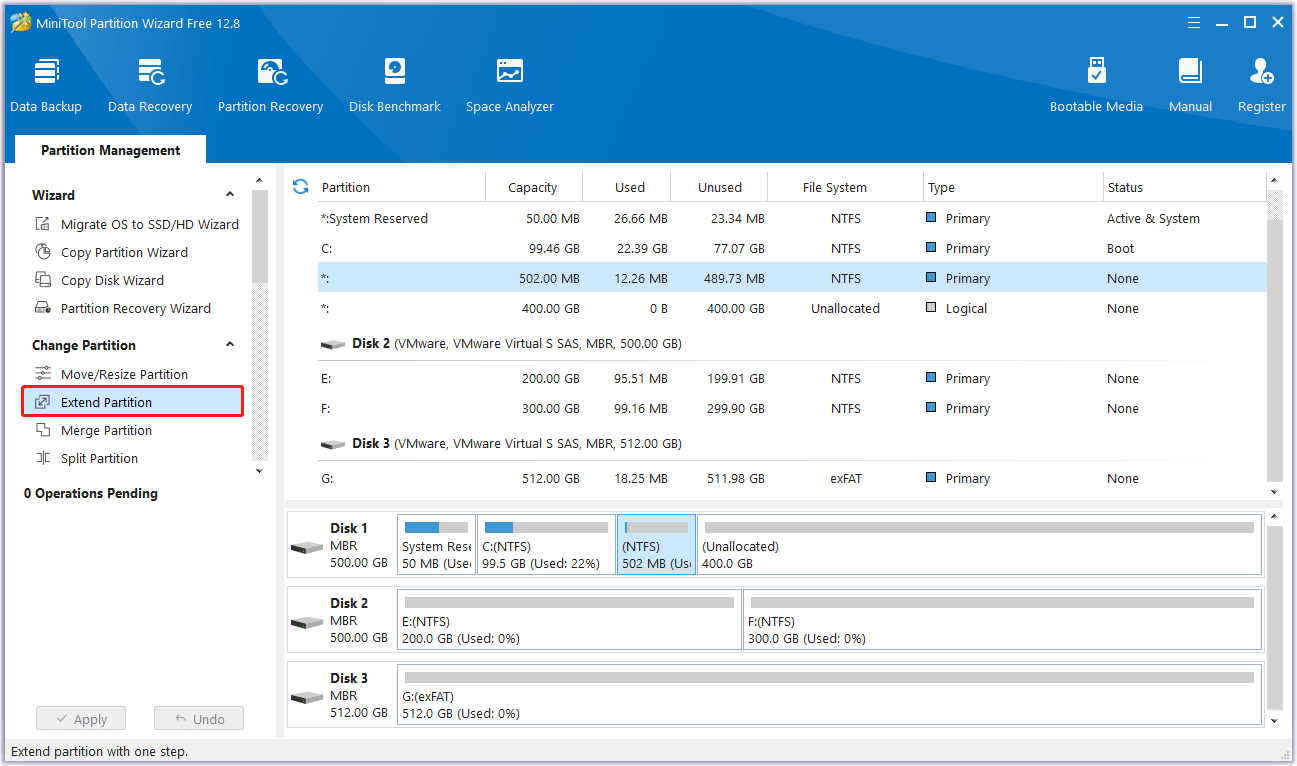
Step 3. Then, click the down arrow to choose where you want to choose free space from. After that, drag the blue block to the right to select how much free space you want to increase. Finally, click OK to confirm your selection.
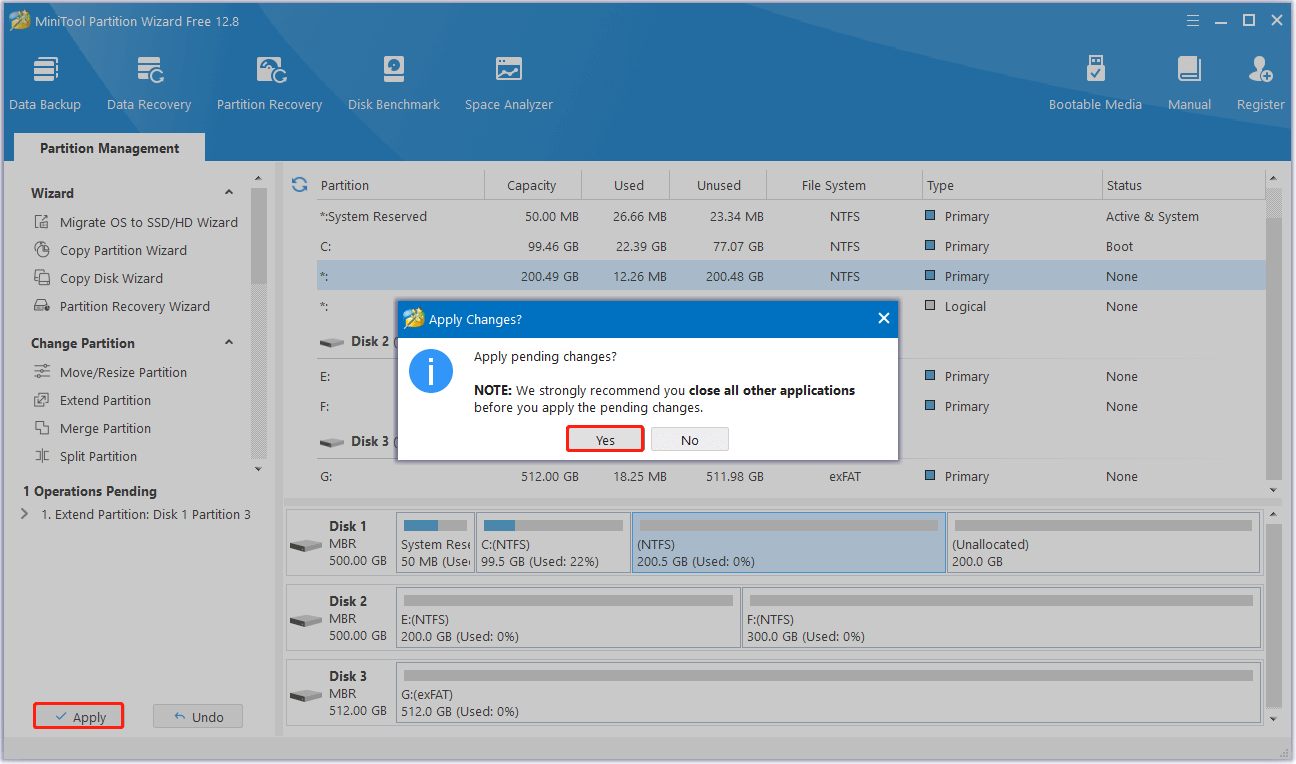
Step 4. Click the Apply and Yes sequentially to execute the changes.
Method 2. Increase Recovery Partition Size with Command Prompt
Command Prompt is a built-in tool on Windows computers that can help users perform entered commands and perform advanced administrative functions. You can also use it to increase Recovery Partition size to solve the Recovery Partition full issue. Here’s the tutorial:
Step 1. Press the Win + S keys simultaneously to open the Search window and type “cmd” in the search window. Then, right-click Command Prompt and select Run as administrator.
Step 2. Type “reagentc /info” and press Enter to check the WinRE status. If the WinRE is enabled, type “reagentc /disable” to turn off WinRE.
Step 3. Shrink the OS partition and prepare the disk for a new Recovery Partition. Here are the commands, and don’t forget to press Enter after each command.
- diskpart
- list disk
- sel disk [OS disk index] (This should be the same disk index as the Windows Recovery Environment (WinRE).)
- sel part <OS partition index>
- shrink desired=250 minimum=250
- sel part <WinRE partition index>
- delete partition override
Important: The commands above are based on a specific partition layout and should not be run blindly. If the Recovery Partition is not directly after the OS partition, the steps may not work as expected. Microsoft provides a sample PowerShell script for resizing the WinRE partition, which checks the partition layout and can either extend the existing WinRE partition or create a new one when the layout does not allow direct extension.
Step 4. Create a new Recovery Partition. Different partition styles have different commands. You need to check if the disk is GPT or MBR by seeing the return result of the “list disk” command. If there is an asterisk (*), it means that the disk is GPT. Otherwise, it is MBR.
GPT users need to run:
- create partition primary id=de94bba4-06d1-4d40-a16a-bfd50179d6ac
- gpt attributes =0x8000000000000001
MBR users should run this command:
- create partition primary id=27
- format quick fs=ntfs label= “Windows RE tools”
Step 5. Type the command “run list vol” and press Enter. Next, type “exit” to exit the Diskpart.
Step 6. Type “ reagentc /enable” and press Enter to enable the WinRE. After that, type “reagentc /info” to make sure to check the information about the Recovery Partition.
Increase Recovery Partition Size FAQ
Bottom Line
o increase space in your Recovery Partition for Windows Recovery Environment updates, you can use two methods: MiniTool Partition Wizard for a graphical approach, or Command Prompt and DiskPart for a built-in method.
Always back up important data and verify the correct disk and partition numbers before making changes. If your Recovery Partition isn’t directly after the OS partition, additional operations may be needed.
For assistance with MiniTool Partition Wizard, contact support at [email protected].
About The Author

Position: Columnist
Charlotte is a technology columnist with a strong focus on the Windows operating system, specializing in disk management, backup, and data recovery. She is passionate about analyzing computer errors, identifying root causes, and delivering practical solutions. In her free time, she stays updated on the latest developments in computer systems and hardware while continuously learning new technologies to broaden her expertise. Her writing style is clear and easy to understand, making complex technical topics accessible even to users with limited computer knowledge.
User Comments :