
The Windows 10 recovery partition contains essential files for system recovery in case of serious issues. Before deleting it, understand whether it's safe to do so, how to back it up, and how to restore it if deleted. This guide offers practical management tips.
What Is a Windows 10 Recovery Partition
On a Windows 10 PC, Disk Management may show a small partition with no drive letter, labeled “Recovery”. This partition is used to store recovery tools and files that can help troubleshoot or reset Windows when problems occur (see the image below).

There are actually two kinds of “recovery partition” you might be looking at:
- OEM recovery partition: created by the manufacturer, containing a factory system image. This can take up several GB and is mostly found on older or brand-customized machines.
- WinRE (Windows Recovery Environment) partition: created by Windows 10 itself during installation. It powers startup repair and “Reset this PC,” and is usually well under 1 GB.
On most modern PCs, the partition you’re seeing is the smaller WinRE one, not a full factory-image partition. In either case, it exists to let you troubleshoot or reset Windows without a separate recovery disc.
Can I Delete the Recovery Partition in Windows 10
Yes, in most cases, deleting the Windows 10 recovery partition won’t break your system, as long as you’ve backed it up or don’t plan to factory reset later.
The challenge is that Disk Management won’t let you delete the recovery partition directly, as the Delete Volume option is grayed out, leaving only the Help option available.
Below are the two methods that work:
- MiniTool Partition Wizard (safer, involves a few clicks)
- Diskpart (built-in, requires more steps and carries a higher risk of accidentally deleting the wrong partition)
Method 1: Delete Recovery Partition using Partition Wizard
Let’s see how MiniTool Partition Wizard works on deleting recovery partition Windows 10:
Step 1. Download MiniTool Partition Wizard Free Edition. Install it on computer and run it.
MiniTool Partition Wizard FreeClick to Download100%Clean & Safe
Step 2. Right click on the recovery partition you want to delete and select “Delete Partition”.
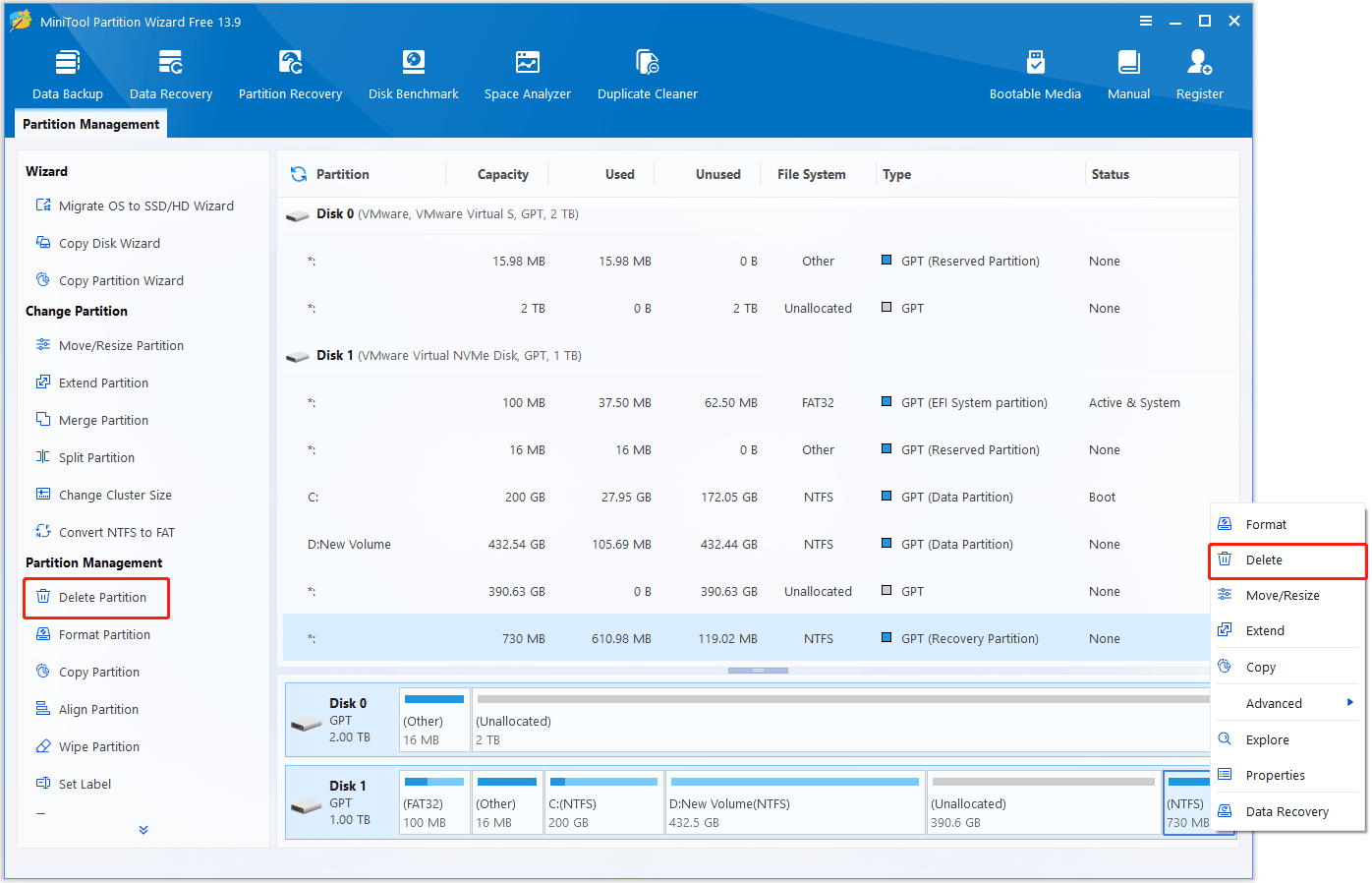
Step 3. The recovery partition will be displayed as unallocated space for your preview. Now click “Apply” to make the operation into effect.
Within a few seconds, you will have Windows 10 recovery partition deleted. Then you can use MiniTool Partition Wizard to add this unallocated space to any partition so as to extend partition or you may just create new partition on this location.
Method 2: Delete Recovery Partition using Diskpart
In fact, Windows also provides you a way to delete recovery partition, that is to use Diskpart.exe to delete partitions from Diskpart command prompt. Please follow these steps to remove Windows 10 recovery partition.
Let’s see how to delete recovery partition Windows 10 using Diskpart.
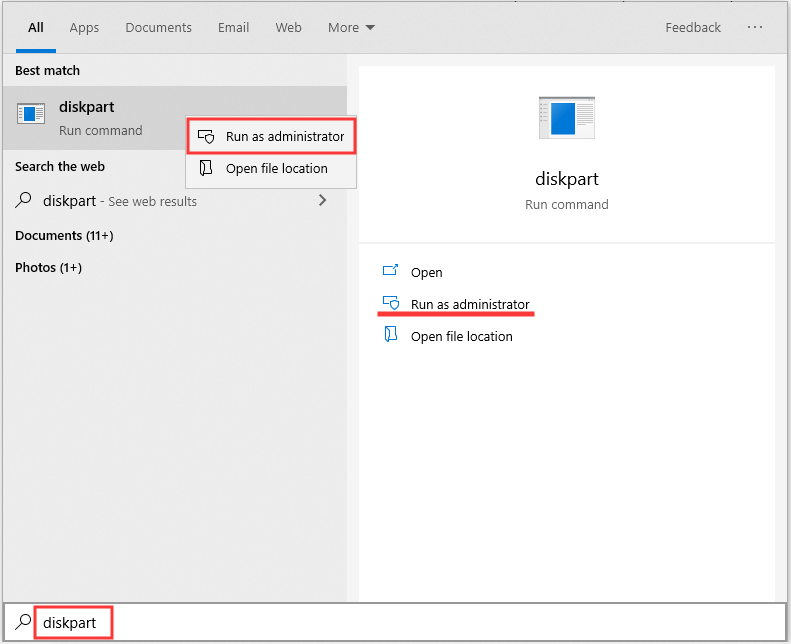
Step 1. Navigate to Windows 10 Start menu, type “diskpart” in the search box, and then Windows 10 will show you the best match. Right-click on “diskpart” and select “Run as administrator”, then confirm that you want to allow this app to make changes to your computer.
Step 2. At Diskpart window, type the following commands in order. Please end each command with the Enter key:
- Type “list disk” to display all your disks. Please pay attention to the disk number that contains the recovery partition.
- Type “select disk n” where “n” should be replaced with the correct disk number.
- Type “list partition” to list all the partitions on the selected disk. By viewing the partition label and other partition information, you will know which one is the recovery partition to be deleted.
- Type “select partition n” where “n” should be replaced with the partition number of the recovery partition.
- Type “delete partition” to delete the recovery partition.
- Type “exit” to quit.
Kindly reminder:
Sometimes, you may fail to delete recovery partition and an error message which reads “cannot delete a protected partition without the force protected parameter set” appears:

This error message is likely to appear on GPT disk. If the recovery partition you intend to delete is marked as protected partition by Windows, then deletion is prevented. At this time, you can type “gpt attributes=0x8000000000000000” and then repeat “delete partition” to solve this issue.
If you are familiar with Diskpart, you can continue creating a new partition on the released unallocated space before you exit. Or you can use this unallocated space to enlarge partition. But probably you will encounter “Virtual Disk Service error” during the process. Here I suggest using MiniTool Partition Wizard Free Edition to save time, which can break some limitations in Diskpart.
So the bottom line here is: both MiniTool Partition Wizard and Diskpart are useful to delete recovery partition Windows 10. But in my opinion, the former one is easier to operate, and the latter is likely to lead to errors.
Although Diskpart is able to delete recovery partition, without a clear interface to display the details, there are chances that you may delete a wrong partition and the operations are irreversible. For those who are unfamiliar with Diskpart, obviously this is not a good choice.
Windows 10 Recovery Partition: How to Manage It SafelyClick to Tweet
How to Back Up the Recovery Partition Before Deleting It
If you’re not sure whether you’ll ever need the recovery partition again, back it up before deleting it — that way you free up disk space now without losing the option to restore it later.
The easiest way to do this is with MiniTool ShadowMaker, a backup tool that lets you image any partition — including the recovery partition — into a single compressed file stored on another drive.
How to back up the recovery partition with MiniTool ShadowMaker:
Step 1. Download and launch MiniTool ShadowMaker.
MiniTool ShadowMaker TrialClick to Download100%Clean & Safe
Step 2. Go to Backup > SOURCE > Disk and Partitions, then check the recovery partition and click OK.
Step 3. Click DESTINATION and choose a target location — ideally an external drive or a different disk. Then, choose OK.
Step 4. Click Back up Now and OK.
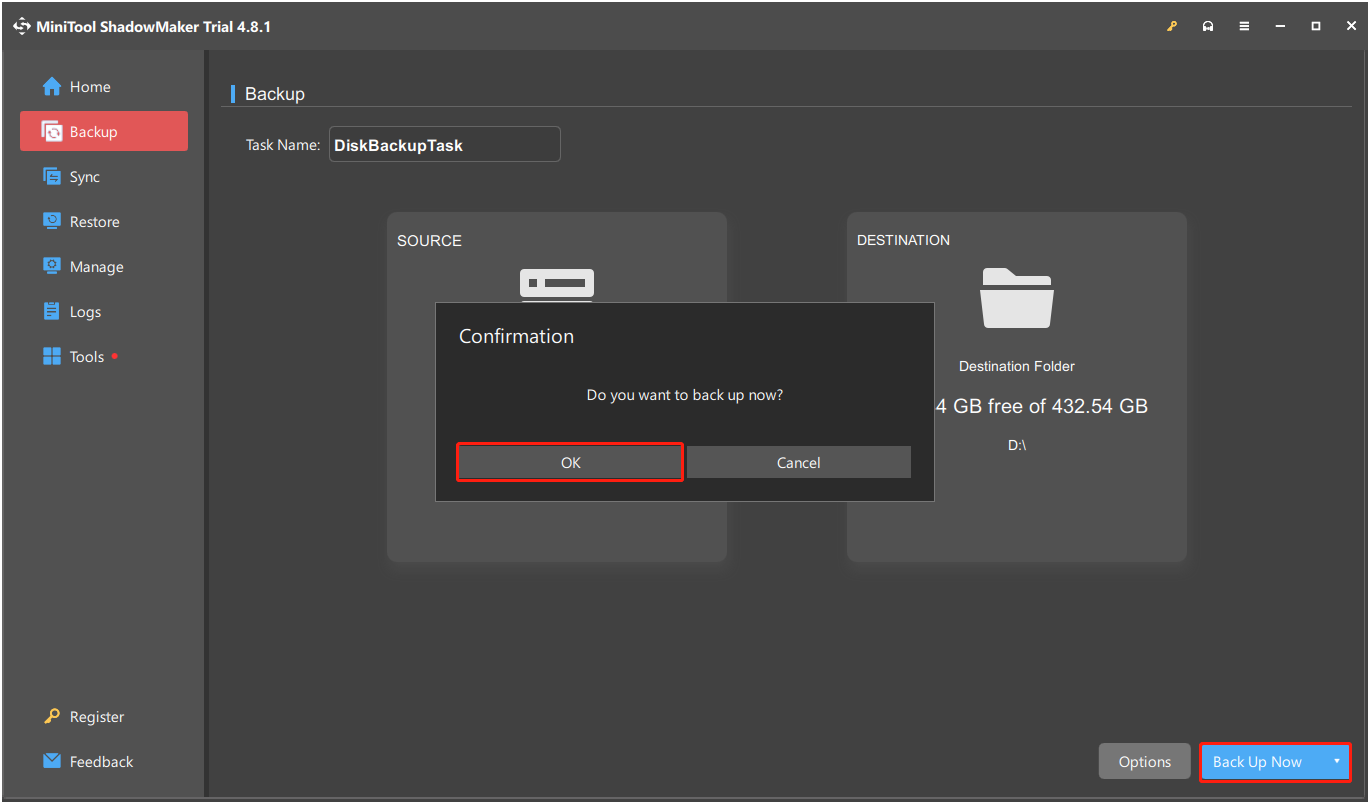
The recovery partition is now saved as an image file. You can restore it anytime before or after deleting the original partition.
How to Restore a Deleted Recovery Partition
Deleted the recovery partition and regret it? As long as you haven’t written new data to the unallocated space it left behind, MiniTool Partition Wizard’s Partition Recovery feature can usually get it back.
MiniTool Partition Wizard FreeClick to Download100%Clean & Safe
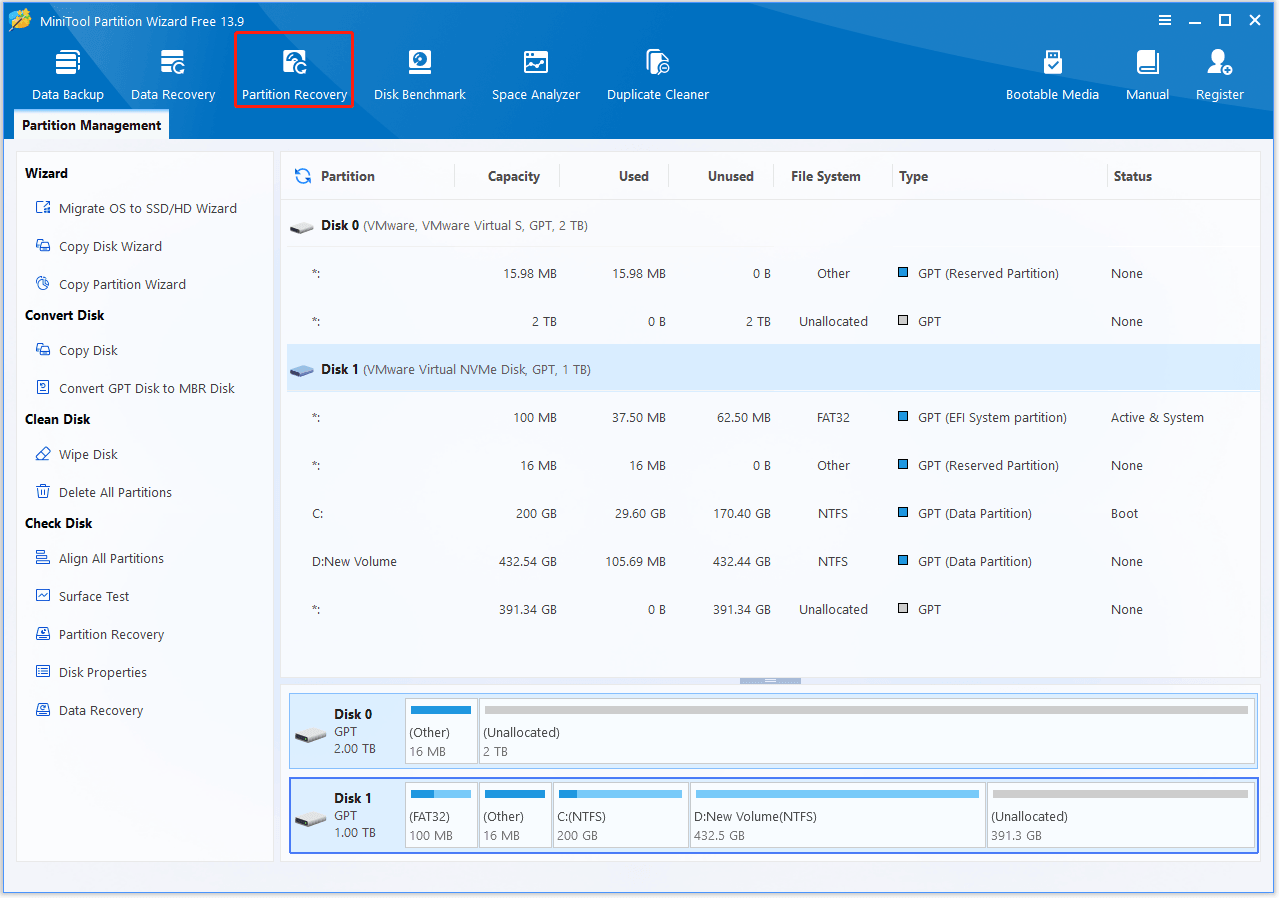
Step 1. Run Partition Wizard Free Edition to the main interface. Then right click on the disk that used to contain the recovery partition and choose “Partition Recovery” from the option box.
Step 2. If you are using the Free Edition, you will see notice saying Free Edition is only capable of scanning for lost partitions. To recover, you need to upgrade software to Pro Edition. If you are already running the Pro Edition, the red notice will not show up. Now to continue, click “Next“.
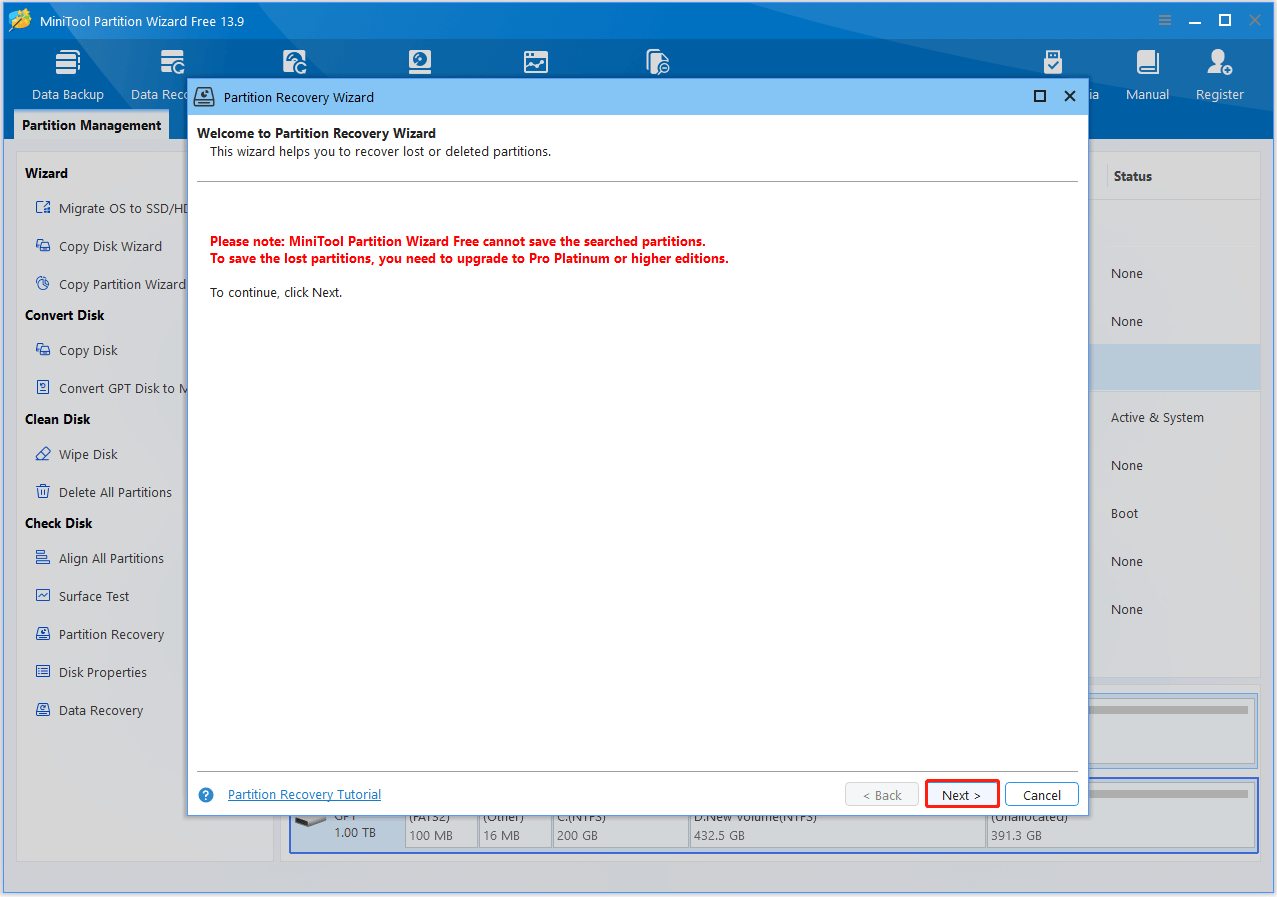
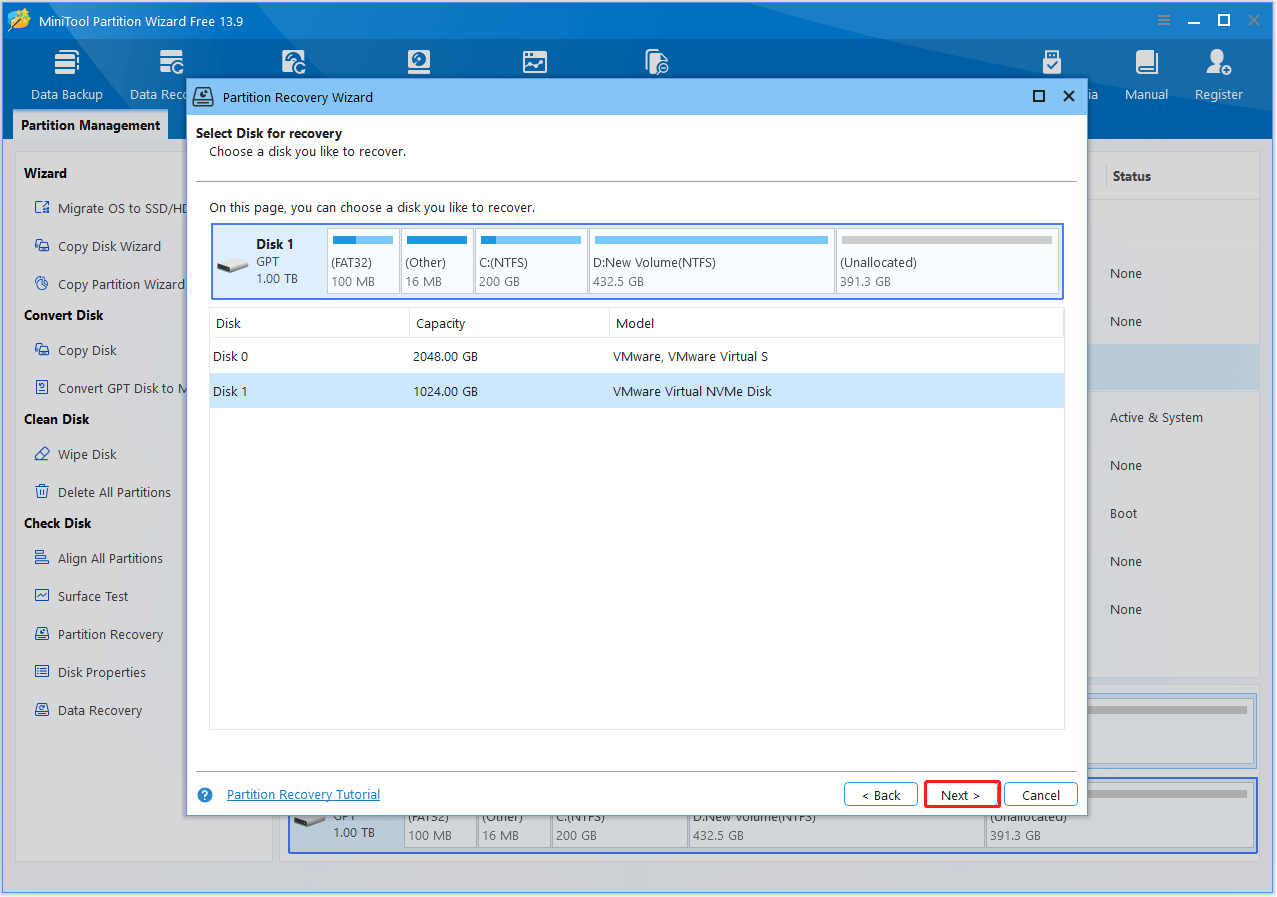
Step 3. Now choose a disk you want to recover partitions from.
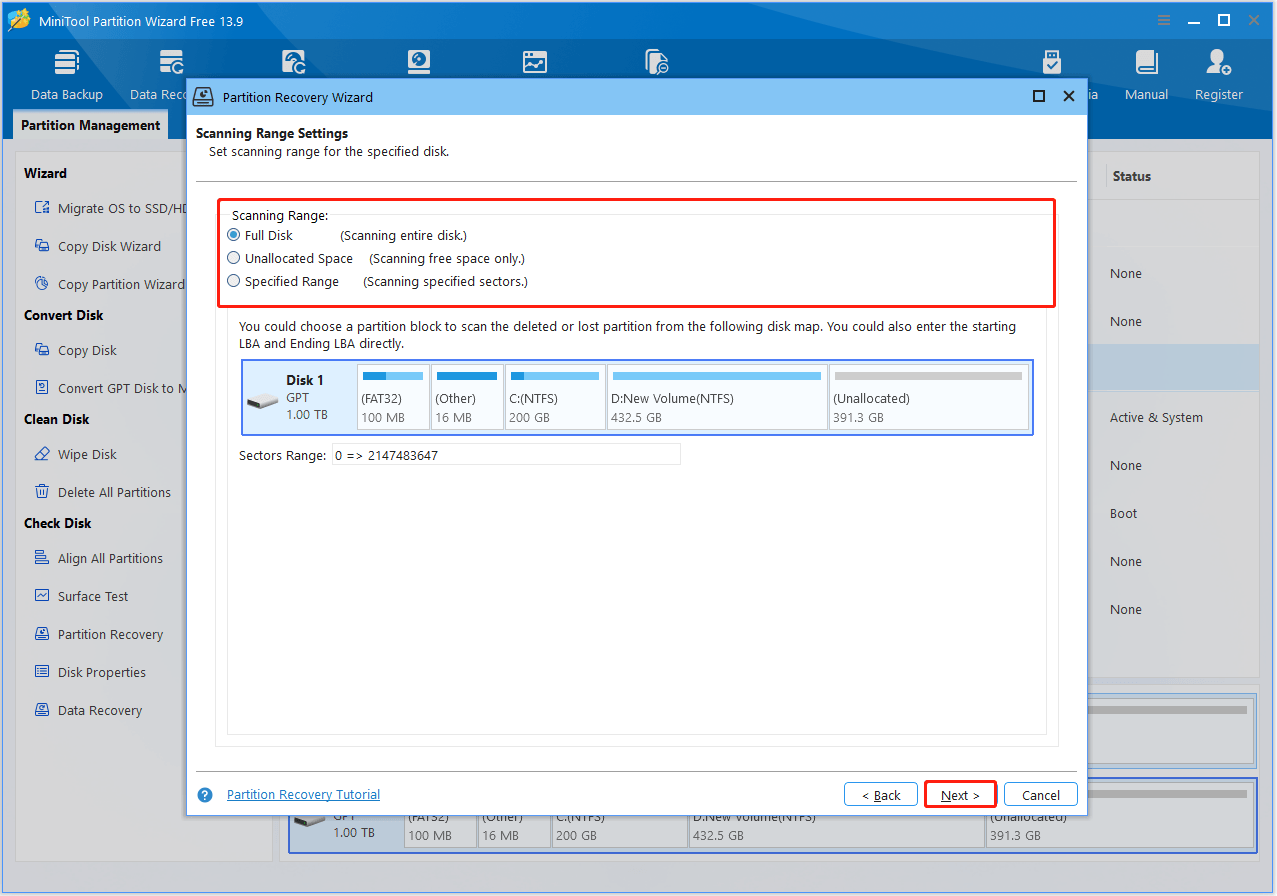
Step 4. Then set a scanning range to search for the deleted recovery partition. It is recommended to choose Full Disk or Unallocated Space here for they are easy for users to carry out. Then click “Next” to go on.
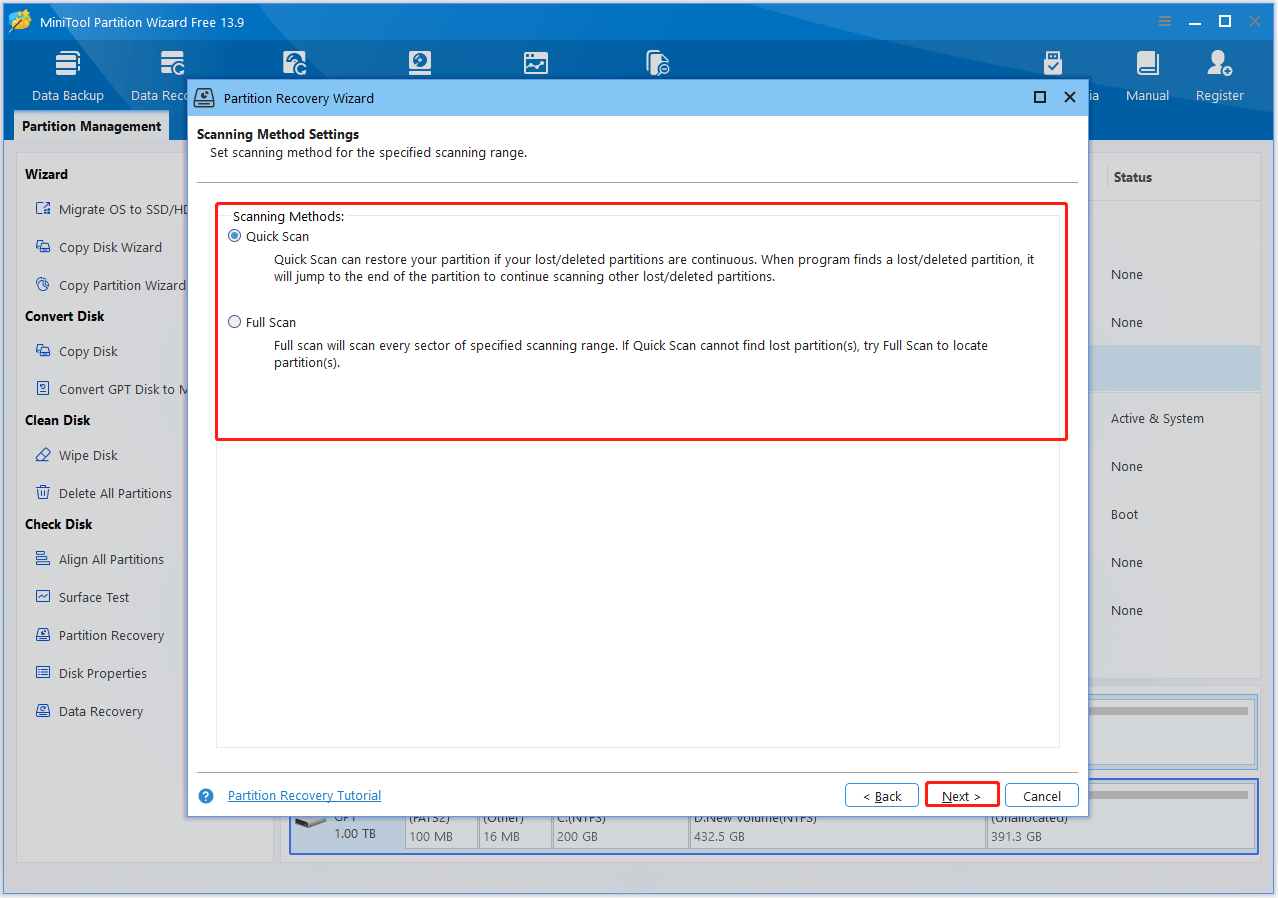
Step 5. In the next page choose a scanning method. Do you want a Quick Scan or would you prefer a Full Scan? I suggest using Quick Scan which saves a lot time first to take your chance. Click “Next” and continue.
Step 6. Here comes to the scanning result page. Now you need to tick ALL partitions you need to do the recovery. Look! The recovery partition is successfully found by Partition Wizard. So here I just tick this partition along with the rest important ones. Then click “Finish” to go back to the main interface.
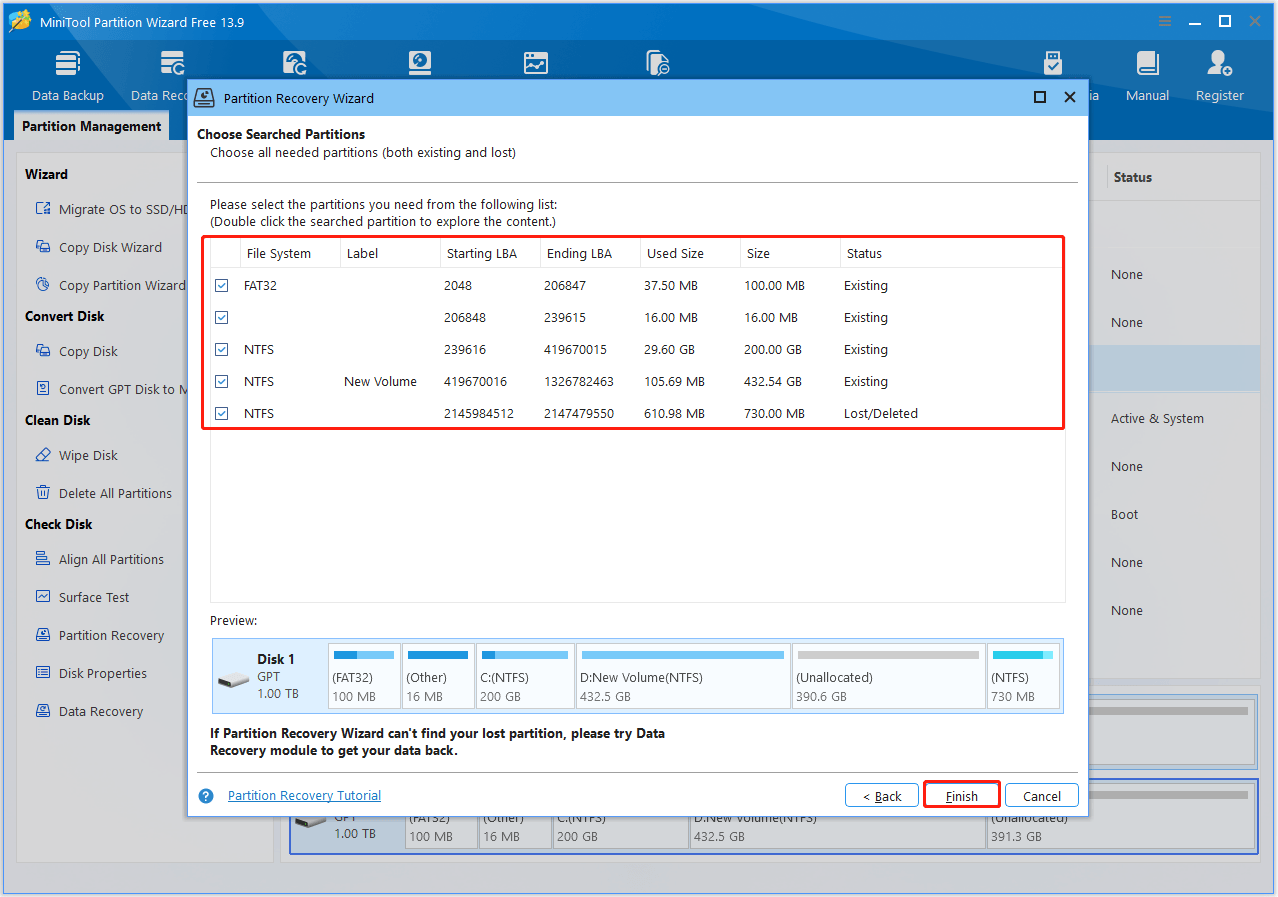
Step 7. Finally, hit the “Apply” button to start the recovery process (only the paid editions allow you to do so).
MiniTool Partition Wizard DemoClick to Download100%Clean & Safe
Related Article: HP Recovery Drive Full Windows 10/8/7? Here’re Full Solutions!?
Windows 10 Recovery Partition: How to Manage It SafelyClick to Tweet
How to Restore Windows 10 from the Recovery Partition
If your computer isn’t running the way it should and keeps sending out error messages, or you just want to make a reset to its default state, then Windows 10 recovery partition plays an rather important role. How to factory reset a Windows 10 laptop? Well, the process of restoring windows 10 from recovery partition is rather easy. Just follow these steps:
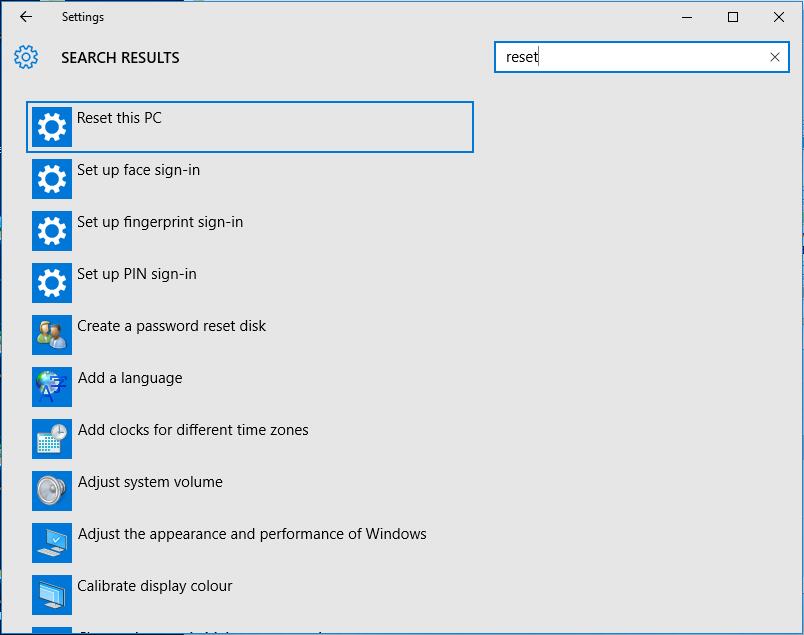
Step 1. Navigate to Windows 10 Start menu to choose “Settings”. Then in the pop-up new window, input “reset” to select “Reset this PC”.
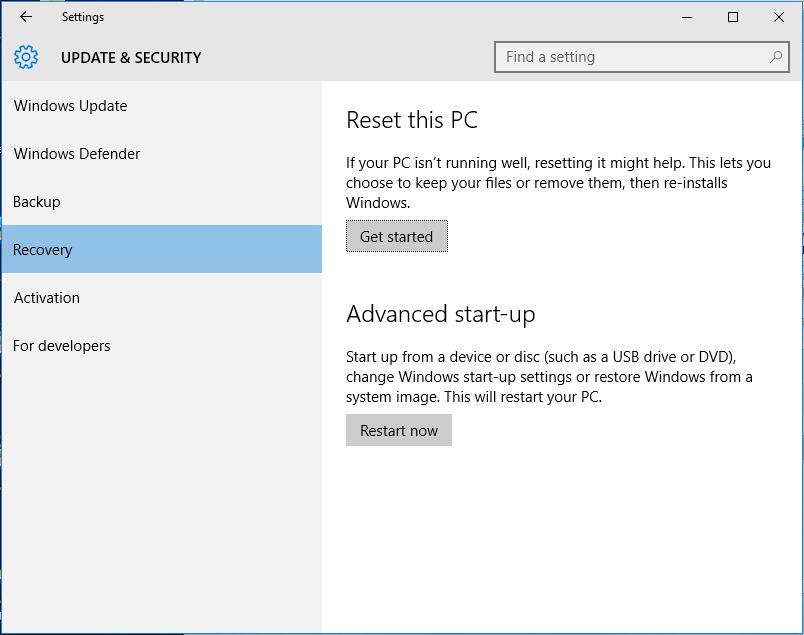
Step 2. Under UPDATE & SECURITY -> Recovery, click “Get Started”.
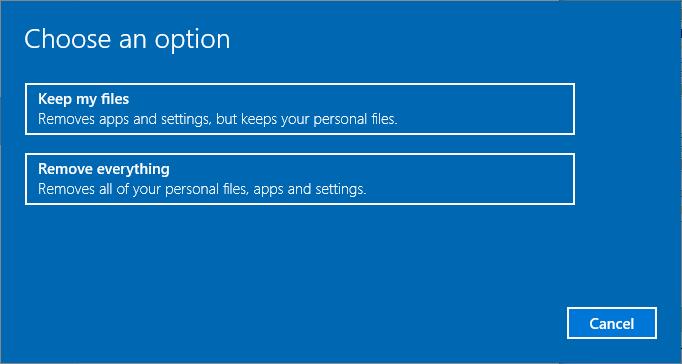
Step 3. Here you can choose how to carry out the recovery: to keep your files or to remove everything. Depending on your own needs, you should make your own decision. Then the reset process begins.
This is the end of how to restore Windows 10 from recovery partition. Rather easy right? But for Windows 8 and Windows 7, things are more complicated. You can refer to How to Factory Reset a Laptop – Windows 7 & 8 to get the detailed steps.
How to Create Windows 10 Recovery Partition
When you reinstall Windows 10 via a clean install, Windows Setup usually repartitions the disk and automatically creates a new WinRE recovery partition for you — no action needed on your part.
However, if you reset the PC locally through “Reset this PC” or reinstall without a full clean format, Windows can fail to recreate this partition, leaving you with errors like “recovery partition not found” or a disabled recovery environment.
If that happens, you’ll need to manually allocate space for a new partition and re-register it with Windows using the reagentc command. It has a few more steps than creating a regular partition, but not complicated once you know the sequence.
We’ve covered the exact commands and space requirements in a separate guide: How to Create Recovery Partition Windows 10.
Windows 10 Recovery Partition FAQ
Summary
This guide covered what a Windows 10 recovery partition actually is, whether it’s safe to delete, how to back it up first, how to recover it if you delete it by mistake, how to use it to reset Windows, and how to create one from scratch.
For nearly all of these tasks, MiniTool Partition Wizard is the safer, faster option compared to manual tools like DiskPart. If you have any questions about using this software, email us via [email protected].
About The Author

Position: Columnist
Charlotte is a technology columnist with a strong focus on the Windows operating system, specializing in disk management, backup, and data recovery. She is passionate about analyzing computer errors, identifying root causes, and delivering practical solutions. In her free time, she stays updated on the latest developments in computer systems and hardware while continuously learning new technologies to broaden her expertise. Her writing style is clear and easy to understand, making complex technical topics accessible even to users with limited computer knowledge.
User Comments :