
Do You Need to Expand PS5 Storage?
PlayStation 5 (PS5) revolutionized the gaming experience with its lightning-fast loading times, immersive 3D audio, and stunning 4K graphics.
However, most players face a common problem: insufficient storage space. This is because modern game files are incredibly large.
Modern AAA games typically exceed 100GB, and some, like Call of Duty: Black Ops Cold War, can even surpass 300GB with all content installed. Just installing a few of these games can consume all the available space on the console, both the original and the slim models.
The original PS5 and PS5 Slim simply cannot meet the demands of modern games due to the limited space (825GB). The PS5 Pro, equipped with a larger 2TB SSD, offers even more storage. But even so, it quickly fills up for avid gamers with large game libraries.
In addition, a significant portion of the storage capacity advertised by Sony is occupied by the operating system and system files, thus reducing the actual space available for gaming.
Therefore, most PS5 users eventually need to expand their console’s storage.
How to get more storage on PS5? There are mainly 2 methods: adding a built-in M.2 SSD and connecting an external USB. All PS5 models offer slots for them.
The key differences between the two methods are as shown below:
| Feature | Internal M.2 SSD | External USB Drive |
| PS5 games playback | Play directly | Requires a copy to the internal SSD |
| PS4 games playback | Play directly | Play directly |
| Performance | Same performance as the original built-in SSD | Slower than the built-in SSD |
| Installation difficulty | Moderate (requires tools) | Easy (plug-and-play) |
| Portability | No | Yes |
PS5 Storage Expansion: Add an Internal M.2 SSD
For storage expansion PS5, adding an internal M.2 SSD is the best method, which matches the console’s native performance.
By installing a compatible SSD into the PS5’s dedicated expansion slot, you can gain additional high-speed storage that works seamlessly with PS5 games, PS4 titles, and media apps.
The internal second M.2 SSD method is suitable for gamers who demand high performance, play many PS5 games, value seamless/integrated convenience, and have a larger budget.
Key Requirements
It’s important that you only use a supported M.2 SSD to expand PS5 storage, and that meets the following requirements:
- Interface: PCI-Express Gen4x4 supported M.2 NVMe SSD (Key M).
- Storage space: 250 GB – 8 TB.
- Form factor: 2230, 2242, 2260, 2280, 22110.
- Sequential Read Speed: 5,500 MB/s or faster is recommended.
- Physical Size (with heatsink): Up to 25 mm width, 30/42/60/80/ 110 mm length, and up to 11.25 mm thickness.
- Cooling: An effective heat-dissipation mechanism, such as a heatsink and a heat transfer sheet, is required to prevent thermal throttling and damage.
Recommended M.2 SSDs
Here are some high-performance options validated for PS5:
- WD_BLACK SN850X: Read speeds up to 7,300MB/s, write speeds up to 6,300MB/s, a built-in heatsink, and a wide range of capacities (1/2/4/8 TB). Officially licensed by Sony, it’s a favorite among enthusiasts for its reliability and speed.
- Samsung 990 Pro: Boasts 7,450MB/s read speeds and 6,900MB/s write speeds, with a compact heatsink designed for PS5’s tight internal space. Ideal for users needing maximum capacity.
- Seagate FireCuda 540: A budget-friendly option with 7,300MB/s read speeds and a durable heatsink. Perfect for beginners or those upgrading from the base model.
- Crucial T500: Considered to be a great price-to-performance option with high speeds up to 7,300 MB/s and a pre-installed heatsink.
Installation Process
Installing the built-in SSD is straightforward. And you just prepare a size 1 Phillips screwdriver.
Before installing or removing it, touch a grounded metal object to discharge any static electricity from your body. Otherwise, you may damage your M.2 SSD or PS5 console.
Before starting, ensure the PS5 console is completely turned off, and all cables and devices are disconnected. Wait a while for the console to cool down.
For PS5 Slim/Pro consoles (CFI-2000/7000 model group)
- Remove the triangle cover.
- Remove the screw from the expansion slot cover and then remove the cover.
- Remove the screw and spacer, and then adjust the spacer to the size of the M.2 SSD.
- Holding the edge of the M.2 SSD, align it with the notch on the expansion connector. Tilt the M.2 SSD diagonally upward, and firmly insert it all the way into the expansion connector.
- Tilt the M.2 SSD down and fasten it with the screw.
- Attach the expansion slot cover and fasten the screw.
- Install the triangle cover.
- Attach the feet, connect the AC power cord and cables, and then turn on the power.
For PS5 original consoles (CFI-1000 model group)
- Remove the base and place the console on a flat surface with the PlayStation logo facing down and the power button facing you.
- Remove the console cover by gripping the top left corner. Gently lift the cover slightly and slide it off to the right. You will hear a click when it detaches.
- Locate the expansion slot, which is a long, rectangular metal cover secured with one screw. Use a Phillips screwdriver to remove this screw and the cover.
- Remove the M.2 SSD screw and spacer from the expansion slot’s furthest hole and reposition the spacer in the hole corresponding to your SSD’s length.
- Insert the M.2 SSD by holding the edge, aligning the notch, and tilting it diagonally upward. Firmly insert it all the way into the expansion connector.
- Secure the SSD by gently tilting it down and fastening it to the spacer with the screw you removed in step 4.
- Reattach the cover of the expansion slot, fasten its screw, and then slide the main PS5 cover back into place until it clicks.
- Reconnect all cables and power on the console.
When your PS5 console turns on, the formatting guide appears. Follow the onscreen instructions and format the M.2 SSD.
Once formatted, the M.2 SSD will appear in your storage settings, and you can go to Settings > Storage > Installation Location to set the new M.2 SSD as the default download location for future games and apps.
You can also move existing games from the console storage to the M.2 SSD via the Game Library menu.
PS5 Storage Expansion: Add an External USB Drive
Adding an external USB drive to the PS5 is another method for PS5 storage expansion. This method is suitable for gamers who are budget-conscious, mainly play PS4 games, and prioritize a simple setup.
You can store PS5 games on an external USB drive, but you can’t launch them directly from there. You need to transfer them back to the PS5’s internal SSD or M.2 SSD for playing.
Even the fastest external USB drives are limited by the USB interface, and their speeds cannot match the PCIe 4.0 speeds of an internal M.2 SSD.
Key Requirements
Sony’s requirements for external storage are more lenient than for internal SSDs, but not all USB drives will work. To ensure compatibility, the following requirements should be met:
- USB Standard: Superspeed USB 5Gbps (USB 3.0/3.1/3.2) or faster. USB 2.0 drives are supported but offer sluggish transfer speeds and are not recommended for gaming.
- Capacity: 250GB (minimum) to 8TB (maximum).
- Connection: Direct connection to the PS5’s USB-A or USB-C ports. A USB hub is not supported, as they can cause connectivity issues or speed degradation.
Recommended External USB Drives
Here are some recommended external USB drives:
- Seagate Game Drive SSD: USB 3.2 Gen 2 (10Gbps) SSD with a compact, PS5-branded design. Officially licensed, it offers transfer speeds up to 2000MB/s and plug-and-play compatibility.
- Samsung T7 Shield SSD: Rugged, water/dust-resistant SSD with USB 3.2 Gen 2×2 (20Gbps) support. Transfer speeds up to 2800MB/s make it ideal for moving large game files.
- WD My Passport SSD: A budget-friendly option with USB 3.2 Gen 2 (10Gbps) and transfer speeds up to 1050MB/s. Compact and lightweight, it’s great for gamers on the go.
- Seagate Expansion HDD: The cheapest option for mass storage, but with caveats. USB 3.0 (5Gbps) transfer speeds and HDD mechanics result in slower load times, best suited for archiving unused games.
Setup and Usage Guide
Setting up an external drive is far simpler than installing an internal SSD. Here is the step-by-step guide:
Step 1. Connect the drive.
Plug the external drive into one of the PS5’s USB ports (USB-C on the front or USB-A on the back). Avoid using the front USB-A port if possible, as it’s limited to USB 2.0 on some PS5 models.
Step 2. Format the drive.
The PS5 will detect the drive and prompt you to format it as “USB Extended Storage”.
This process erases all existing data, so ensure the drive is empty or back up important files first.
Step 3. Manage storage.
Once formatted, the drive will appear in the PS5’s storage settings. You can set it as the default installation location for PS4 games, while PS5 games must be moved manually to the external drive for storage.
- To change the default installation location, go to Settings > Storage > Installation Location, and then select USB Extended Storage under PS4 games and apps.
- To move games from console to USB drive, go to Settings> Storage > Console Storage > Game and Apps, select the game(s) you want to move, select Move, and then select USB Extended Storage.
Common PS5 Storage Expansion Issues
Even if you strictly follow the steps for the PS5 storage expansion, you may still encounter problems. How to fix PS5 storage expansion issues? Here are solutions for the most common issues.
#1. M.2 SSD Not Recognized by PS5
If your PS5 is not recognizing your M.2 SSD, the issue usually stems from compatibility, improper installation, or outdated system software.
- Check compatibility: Ensure the drive meets all of Sony’s requirements (PCIe 4.0 x4, NVMe, 5,500 MB/s+ speed, heatsink).
- Reinstall the drive: Turn off the PS5, unplug it, and reinsert the SSD. Make sure it’s fully seated in the M.2 slot and secured with the screw.
- Update system software: Go to Settings > System > System Software > Update System Software to install the latest firmware.
#2. External USB Drive Not Recognizing/Formatting on PS5
If your PS5 is not recognizing or formatting an external USB drive, the problem is usually related to an incompatible file system, a loose connection, or a faulty cable.
Now, follow the steps to solve this issue.
Step 1. Check physical connection.
- Check the connection: Disconnect the USB cable. Then firmly reinsert it into both the hard drive and the console.
- Try a different cable/port: Try a different USB cable or a different USB port on the console to rule out a faulty cable or port.
- Check the hard drive power: If you are using a mechanical external hard drive that requires external power, ensure it is connected to a power source and receiving power.
Step 2. Format the external USB drive on your PC. This is helpful according to the user’s report.
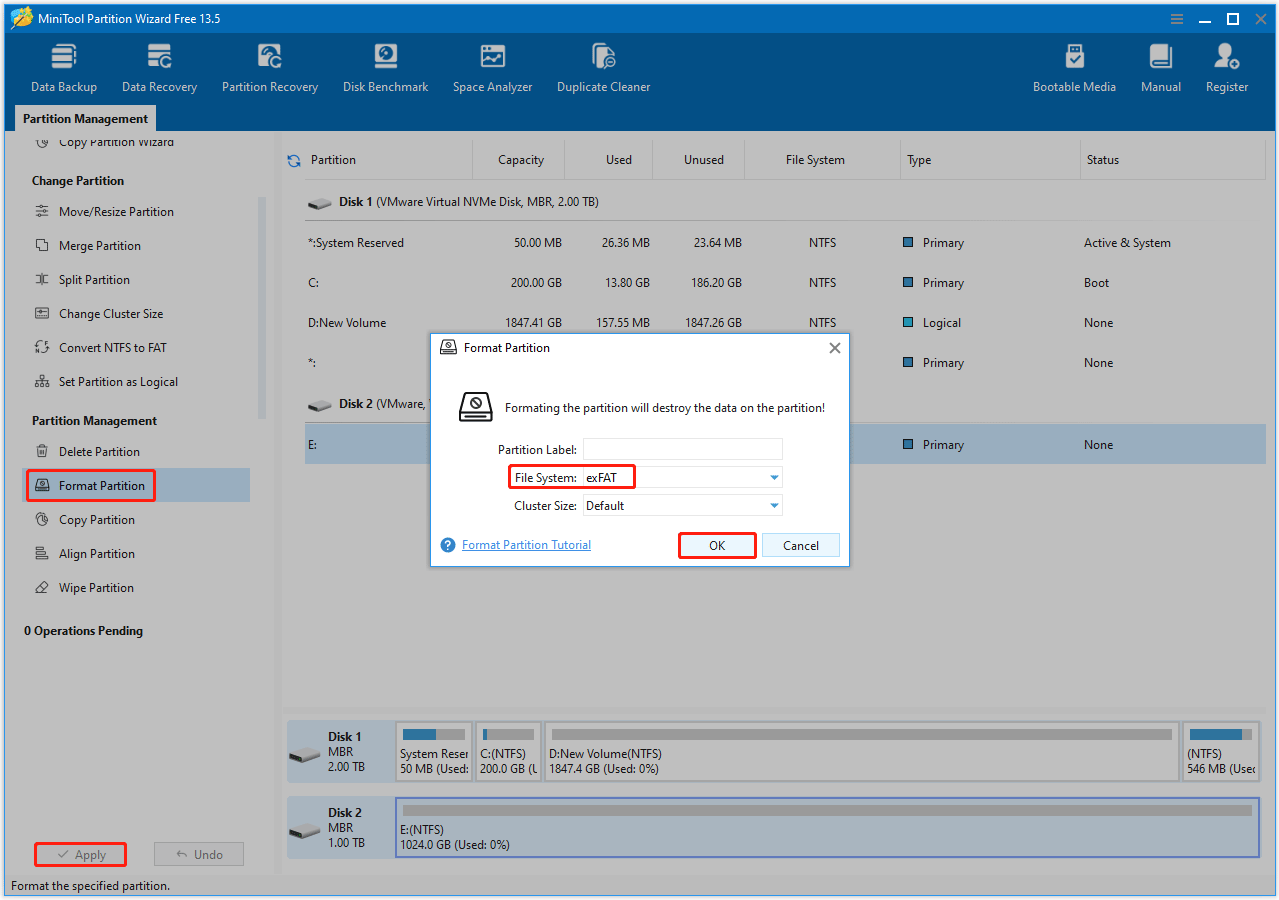
To do that, try a professional and free partition manager, MiniTool Partition Wizard. It can format drives to exFAT, FAT32, NTFS, and Ext 2/3/4.
Now, download and install this software. Then, try the following steps to format the drive.
MiniTool Partition Wizard FreeClick to Download100%Clean & Safe
- Run this software to enter its main interface, highlight the partition on the external drive.
- Choose the Format Partition feature from the left action panel.
- In the pop-up Format Partition window, set the File System to NTFS/exFAT/FAT32. Then click OK.
- Click Apply to confirm the changes.
#3. Slow Transfer Speeds
- For internal M.2 SSDs: Ensure the drive’s read speed is 5,500 MB/s+. If speeds are low, check the heatsink, because overheating causes throttling.
- For external USB drives: Use a USB 3.2 Gen 2 cable and port. Avoid using USB hubs.
Further reading: Here are some tips to manage PS5 storage efficiently:
- Prioritize games on internal/M.2 storage: Reserve your internal storage (native SSD + M.2 SSD) for the games you’re currently playing. Move finished games you haven’t played often to external storage to free up space for new releases.
- Delete unnecessary game data: Most PS5 games store temporary files, demos, and old updates that take up space. You should delete them.
- Avoid overfilling external storage: While external USB drives can hold a lot, avoid filling them. Drives perform best when they have at least 10-15% free space.
How to expand storage on PS5? This post offers 2 effective methods.Click to Tweet
PS5 Storage Expansion FAQ
While you can plug multiple drives into the console's USB ports, the system only recognizes and allows active use of one extended storage drive at a time.
If you use the external USB drive for PS5 backup, you just need to format it to exFAT, which is also supported by PCs. In this case, you can use the same external USB drive for both the PS5 and your PC.
Bottom Line
PS5 storage expansion is a critical upgrade for any gamer who doesn’t want to delete games to make room for new ones.
Whether you prioritize speed (internal M.2 SSD) or convenience (external USB drives), there’s an option that fits your needs.
If you have any questions related to MiniTool Partition Wizard, just contact us by sending an email via [email protected].
User Comments :