
In our daily work, we frequently encounter file compression. So, how does it work? What types of file compression are there, and what are their respective advantages and disadvantages?
Before introducing these topics, let’s first understand “how does file compression work?”
Understanding this will help us better appreciate the various benefits of file compression.
In fact, the core principle of file compression is to use specific algorithms to identify and remove duplicate or unnecessary parts of the data, representing the same information with fewer bits and thereby reducing file size.
This not only lowers the required storage space but also improves transmission efficiency.
What Are the Types of File Compression?
File compression is mainly divided into two types: lossless compression and lossy compression. This section explains them and their application scenarios.
#1. Lossless Compression
Lossless data compression means that the information is not destroyed after compression and can be completely restored to its original state before compression. It is suitable for data scenarios that require precise recovery, such as text files, source code, and databases.
#2. Lossy Compression
Lossy compression is a method that is the opposite of lossless compression. It reduces file size by discarding some data, and the lost details usually do not significantly affect the overall quality of the file.
It is suitable for scenarios where file size needs to be reduced, and some quality loss can be tolerated, such as the compression of audio, video, and image files.
What Does Compressing a File Do
What is the specific process of compression? Here is a simplified explanation.
1. Lossless compression operating procedures.
- Analyze file data: Before compression begins, the algorithm analyzes the data and identifies duplicate information.
- Replace redundant data: The algorithm replaces duplicate data with shorter symbols or codes.
- Create compressed file: The compressed data is packaged into a new, smaller file.
- Decompression process: During decompression, the compression software reads the encoded data in reverse order and restores the original data according to the algorithm.
2. Lossy compression operating procedures.
- Data analysis: Analyze the characteristics of the raw data to identify which information can be discarded.
- Data discarding: Remove information that has little impact on the overall perception of the file from the data.
- Encoding and compression: Encode the remaining data and create a compressed file.
- Decompression process: During the decompression process, the compression software restores the file from its compressed format to a usable form, but discarded details cannot be recovered.
Pros and Cons of File Compression
When you compress a file, you’re essentially making it smaller.
So, what are its advantages and potential disadvantages? The following content will guide you through the main benefits and drawbacks of file compression.
#1. Advantages of File Compression
- Faster transfer speeds: File compression reduces the amount of data, allowing the same content to be represented with fewer bits, thereby reducing the bandwidth and time required for transmission.
- Easier sharing: Compressed files can package multiple files or folders into a single unit, greatly improving sharing efficiency. At the same time, it facilitates unified management and archiving, reducing the risk of file loss or omission.
- Improved backup: Compressed files can package multiple files or folders into a single compressed file, simplifying the backup process.
- Save money: Compressing files can help you save money. By compressing files for storage, you can effectively reduce the need for additional storage devices, thereby reducing data storage costs.For example, if a file is reduced to half its original size after compression, there is no need to purchase an additional hard drive to store this data.
- Saves storage space: The advantage of file compression is its ability to reduce file size, thereby saving storage space.
Further Reading:
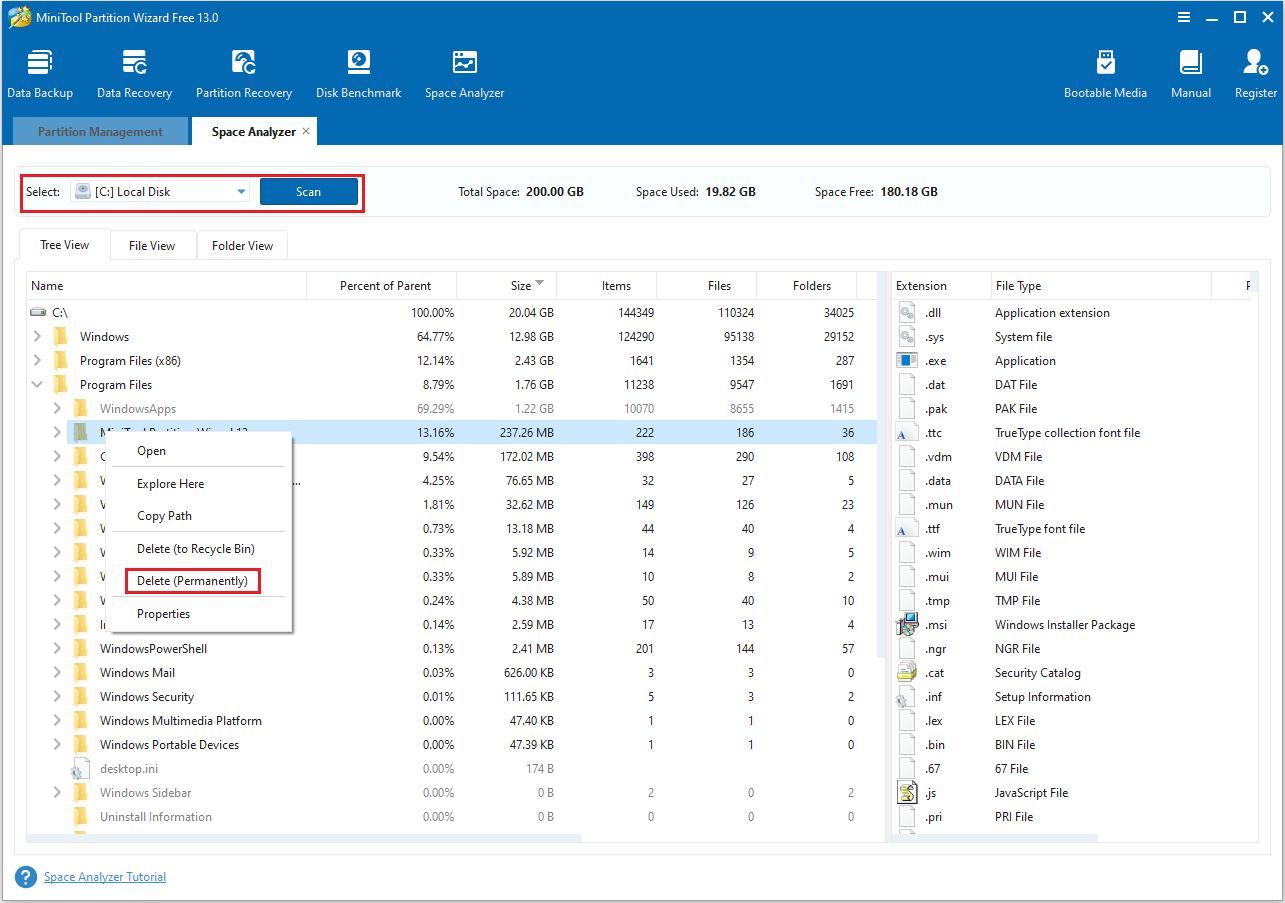
To free up disk space, a recommended method is to utilize the Space Analyzer feature of the MiniTool Partition Wizard. Here is the guide:
MiniTool Partition Wizard FreeClick to Download100%Clean & Safe
Step 1: Launch MiniTool Partition Wizard to get its main interface.
Step 2: Select the Space Analyzer feature on the top toolbar to launch the disk usage analyzer.
Step 3: Select the drive/partition and click Scan.
Step 4: After the scan, unfold the tree structure to find large or unnecessary files.
Step 5: Select the files or folders you don’t need and choose Delete (Permanently).
#2. Disadvantages of File Compression
- Processing time and resource consumption: Compressing and decompressing files consumes computational resources (CPU and memory) and time, which can be a drawback.
- Quality or data loss: Lossy compression reduces file size by deleting some data deemed less important. The original quality cannot be fully recovered, which is a problem for professional applications requiring high fidelity.
- Risk of corruption and data loss: If a large compressed file suffers a single bit corruption during transmission or storage, the entire archive or its files may become unopenable or unrecoverable.
- Compatibility and accessibility issues: To open compressed files, both the sender and receiver need compatible software that supports the specific compression format (e.g., RAR, 7z, or ZIP).
- Compressed files may contain viruses or malware: If a compressed file contains viruses or other malware, your computer may be at risk because some antivirus software cannot detect these hidden, harmful contents when compressed.
Common Compression Tools
There are many file compression tools available, such as 7-Zip, WinRAR, and WinZip, which offer rich features and higher compression efficiency.
However, for common ZIP files, most versions of Windows have built-in decompression functionality, so you can directly decompress and access the files without installing additional software.
The specific steps are as follows:
Step 1: Right-click on an archive file and then select Extract All.
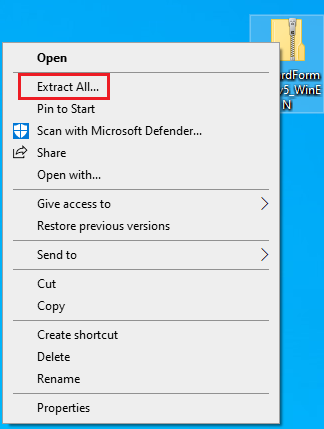
Step 2: In the new pop-up window, select a destination and click Extract.

Further Reading:
Windows 10 built-in decompression function only supports ZIP files. Other formats (such as RAR or 7z) require third-party software for decompression. If the compressed file is password-protected, the system will prompt you to enter the password before opening it.
Starting with Windows 11 version 24H2, the system natively supports direct decompression of ZIP, RAR, 7z, TAR, and other formats, but does not support operations on encrypted archive files.
If you need third-party decompression software, 7-Zip or WinRAR is recommended.
Here are the steps to use WinRAR to extract files in Windows 10.
Step 1: Right-click on an archive file and then select Extract files from the menu.

Step 2: In the Extract path and options window, click Desktop from the right and then click OK.

What Does Compressing a File Do FAQ
First, compression itself does not damage files, but files may become corrupted if the compression or decompression process is interrupted or if unreliable software is used.
Second, compression itself does not make files more vulnerable to security attacks, but weak compression algorithms, outdated formats, or insecure tools can introduce risks.
For Windows 10, which only supports the ZIP format, file decompression software may be needed. For Windows 11, which supports multiple archive formats such as ZIP, RAR, 7z, and TAR, file decompression software may be unnecessary.
1. ZIP format is widely supported and offers moderate compression ratios.
2. RAR format generally offers better compression ratios but requires specific software to open.
3. 7z format (from 7-Zip) often offers even higher compression ratios but is less common than ZIP.
4. TAR and GZ formats are primarily used in Linux environments and are suitable for compressing large datasets.
Bottom Line
This article introduces the meaning and operation process of lossy and lossless compression, further explains the advantages and disadvantages of file compression, and shows how to open compressed files.
If you have any questions or suggestions while using MiniTool Partition Wizard, you can contact us via [email protected] for further assistance.
About The Author

Position: Columnist
Cecilia has been an editor at MiniTool for two years. She primarily focuses on disk and partition-related content, with particular expertise in disk cloning, partition recovery, and PDF document conversion. She is dedicated to providing users with clear and accurate solutions to help them efficiently resolve common computer problems.
User Comments :