
You can resize a partition in Windows 11/10 by shrinking or extending it. Windows provides built-in tools such as Disk Management, DiskPart, and PowerShell, while MiniTool Partition Wizard can resize partitions in situations where Windows cannot, such as when unallocated space is not adjacent to the target partition.
Quick Answer
You can resize a partition in Windows using:
- Disk Management (best for simple resizing)
- Windows Storage Settings (Windows 11 only)
- DiskPart (simple command line tool)
- PowerShell (advanced command line tool)
- MiniTool Partition Wizard (supports moving, extending, and resizing when Windows tools fail)
What’s the difference among these tools? Here is a comparison table.
| Features | 4 Windows Built-in Tools | MiniTool Partition Wizard |
| Shrink Volume | Yes, but it might not work as expected if there are unmovable files | Yes |
| Extend Volume with Unallocated Space | Yes, but the unallocated space must be located immediately to the right of the volume | Yes, as long as the unallocated space and the volume on the same physical disk |
| Extend Volume with Another One | No | Yes, as long as the 2 volumes on the same physical disk |
| Supported File Systems | NTFS, ReFS | NTFS, FAT32, FAT |
| Data Safety | Basic | Enhanced |
How to change partition size in Windows 11/10? Follow the detailed guides below.
Resize a Partition Using Disk Management
Disk Management is the default graphical disk tool and a Windows-built-in tool. It supports basic operations like creating, deleting, formatting partitions, and simple shrinking/extending.
How to reallocate disk space using this tool? Press Win + X and select Disk Management from the menu to open it. Then, follow the guides below.
Option 1: How to Shrink a Partition (Reduce Size)
Use this option if you want to make a partition smaller.
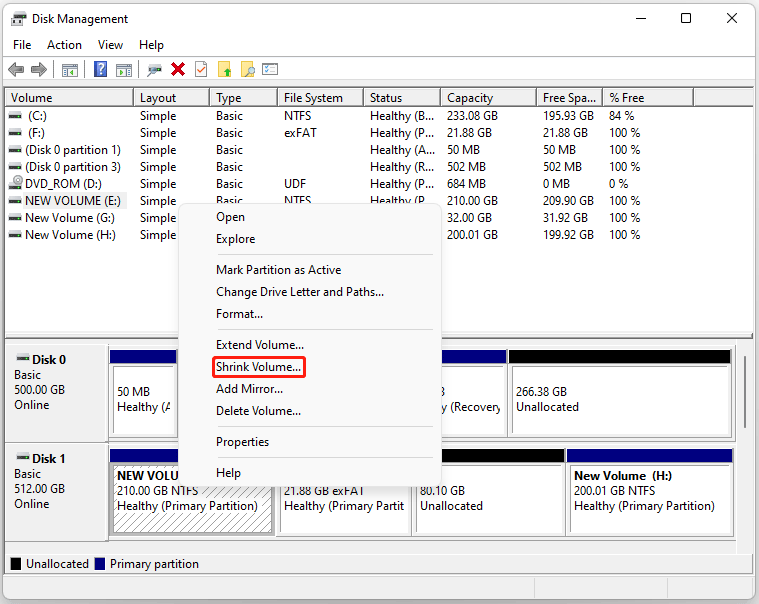
- Right-click the partition you want to shrink and click Shrink Volume.
- Windows will query the volume for available shrink space (this may take a minute).
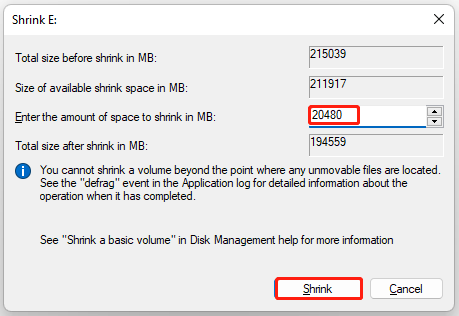
- In the box labeled “Enter the amount of space to shrink in MB”, type your desired size. For example, enter 10240 for 10 GB.
- Click the Shrink Volume button.
The freed space will now appear as black Unallocated space directly to the right of the partition.
Option 2: How to Extend a Partition (Increase Size)
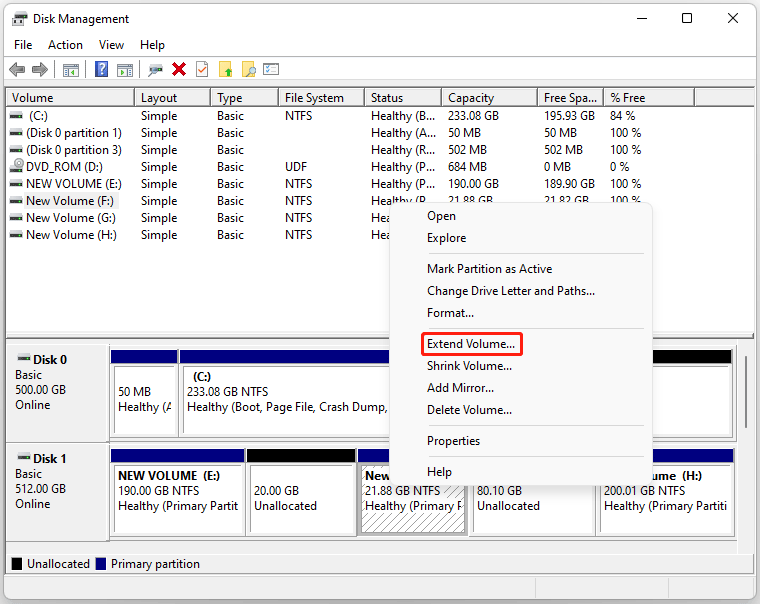
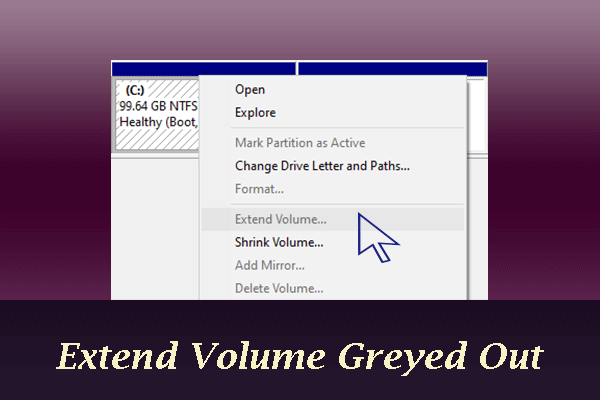
Use this option if your drive is running out of space and you want to make it larger. However, this option can only extend a partition with unallocated space immediately to its right.
- Right-click the partition you want to expand and click Extend Volume.
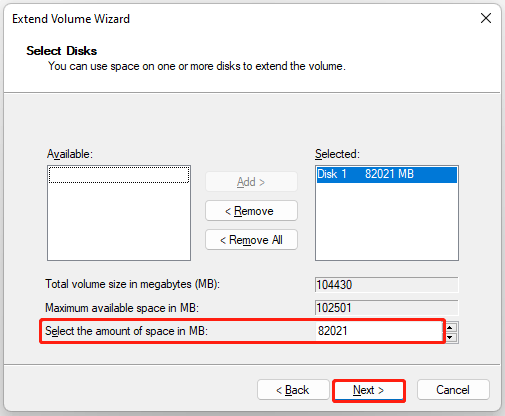
- Click Next on the welcome screen.
- The wizard automatically selects all available unallocated space. Click Next to use it all, or adjust the amount in MB if you only want to use some of it.
- Click Finish to instantly merge the space.
Here is a video guide:
Resize a Partition Using MiniTool Partition Wizard
When Disk Management fails to shrink or extend a partition, MiniTool Partition Wizard can help you complete the partition resizing job effectively.
As a free Windows partition resizer, it can:
- Extend a partition using unallocated space, regardless of intervening partitions or the location of the unallocated space.
- Extend a partition using free space from other existing partitions.
- Support shrinking or extending NTFS/FAT32 partition, EFI partition, System Reserved partition, Recovery partition, Recovery partition, and some OEM partitions.
MiniTool Partition Wizard FreeClick to Download100%Clean & Safe
Option 1. How to Shrink a Partition
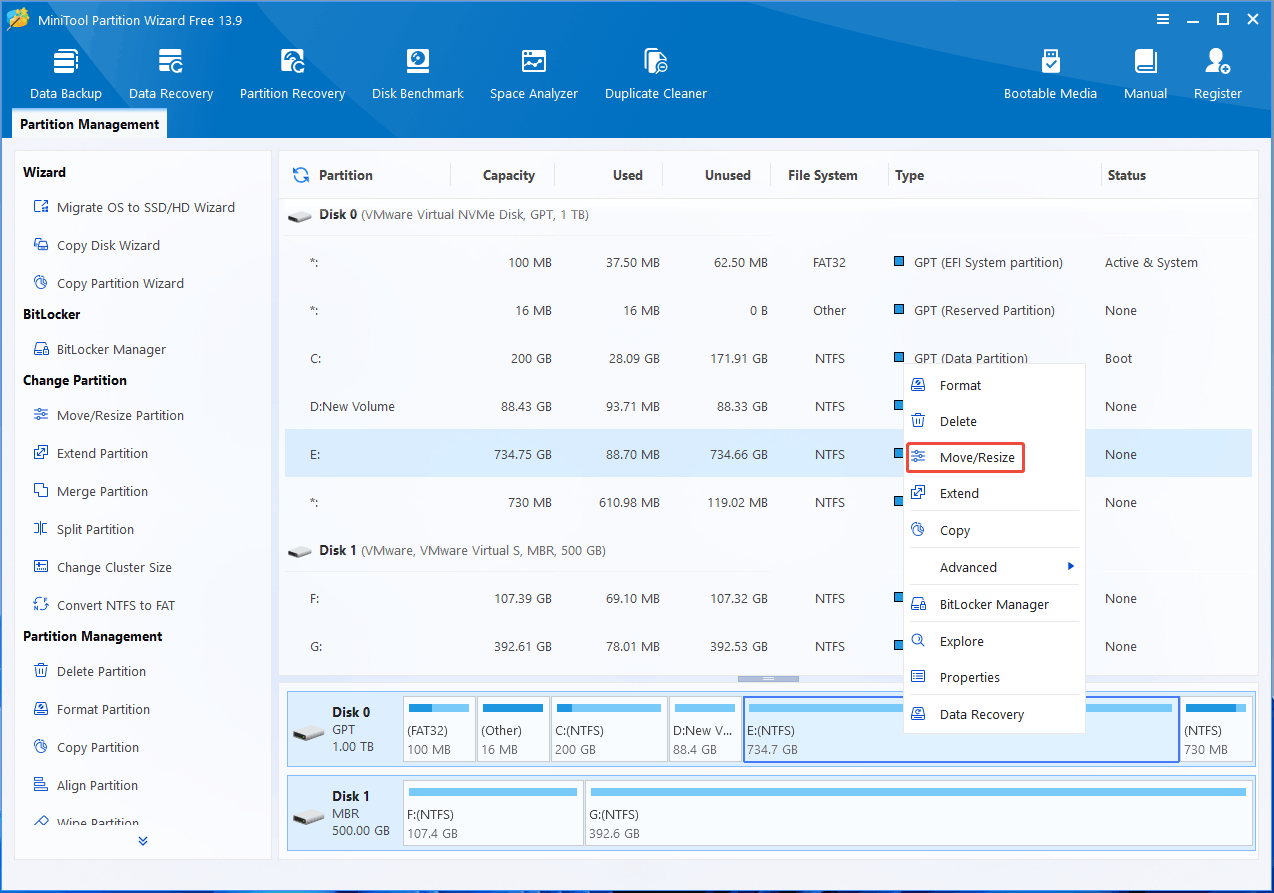
With the Move/Resize feature, you can shrink a partition easily. Here are the steps.
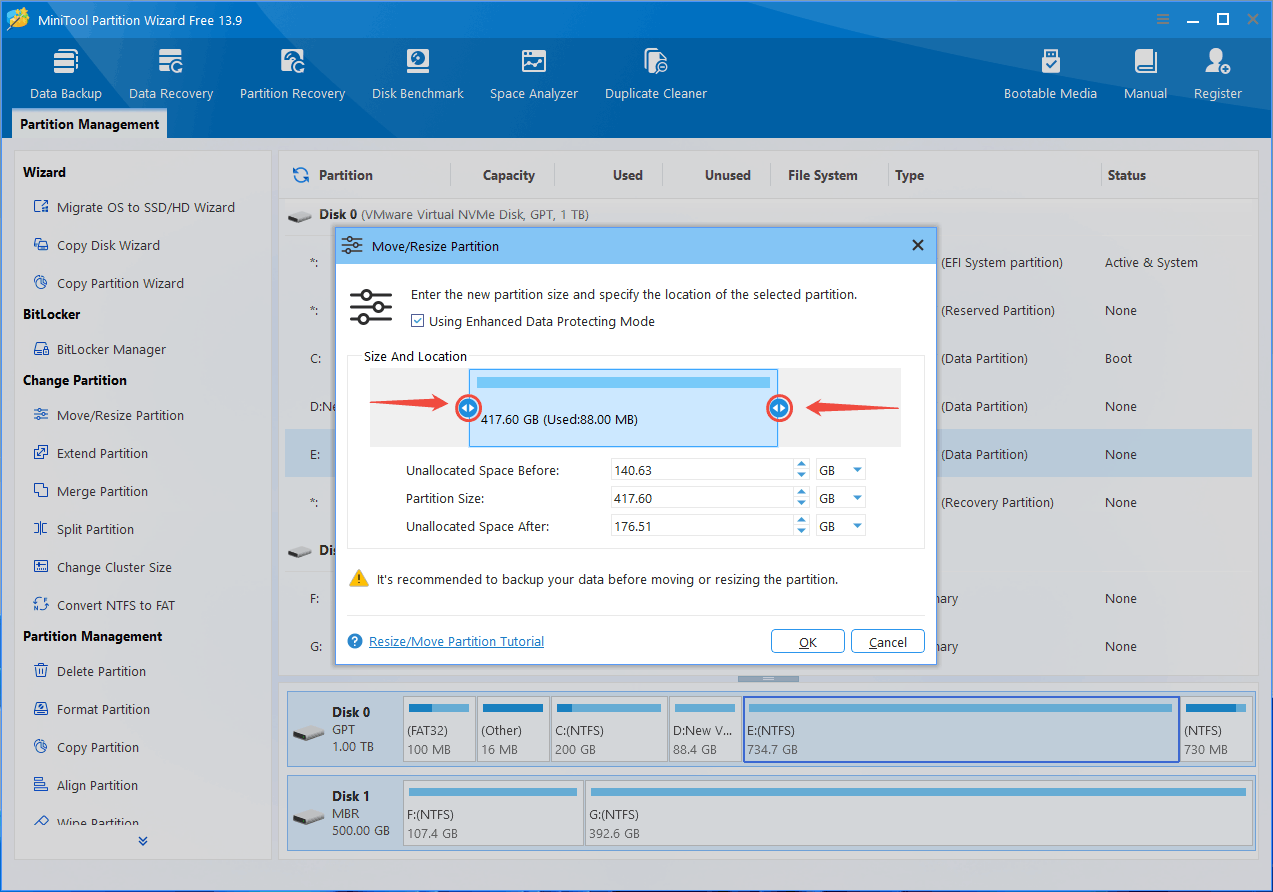
Step 1. Open MiniTool Partition Wizard. Right-click the partition you want to shrink and select Move/Resize.
Step 2. On the pop-up window, click and drag either the left or right edge of the partition handle inward toward the center to shrink the partition.
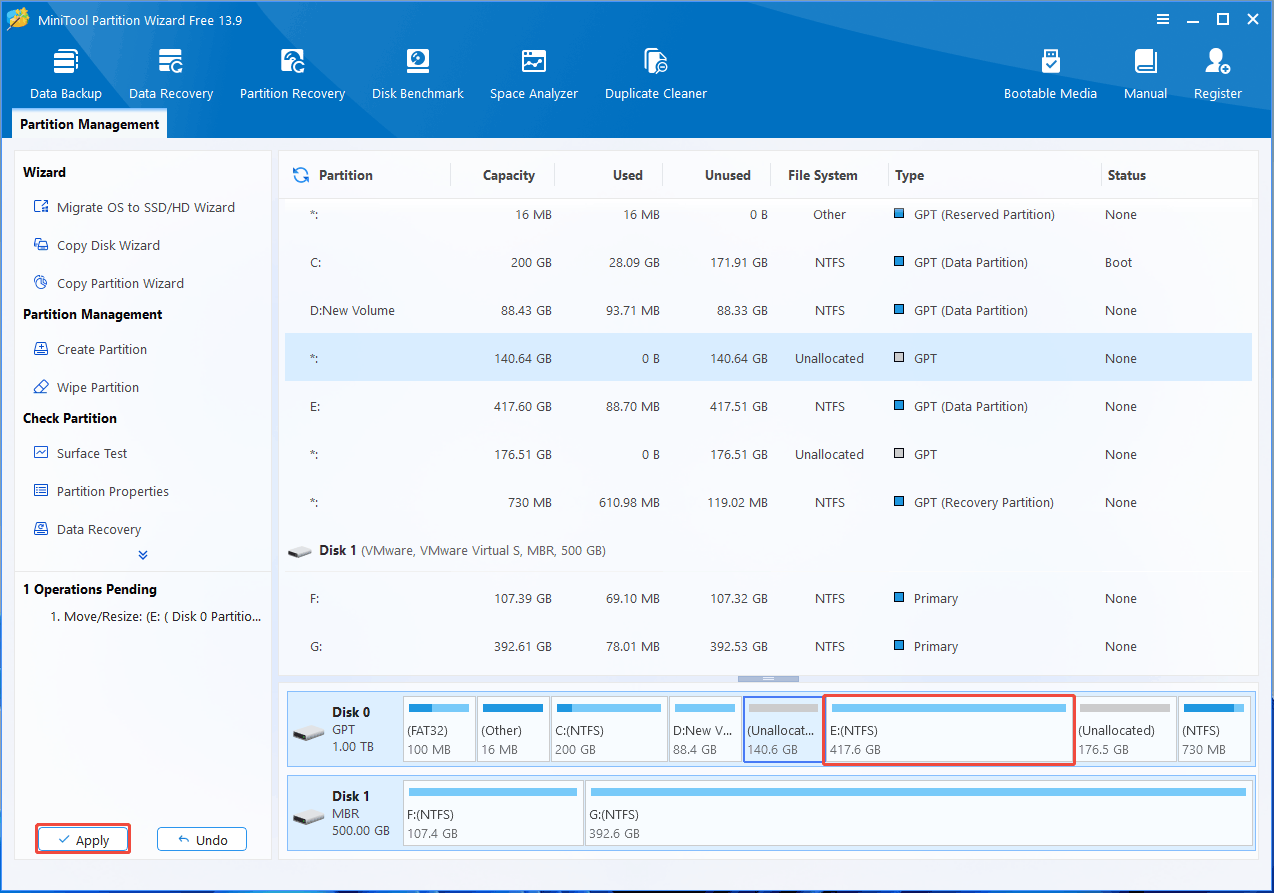
Step 3. Review disk layout and click Apply to execute the shrinking operation.
Option 2. How to Increase Partition Size
If you want to extend a partition with non-contiguous unallocated or free space in another partition, you can use the Extend Partition feature.
- Open MiniTool Partition Wizard.
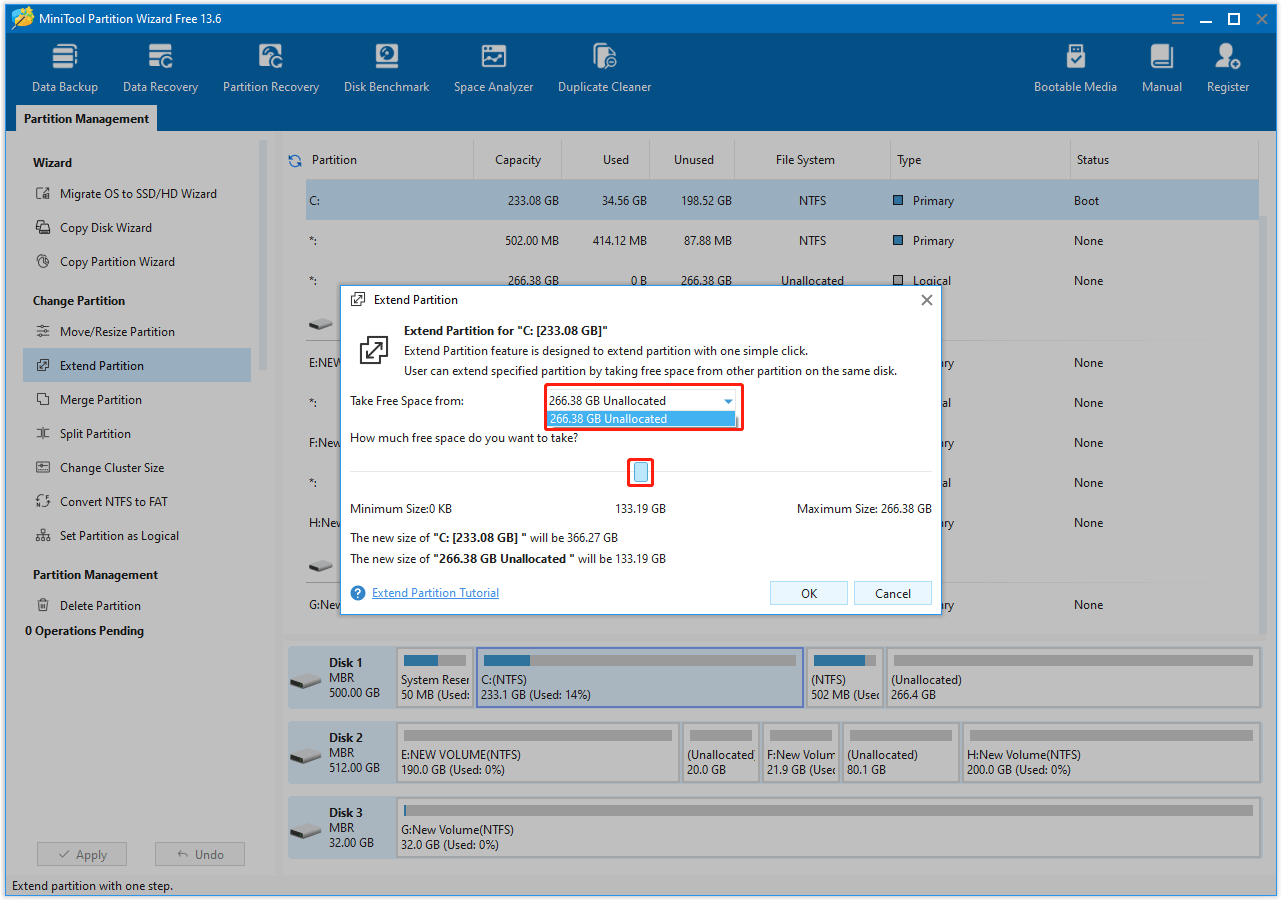
- Right-click the partition you want to expand (e.g., C:) and select Extend.
- Open the drop-down menu labeled Take Free Space from and select the drive or unallocated block you want to take space from.
- Drag the slider to choose exactly how much space to take.
- Click OK.
- Click Apply in the bottom-left corner to finish.
Resize a Partition Using Windows Storage Settings
How to change partition size in Windows Storage Settings? Follow the steps below.
- Press Win + I to open Settings.
- Go to System > Storage.
- Expand Advanced storage settings and then click Disks & volumes.
- Find the partition that you want to resize and then click the Properties button.
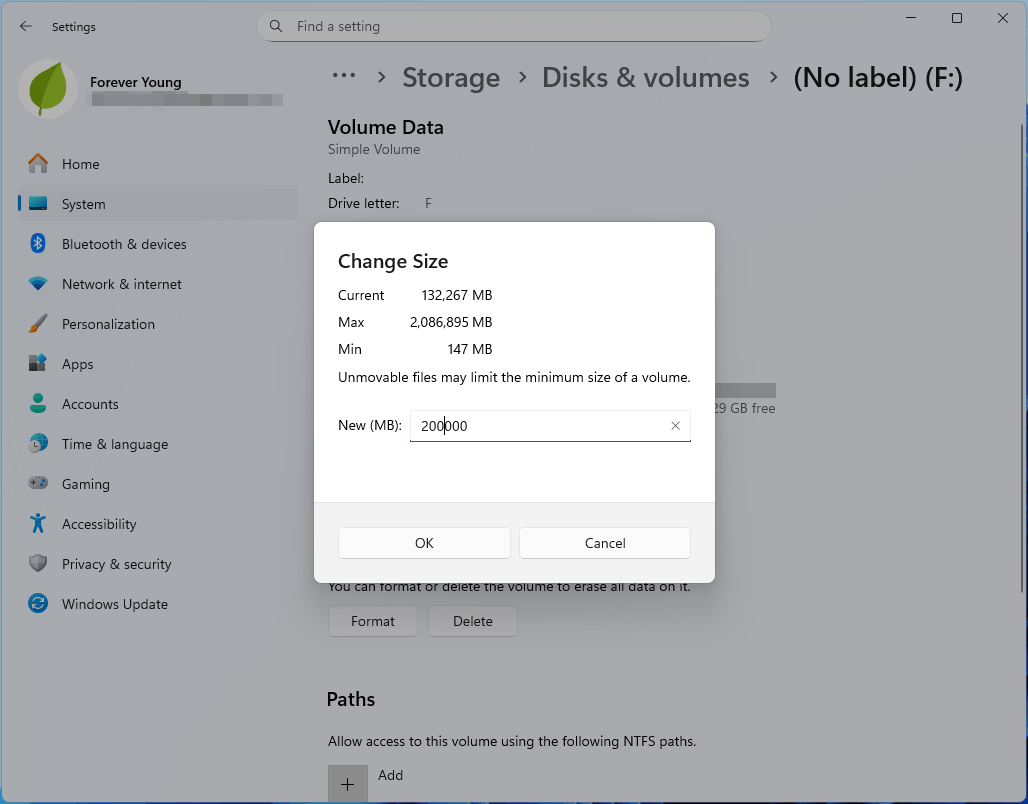
- Click the Change size button.
- On the pop-up window, type the new size of the partition in MB. A larger size means extending and a smaller size means shrinking. You can see the Max size and Min size you can enter.
- Click OK.
Resize a Partition Using DiskPart
DiskPart is an advanced text-based tool for professional disk management. Regarding partition shrinking and expansion methods, it shares the same limitations as Disk Management.
Type cmd in the Search bar, right-click Command Prompt, and select Run as administrator. Type diskpart and press Enter. Then, follow the guides below to shrink or extend a volume.
Option 1: How to Shrink a Partition (Decrease Size)
Use this to reduce a partition’s size and create unallocated space to its right.
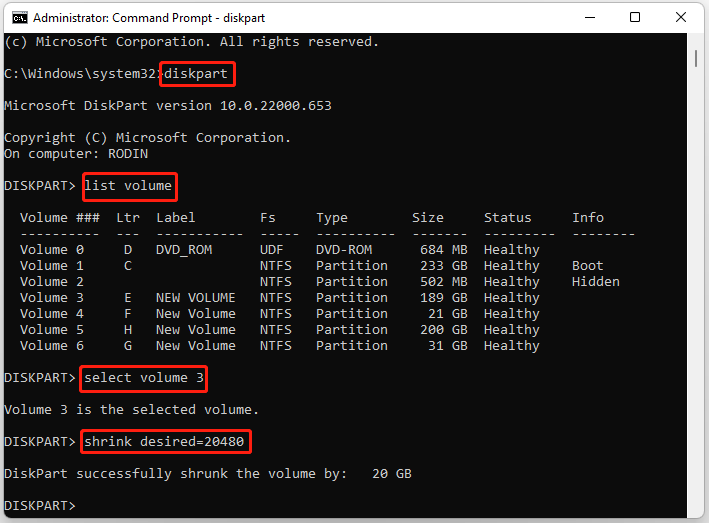
- Type list volume and press Enter to see all partitions.
- Identify the volume number you want to shrink.
- Type select volume <number> (e.g., select volume 3) and press Enter.
- Run one of these two commands:
- To shrink by a specific amount: Type shrink desired=<amount in MB> (e.g., shrink desired=20480 to shrink it by exactly 20 GB) and press Enter.
- To shrink to the maximum possible limit: Type shrink and press Enter (Windows will shrink it as much as unmovable files allow).
Option 2: How to Extend a Partition (Increase Size)
Diskpart can only extend a partition if there is unallocated space located directly to its right on the same physical disk.
- Type list volume and press Enter.
- Type select volume <number> (e.g., select volume 3) for the partition you want to expand and press Enter.
- Run one of these two commands:
- To use all available empty space: Type extend and press Enter.
- To add a specific amount of space: Type extend size=<amount in MB> (e.g., extend size=20480 to add 20 GB) and press Enter.
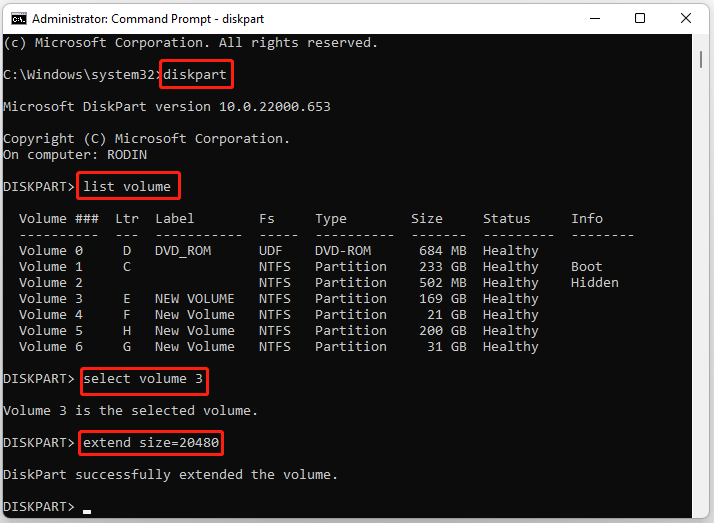
Once you see a success message, type exit and press Enter to close Diskpart.
Here are some common Diskpart errors:
- “The volume cannot be extended”: The unallocated space is either on a different disk or it is not directly to the right of your target partition.
- “The parameter is incorrect”: Double-check your numbers. Ensure you didn’t accidentally request to shrink or extend by a value larger than the available space.
Resize a Partition Using Windows PowerShell
How to reallocate disk space using Windows PowerShell? Here is the guide.
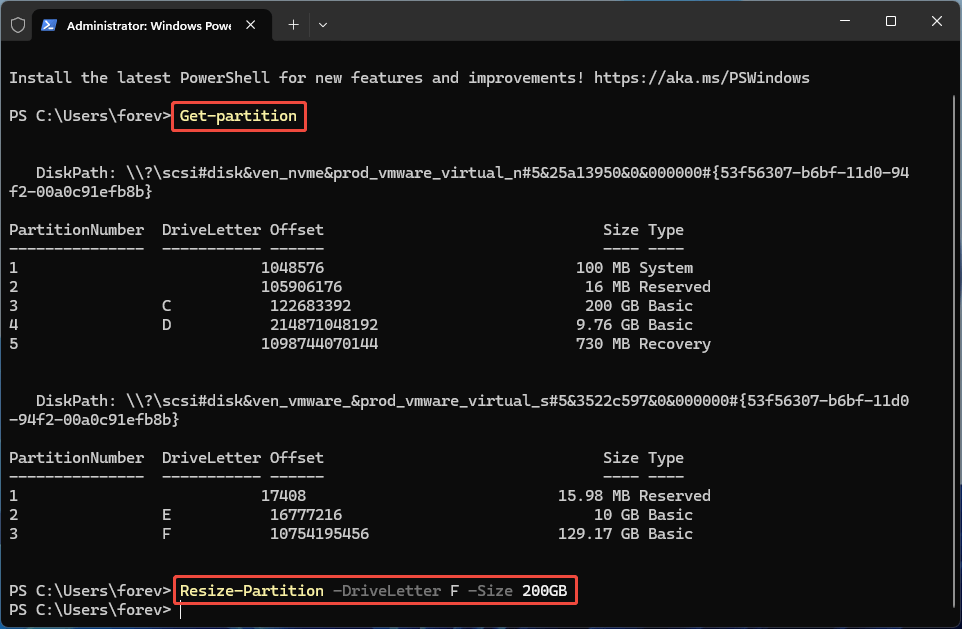
Step 1: Press the Win + X and then select Terminal (Admin) from the menu.
Step 2: Type Get-Partition and press Enter. It will list all partitions and display their details.
Step 3: Type Resize-Partition -DriveLetter * -Size # and press Enter. It will resize the * partition to the # size. A larger size means extending and a smaller size means shrinking.
Free Software to Resize Partition FAQ
Free utilities like MiniTool can seamlessly resize NTFS and FAT32 file systems without requiring data deletion.
Even if you have 500 GB of free space, if a file like the Windows virtual memory pagefile (pagefile.sys), hibernation file (hiberfil.sys), or a System Restore Point is sitting physically at the 400 GB mark of the drive, you cannot shrink the partition below 400 GB using native Windows tools.
Bottom Line
Resizing a partition is one of the easiest ways to optimize disk space and solve storage problems without reinstalling Windows. Built-in tools such as Disk Management and DiskPart can handle basic partition resizing tasks for free.
However, if you need more advanced features such as moving partitions, extending volumes without adjacent unallocated space, or managing complex disk layouts, MiniTool Partition Wizard provides a more flexible and user-friendly solution.
If you have any questions related to MiniTool Partition Wizard, just contact us by sending an email via [email protected].
About The Author

Position: Columnist
Linda has been an editor at MiniTool for seven years. She continuously learns about computers and puts her knowledge into practice. Moreover, she is particularly knowledgeable in disk management, data recovery, system installation, and PDF editing. Her articles typically reference multiple examples or are based on her own experience, providing users with the most suitable solutions.
User Comments :