
You may want to convert exFAT to NTFS for some reason. Then, you come to the right place. This post shows you how to do the conversion in 3 steps without losing data. During the conversion, File Explorer, Disk Management, DiskPart, and MiniTool Partition Wizard may be used.
Why Do You Need to Convert exFAT to NTFS?
exFAT (Extensible File Allocation Table), introduced by Microsoft in 2006, is a file system optimized for flash memory, such as USB flash drives and SD cards. In addition, it has been adopted by the SD Association as the default file system for SDXC and SDUC cards larger than 32 GB.
However, it lacks data protection features such as the file system journaling system, file permissions and encryption, etc. As a result, drives formatted as exFAT are more vulnerable to corruption and cannot take advantage of many Windows-only features.
By contrast, NTFS (New Technology File System) supports various advanced features like access control lists (ACLs), filesystem encryption, transparent compression, sparse files, file system journaling, and volume shadow copy.
Therefore, if you want improved security, stability, or full Windows functionality, converting exFAT to NTFS is necessary.
How to Convert exFAT to NTFS Without Losing Data
There is no tool that can directly convert exFAT to NTFS. The exFAT to NTFS conversion usually involves formatting. If you want to convert exFAT to NTFS without losing data, follow the steps below.
Step 1. Transfer Data to Another Drive
The first step is to transfer data to another drive (both internal and external drives are OK), which aims to protect the data. To transfer data, the best method is Copy and Paste. Here is the guide:
- Press the Windows logo key + X and then select File Explorer to open it.
- Open the exFAT partition under This PC.
- Press Ctrl + A to select all files in this partition and then press Ctrl + C to copy them.
- Open another partition and then press Ctrl + V to paste them.
- After the copying process is completed, confirm that all files are intact.
Step 2. Format exFAT to NTFS
After transferring or backing up the data, you can then format the exFAT partition to NTFS. How to change exFAT to NTFS? Here are 4 options for you.
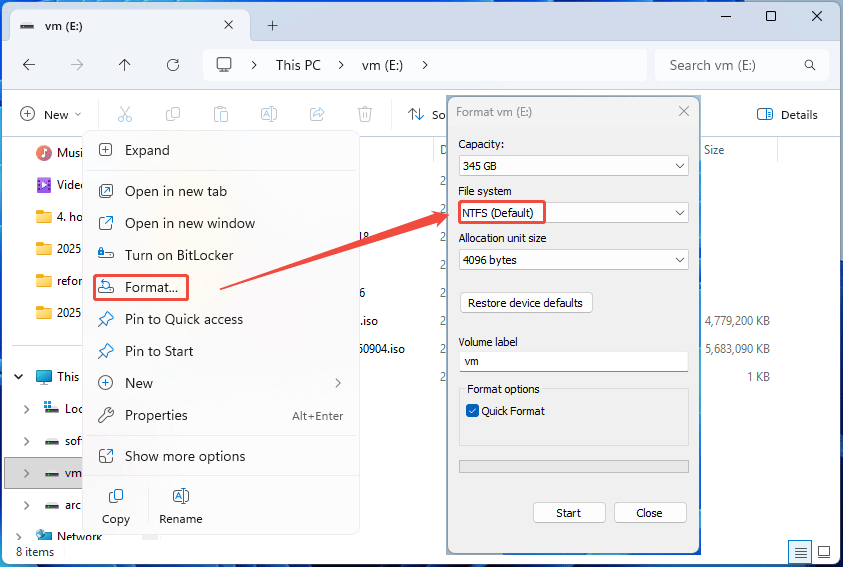
Option 1. Use File Explorer
This option is recommended because of its simple steps.
- Open File Explorer.
- Right-click the exFAT partition under This PC and then choose Format.
- On the pop-up window, make sure the File system is NTFS, and then click Start to format the drive.
- Click OK to confirm the operation.
Option 2. Use Disk Management
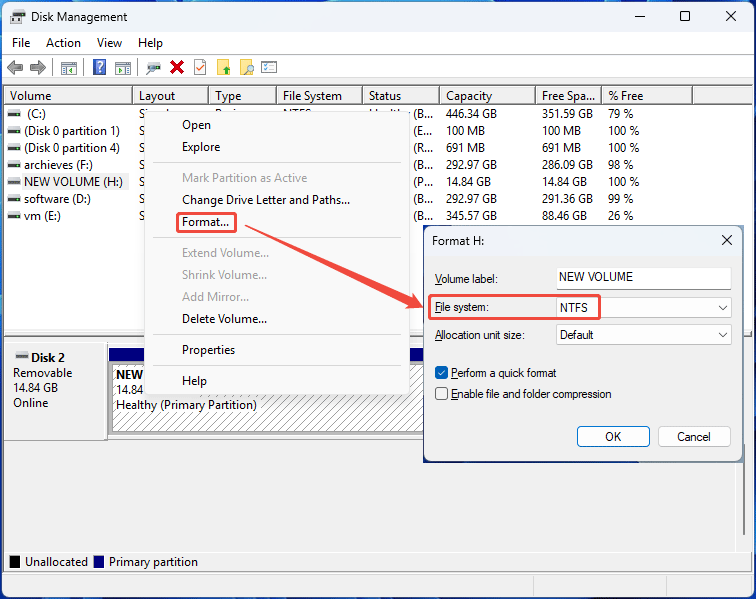
Disk Management is a GUI tool built into Windows to manage disks and partitions. Its partition formatting process is as follows:
- Press the Windows logo key + X and then select Disk Management to open it.
- Right-click the exFAT partition and then choose Format.
- Change the File system to NTFS and then click OK.
- Click OK again to confirm the operation.
Option 3. Use DiskPart
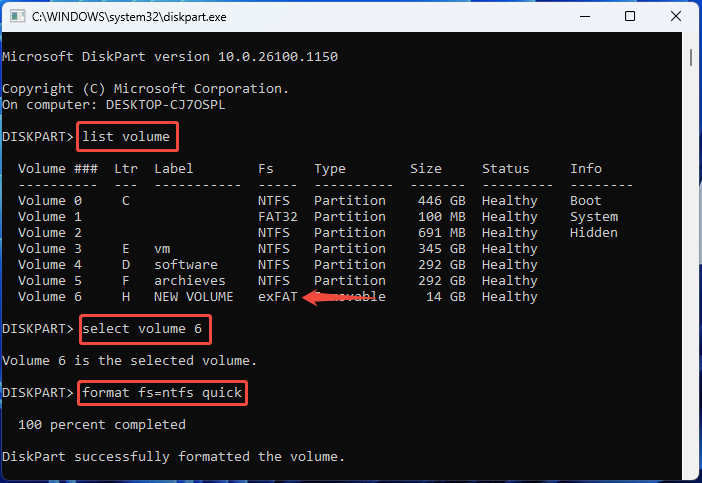
DiskPart is a command-line tool built into Windows to manage disks and partitions. Here is how to change exFAT to NTFS via DiskPart commands.
- Press the Windows logo key + R to open Run.
- Type “diskpart” and press Enter to open it.
- In the DiskPart window, type “list volume” and press Enter.
- Type “select volume *” and press Enter. * is the volume number of the exFAT partition.
- Type “format fs=ntfs quick” and press Enter.
Option 4. Use MiniTool Partition Wizard
MiniTool Partition Wizard is a professional disk and partition management tool. It can create/format/delete partitions, move/resize/extend partitions, split/merge partitions, recover lost partitions, etc.
Here is how to change exFAT to NTFS via this software.
MiniTool Partition Wizard FreeClick to Download100%Clean & Safe
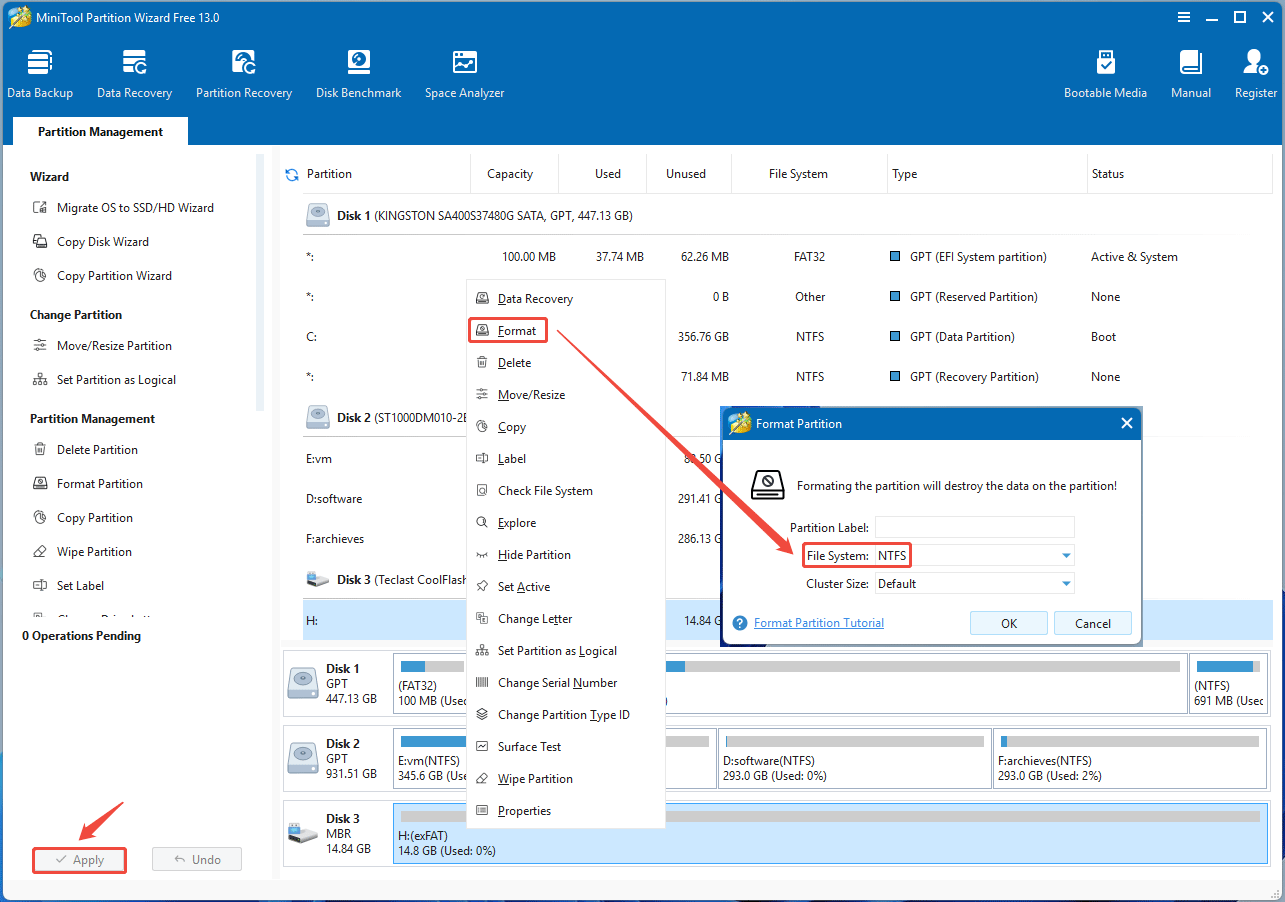
- Download and install MiniTool Partition Wizard. Then, launch this software.
- Right-click the exFAT partition and choose Format.
- Change the File System to NTFS and then click OK.
- Click the Apply button to start the formatting process.
- Click Yes to confirm the operation.
Step 3. Transfer Data Back to the Drive
After changing exFAT to NTFS, you can then move the data back to the NTFS partition by the Copy and Paste method.
Further Reading:
#1. What to do if you just want to convert a portion of the exFAT partition to NTFS?
As an exFAT partition can’t be shrunk, the suitable approach should be as follows:
- Transfer the data to another drive.
- Delete the partition to get unallocated space.
- Use the unallocated space to create two partitions. One is formatted as exFAT and the other as NTFS.
- Move the data back to the desired partition.
#2. How to Convert NTFS to exFAT?
exFAT has wide compatibility because it can work with Windows, macOS, and modern Linux systems natively. Then, you may want to convert NTFS to exFAT.
The process to convert NTFS to exFAT is the same as the process to convert exFAT to NTFS. However, if you just want to convert a portion of the NTFS partition to exFAT, the process will be different because the NTFS partition supports the shrink feature. The steps should be as follows:
- Shrink the NTFS partition to get unallocated space.
- Use the unallocated space to create an exFAT partition.
Bottom Line
This post explains why you need to convert exFAT to NTFS and shows you how to do that without losing data in 3 steps: transfer or back up data, reformat exFAT to NTFS, and move data back. It also offers 4 options for you to format the exFAT partition to NTFS. Pick one at your will.
In the last section, this post also tells you how to convert a portion of an exFAT partition to NTFS and touches upon how to convert NTFS to exFAT.
With MiniTool Partition Wizard, you can do the conversion more easily. If you encounter issues when using this software, contact us via [email protected] for assistance.
About The Author

Position: Columnist
Linda has been an editor at MiniTool for seven years. She continuously learns about computers and puts her knowledge into practice. Moreover, she is particularly knowledgeable in disk management, data recovery, system installation, and PDF editing. Her articles typically reference multiple examples or are based on her own experience, providing users with the most suitable solutions.
User Comments :