
What Is a Factory Reset?
A factory reset, also known as a “hard reset”, refers to the process of restoring a device to its original factory state.
Factory resets are a common feature found in a wide variety of devices, including mobile phones, computers, tablets, and game consoles.
Although the specific procedures may vary across different devices, the underlying principle remains consistent: clearing user data and restoring the system to its default settings.
This article will focus specifically on computers, detailing exactly what data is deleted during a factory reset and what content may potentially be retained.
Why Is a Factory Reset Necessary?
Performing a factory reset is not a random action. It serves a variety of important purposes. The following are some common reasons:
- Preparing to donate or sell the device: When planning to donate or sell a device, a factory reset will completely wipe all personal data, account information, and other sensitive details.
- Resolving persistent software issues: When standard troubleshooting methods fail to fix recurring system crashes, lag, or malfunctions, a factory reset is often the last resort.
- Restoring device performance: Over time, devices may slow down due to an accumulation of cache files and cluttered data. A factory reset clears away this excess data.
- Eliminating malware or viruses: If a device becomes infected with stubborn viruses or malicious software, a factory reset can purge the compromised data.
- Resolving update errors: Occasionally, system updates may cause compatibility issues. Resetting the device allows the new system to run more stably in a clean environment.
Does Factory Reset Delete Everything
Does a factory reset delete everything? It depends primarily on the specific reset method you use.
Generally speaking, computer factory resets can be categorized into two main types:
#1. Windows built-in reset feature
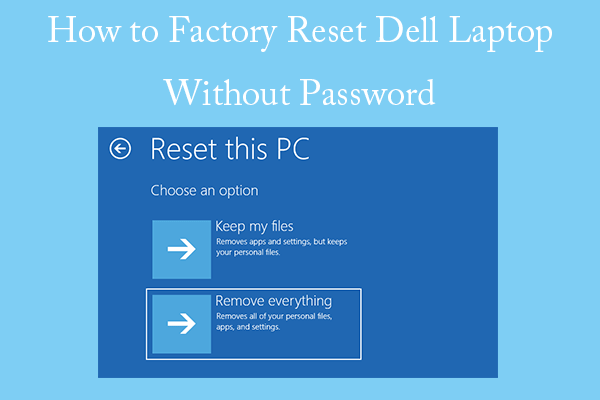
The Windows operating system provides a built-in reset function that allows you to choose between Keep my files or Remove everything, depending on your needs.
#2. Manufacturer-specific one-key recovery
Many brand-name computers (such as Lenovo, ASUS, Dell, HP, etc.) come pre-installed with a proprietary one-key recovery tool.
For instance, HP computers typically require you to repeatedly press the F11 key during startup, while ASUS computers require pressing the F9 key, among others.
By utilizing this tool, you can quickly restore your computer to its original factory state.
Below is a table illustrating the specific differences among the three.
| What will be deleted | What will be kept | Recommended scenario | |
| Keep my files in Windows reset | Apps, settings, and files in the Recycle Bin | Personal files in user folders | When the system has issues, but you don’t want to lose personal files |
| Remove everything in Windows reset | Apps, settings, and personal files | Windows operating system | When preparing to sell, transfer, or completely clean the computer |
| Manufacturer-specific one-key recovery | Apps installed by users, settings, personal files, and user partitions | Original operating system and Apps pre-installed by manufacturers | Quickly delete all personal files and restore the computer to its original factory state. |
- The Remove everything option in a Windows reset not only deletes the software you have installed but also removes software pre-installed by the manufacturer (such as HP Support Assistant). It retains the features built into the operating system itself.
- The Remove everything option in Windows Reset allows you to determine whether to Clean data (perform a full format) or just remove your files, and Delete files from all drives or only from the Windows drive.
- User partitions: When utilizing the one-key recovery feature provided by the manufacturer, the system typically erases any user-created partitions and restores the hard drive to its default factory partition layout. In contrast, the Windows Reset this PC function typically only reinstalls the operating system and does not alter the current disk partitioning structure.
Steps to Perform Before Factory Reset
A PC reset typically involves reinstalling the operating system, which will overwrite data. Therefore, recovering data after resetting a computer is often quite difficult.
To protect personal files and other important data, it is essential to back up your data before performing a factory reset.
To back up your computer, you can use a free PC backup software called MiniTool ShadowMaker, which covers all essential needs.
It offers features such as system backup, disk and partition backup, file backup, file synchronization, and disk cloning.
Download and install MiniTool ShadowMaker by clicking the following button.
MiniTool ShadowMaker TrialClick to Download100%Clean & Safe
Step 1: Launch MiniTool ShadowMaker to its interface and click the Backup tab.
Step 2: By default, the tool backs up the system. To backup data, click SOURCE > Folders and Files. Then go to Computer, click the files or folders you want to back up, and click OK.
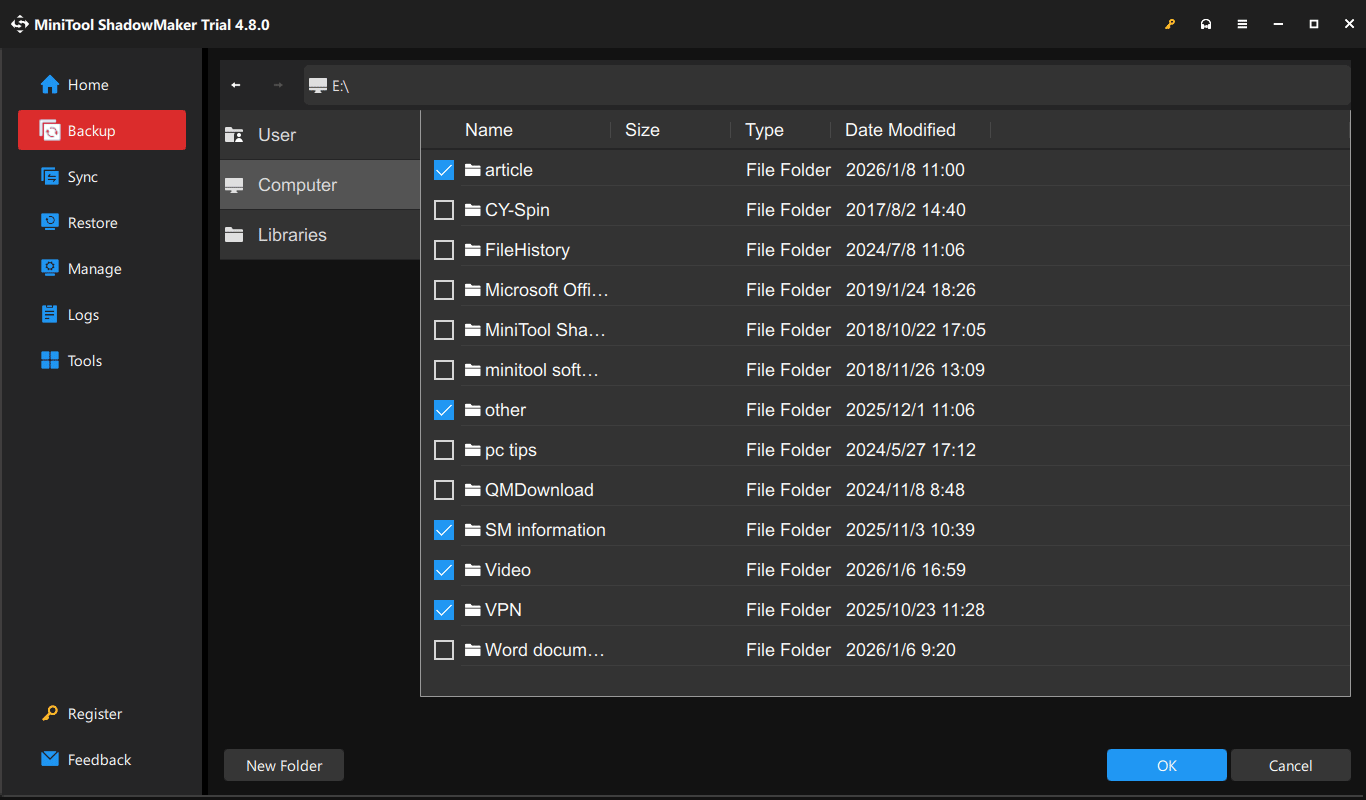
Step 3: You need to click the DESTINATION section to select the destination path. It’s recommended to back up files to external hard drives and USB drives. Then, click OK.
Step 4: After selecting the backup source and destination, click on Back Up Now to start the process at once.
Well, from the above introduction, you can see that MiniTool ShadowMaker is very easy and convenient to back up files to external hard drives or USB drives.
Does Factory Reset Delete Everything FAQ
For most computers, the entire factory reset process typically takes between 30 minutes and one hour to complete. If you choose the Remove everything option, the process may take longer.
It is important to note that if you wish to clear data from external storage or the cloud as well, you must manually delete it or use other tools to securely erase it.
This means that if you have previously updated the system version or installed the latest patches, you may need to redownload and reinstall these updates after the reset.
At this point, you will need to reinstall all necessary software and applications to ensure the device functions properly. Any important files you previously backed up should also be restored to the device.
By restoring the device to its factory settings, user data and settings are cleared. This returns the system to its initial state, effectively restoring the computer’s stability and performance.
Bottom Line
Does a factory reset delete everything? Overall, performing a factory reset deletes most user data, installed software, and system settings, restoring the device to its initial state. Specifically, what data gets deleted depends on the reset method you choose.
If you have any questions or feedback about MiniTool ShadowMaker, feel free to contact our support team at [email protected] for additional help.
User Comments :