
Why Do You Need to Transfer Data from One Internal Hard Drive to Another
Let’s take a look at the situations in which you typically need to transfer data from one internal hard drive to another.
- Upgrade to a larger hard drive: If your current hard drive is running out of space, migrating your data to a larger hard drive can expand storage, allowing you to store more files, applications, and games.
- Improve system performance: Upgrading from an HDD to an SSD can significantly reduce boot time and improve system responsiveness.
- Replace a damaged hard drive: Hard drives may fail due to age, mechanical issues, or bad sectors. Migrating your data to a new, healthy hard drive can help prevent data loss.
- Data backup: Data is protected by migrating it to a new hard drive in case the original hard drive is damaged or malfunctions.
How to Pick a Cloning Method
How to safely and completely migrate existing data is a primary concern for many users.
Is it possible to transfer everything from one hard drive to another hard drive that has files on it?https://www.reddit.com/r/techsupport/comments/135wlo2/is_it_possible_to_transfer_everything_on_one_hard/
Therefore, picking a suitable data transferring method is crucial. Then, the following 3 data migration methods are introduced, telling you their principles and when to use them.
#1. Copy and Paste
Copy and paste is a simple and efficient method when you only need to transfer personal data rather than your entire system.
Therefore, this method is usually used in the following cases:
- Move files from one partition to another (the two partitions can be located on different internal disks).
- Move files from an internal hard drive to an external hard drive. You may do this when reinstalling the OS or upgrading the system disk. Once the OS reinstallation or disk upgrade is done, move the files back to the internal hard drive.
The steps are as follows:
Step 1: Click the File Explorer icon and open it.
Step 2: Browse to the files or folders that you want to transfer. Then select them.
Step 3: Use the keyboard shortcut Ctrl + C (copy).
Step 4: Go to the target location and press Ctrl + V (paste).
Step 5: After confirming that the copied files are complete and correct, delete the original files.
#2. Cloud Storage
This method refers to temporarily uploading files to the cloud (such as Google Drive, OneDrive, or iCloud) via the internet, and then downloading them from the cloud to another hard drive.
It does not require both hard drives to be connected at the same time, nor does it rely on special data migration devices.
This method is suitable for transferring personal files, such as documents, photos, or videos, rather than system or program files.
In addition, it is generally recommended to keep the transferred file size within a few dozen gigabytes, because:
- For many individual users, the available cloud storage is limited, usually around 15GB.
- Uploading and downloading data takes time. If the file size is too large, a long time will be spent.
Take Google Drive as an example, and follow these steps:
Step 1: Log in to Google Drive on the computer and upload the files from the old hard drive to the cloud.
Step 2: After the upload is complete, replace the hard drive and reinstall the OS if needed.
Step 3: Log in to Google Drive again and then download the files to the new hard drive.
Step 4: When the transfer is complete, check the file integrity. Once verified, you may delete the file copies from the cloud.
#3. Disk Cloning
Disk cloning is a method of fully copying the contents of one hard drive to another, including the operating system, installed software, games, personal files, and more.
The cloned hard drive contains the same data as the original one and can be booted and used directly, making it especially suitable for migrating system disks.
How to Install the New Drive in the PC
No matter which method you choose, you need to install the new hard drive in your PC. Then, you can refer to the following steps:
- Shut down the computer and unplug the power cord.
- Open the computer case or laptop back cover.
- Locate the hard drive slot and insert the hard drive into the tray.
- Reinstall the side panel or laptop back cover and tighten the screws.
- Plug in the power cord and boot into the operating system.
How to Transfer Data from One Internal Hard Drive to Another via Disk Cloning
If you want to migrate your entire system (including the operating system and applications) to a new hard drive without reinstalling the system and applications, disk cloning is the most effective solution.
To do disk cloning, you should make sure the disk to be cloned and the destination disk are both connected to the computer. Then, you need to consider the following 2 scenarios:
- The computer has only one hard drive slot, which is typically found on laptops. In this case, you need to use a SATA or NVMe to USB adapter cable to connect the target disk to the PC.
- The computer has a spare hard drive slot. Then, you can directly install the hard drive into the computer.
Which disk cloning software should you use? You can consider MiniTool Partition Wizard, a good disk partitioning software. Its Copy Disk function can help you clone an entire hard drive, including the operating system, partitions, and data.
In addition, this tool can also help you copy partitions, migrate OS to HD or SSD, create/resize/delete/extend partitions, recover data from hard drive, and more.
Here are the Steps:
MiniTool Partition Wizard DemoClick to Download100%Clean & Safe
Step 1: Launch MiniTool Partition Wizard to its interface.
Step 2: Right-click the hard drive that you want to clone and then select Copy.
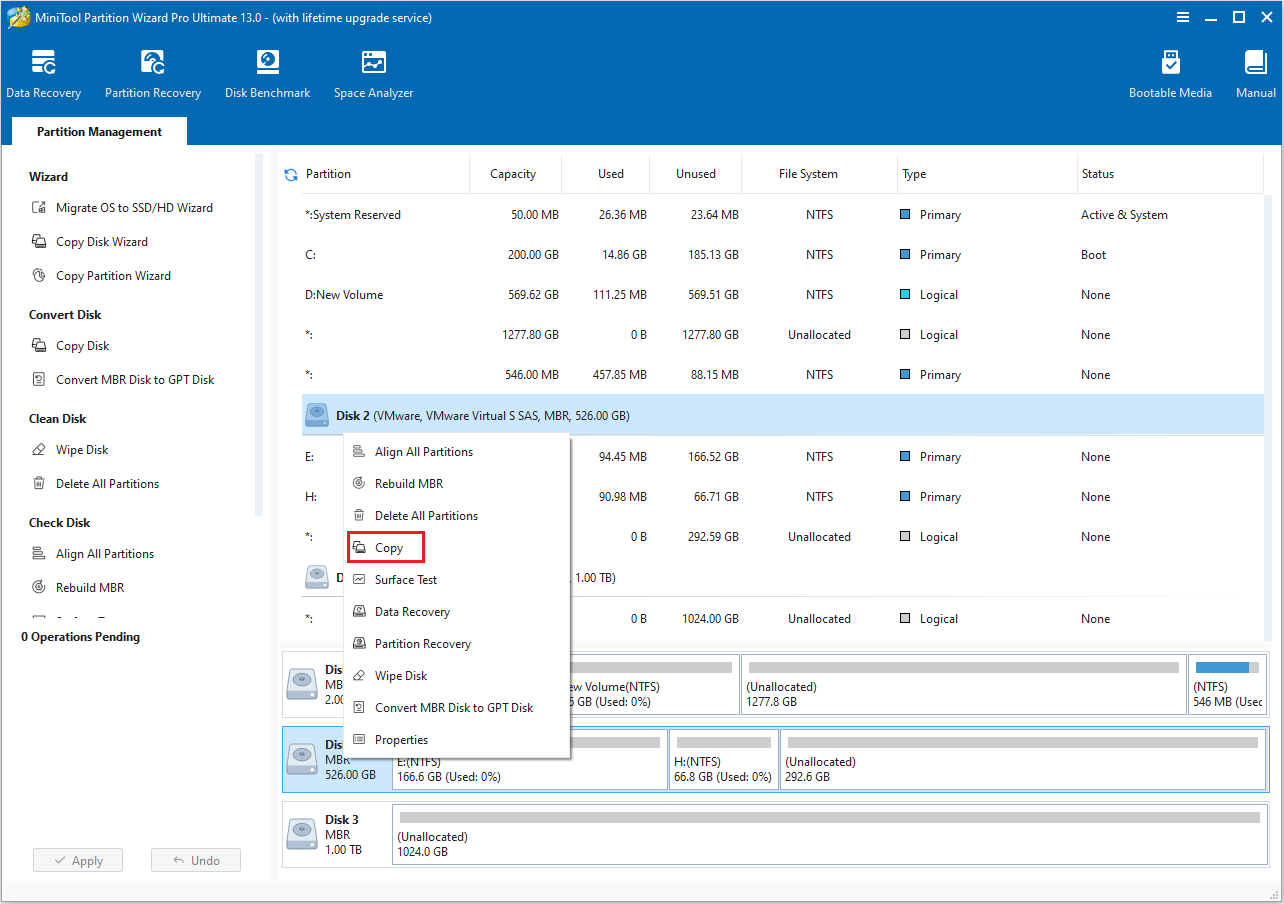
Step 3: Choose the new internal hard drive as the destination drive, then click Next.
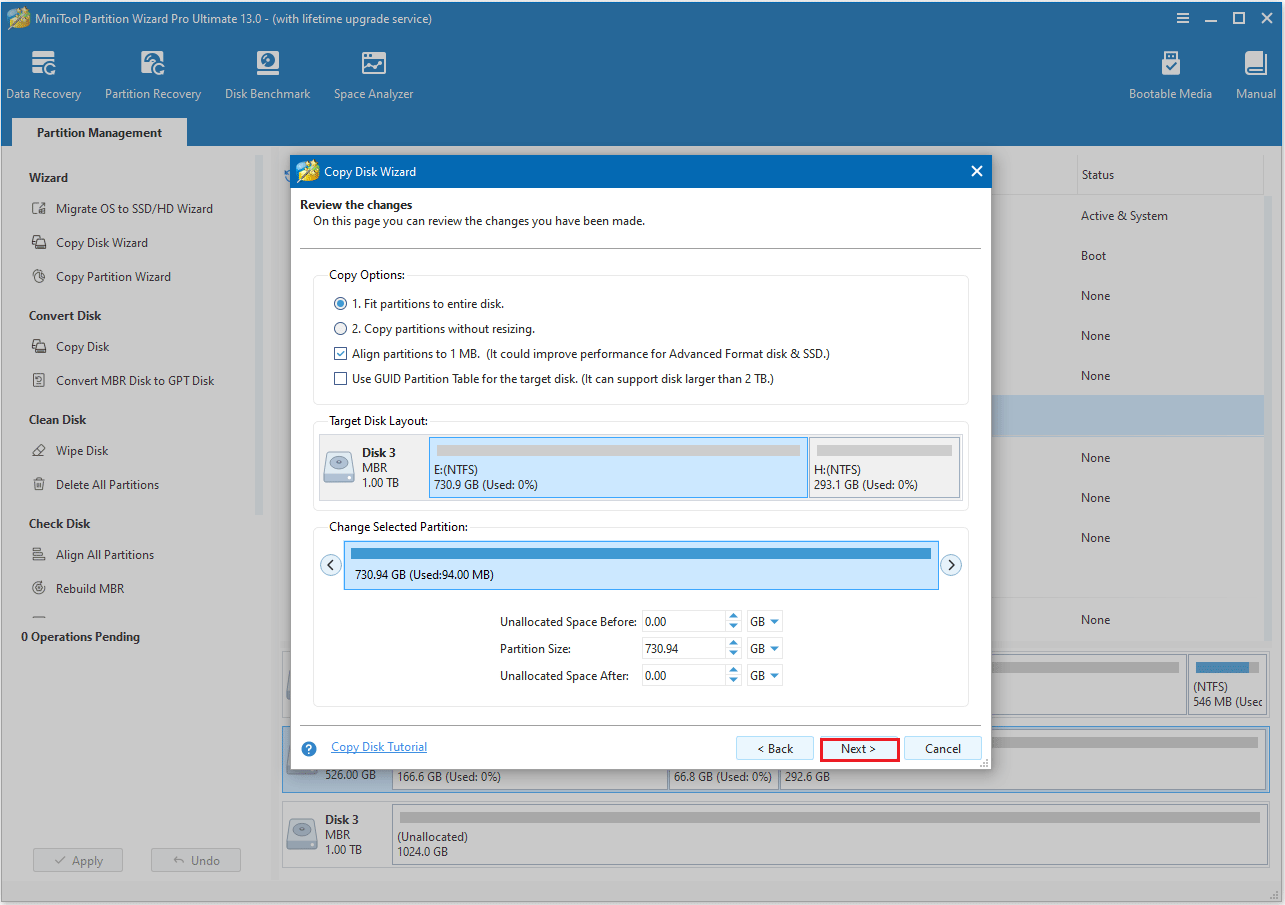
Step 4: Choose a Copy Option and click Next.
- Fit partitions to entire disk: If the new disk is larger than the original one, partitions will be enlarged proportionally to fit the new disk. If the new disk is smaller, partitions will be shrunk proportionally to fit it.
- Copy partitions without resizing: This option copies all partitions from the source disk to the target disk without changing their sizes. If the target disk is larger, the remaining space will stay unallocated. This option is unavailable if the new disk is smaller than the original one.
- Align partitions to 1MB: This option is selected by default. It applies 4K alignment to the disk, improving the disk’s performance.
- Use GUID Partition Table for the target disk: This option only appears when the original disk uses the MBR style. It converts the target disk to the GPT style when cloning the disk. If the target disk is larger than 2TB, it’s recommended that you choose this option.
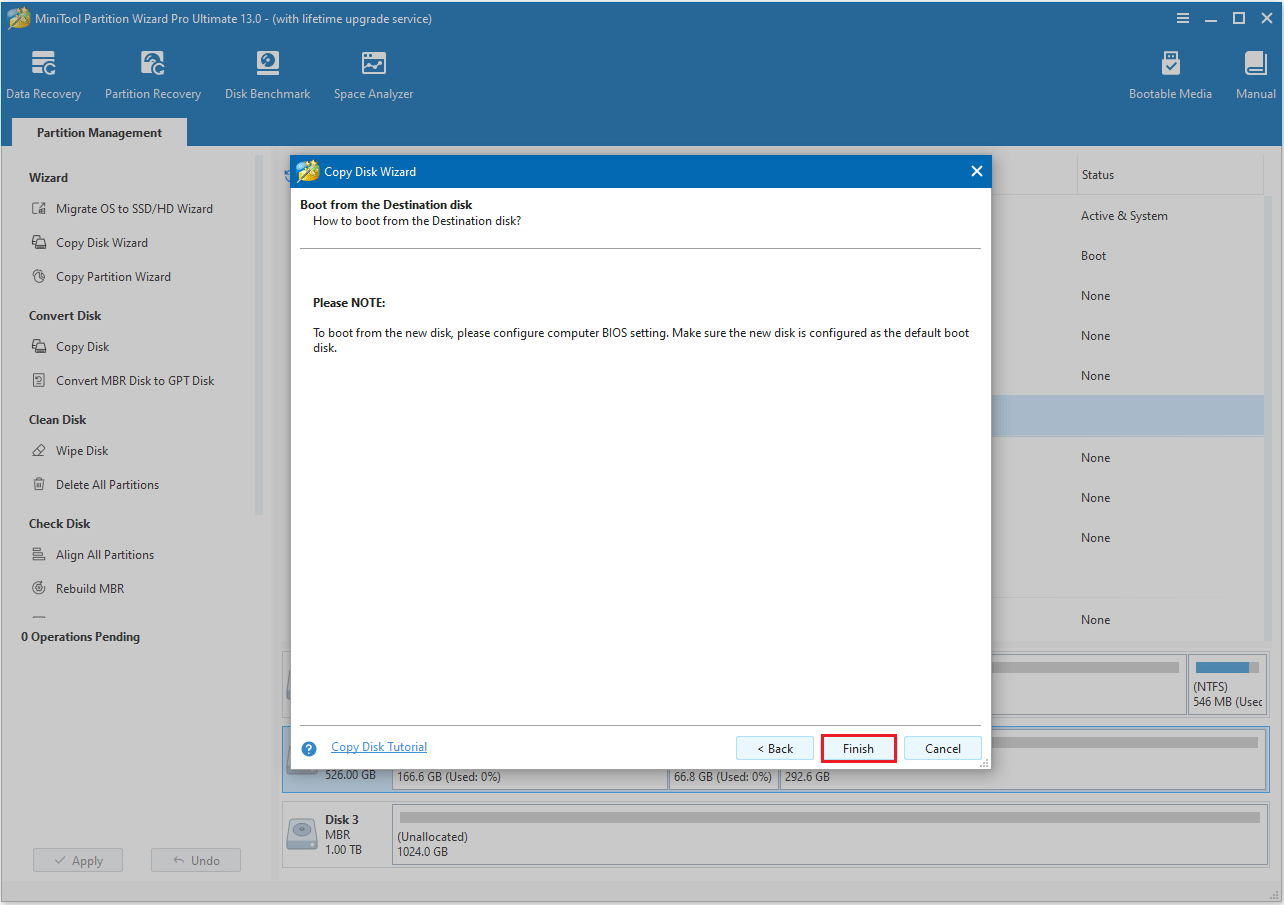
Step 5: Carefully review the note, and then click the Finish > Apply buttons.
After the migration is complete, all data on the old hard drive will be fully copied to the new hard drive.
If you keep the original hard drive in the computer, you may need to change the boot order. Here are the detailed steps:
Step 1: Make sure the computer is turned off.
Step 2: Press the Power button and then immediately press the BIOS key (e.g., F2, F9, F10, F12, or Esc) to enter the firmware.
Step 3: Use the arrow keys on your keyboard to go to the Boot menu.
Step 4: Use the up or down arrows to select the new internal hard drive.
Step 5: Press the “+” or “–” key to move the hard drive to the top of the boot devices.
Step 6: Press the F10 key to save the boot order and exit the BIOS setup.
After the boot order is changed, you can boot from the new disk.
What to Do with the Old Internal Hard Drive?
If you’ve upgraded to an SSD and are left with an old hard drive, here are some suggestions on how to deal with it.
1. Reuse
Buy a hard drive enclosure or use an adapter cable to install the old hard drive, turning it into an external hard drive. It’s convenient for backups, storing large files, and transferring data.
2. Sell
Before selling or giving away your old hard drive, be sure to wipe the disk. Otherwise, others may be able to recover your private files using data recovery software.
3. Recycling
If the hard drive is old or damaged, you can take it to an electronics recycling center or computer shop for disposal.
Transfer Data from One Internal Hard Drive to Another FAQ
In contrast, regular file copying only copies files and folders. It does not copy boot information or the complete partition structure. Therefore, just copying files to a hard drive doesn’t make it able to boot a system directly, nor can it replace the original hard drive.
For a more automated method, you can use cloud storage services like Google Drive or OneDrive to upload files and sync them across devices.
For large numbers of files, it's recommended to use professional migration tools to complete the data migration.
Common solutions include ensuring sufficient target disk space, checking disk health, choosing an appropriate partition format, updating the cloning software, repairing file system errors, and avoiding interruptions during the cloning process.
Bottom Line
This article tells you how to transfer data from one hard drive to another: copying specific files or cloning the entire drive. If you need to move a few files, File Explorer will do the job. But if you want to make a complete copy of your internal hard drive, MiniTool Partition Wizard provides a safer and more efficient option.
Using the Copy Disk feature, you can create a complete copy of your entire drive in just a few minutes, including all partitions, file systems, and hidden data. The tool also lets you manage disks/partitions, recover deleted or lost files, and switch between different disk formats.
If you have any questions or suggestions while using MiniTool Partition Wizard, you can contact us via [email protected] for further assistance.
User Comments :